The Ebola virus is an enveloped, single-stranded RNA virus, a type that germicidal UV-C inactivates readily, and live Ebola dried on surfaces has been measured as only moderately UV-resistant. That measurement and CDC guidance place it well within reach of germicidal UV-C on a pre-cleaned surface, delivered by the ROZOR Disinfection Robot as a no-touch adjunct after manual cleaning.
When a suspected Ebola case moves through your unit, the room it leaves behind becomes part of the problem you have to solve. The 2026 Ebola outbreak has put that question back in front of infection prevention teams worldwide: once the patient is moved, how do you make the environment safe for the next one? This article looks at what the published evidence actually says about UV-C disinfection and the Ebola virus, how long the virus survives on hospital surfaces, why the same question matters acutely across the Gulf, and where a no-touch UV-C step, delivered by the ROZOR Disinfection Robot, fits alongside the manual cleaning your team already does.
Why does the environment matter right now?
The 2026 outbreak is caused by Bundibugyo ebolavirus, with declared outbreaks in the Democratic Republic of the Congo and Uganda. The World Health Organization and the CDC both moved on 17 May 2026: the WHO declared a Public Health Emergency of International Concern, and the CDC opened a public health emergency response. By 22 June 2026 the DRC had confirmed more than 1,000 cases, making this the third-largest Ebola outbreak on record.12
One detail shapes everything that follows: the licensed Ebola vaccines and treatments were certified against the Zaire species, not Bundibugyo, so there is currently no approved vaccine or proven treatment for this strain.2 When pharmaceutical tools are limited, the weight shifts onto the measures that break transmission directly: early isolation, personal protective equipment, safe waste handling, and environmental cleaning and disinfection. The environment is not a footnote in Ebola care. It is a frontline.
Why is the Gulf preparing now?
That reality is not confined to the outbreak zone. The Gulf is the world's largest hub for mass religious gatherings, with Hajj and Umrah drawing millions of pilgrims each year, including from countries affected by the outbreak. Gulf health authorities have moved early: Saudi Arabia restricted travel and visas from affected countries and reinforced screening at points of entry, and the Public Health Authority (Weqaya) confirmed its surveillance system was ready to protect residents and pilgrims through the Hajj season.14
The region has learned this lesson from experience. Middle East respiratory syndrome (MERS-CoV) emerged in Saudi Arabia in 2012, and much of its spread was hospital-based, amplified in emergency rooms and wards. During the 2015 outbreaks, MERS-CoV RNA was recovered from frequently touched surfaces in patient rooms, detectable for up to five days after a patient's last positive respiratory sample.12 MERS-CoV, like Ebola, is an enveloped virus. For a Gulf infection prevention team, the point is direct: the environmental-disinfection capability that mattered during MERS is the same capability that answers a suspected Ebola room today. Preparedness now includes the question of what a hospital does with a room after a high-consequence case.
How long does the Ebola virus survive on surfaces?
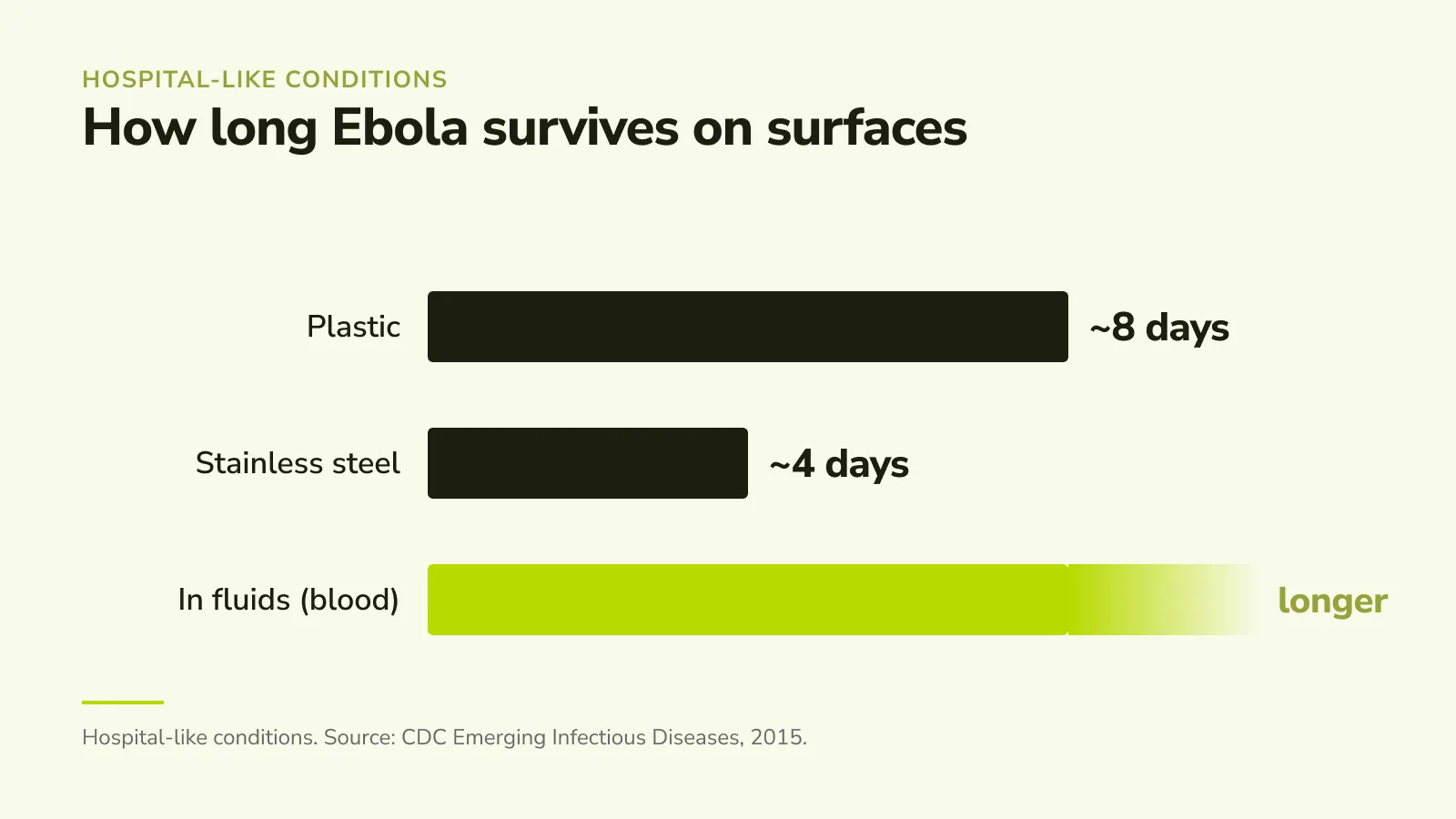
Under hospital-like conditions, the Ebola virus has been shown to remain viable for up to 8 days on plastic and about 4 days on stainless steel, and longer in liquids such as blood.4 Cooler, low-humidity indoor settings extend survival compared with hot, humid outdoor conditions.
This is the reason terminal disinfection carries weight. Ebola spreads primarily through direct contact with the bodily fluids of an infected person, but the surfaces those fluids reach, bed rails, over-bed tables, monitors, door handles, become a secondary reservoir. The longer the virus persists on a high-touch surface, the more that surface matters to the next patient and to the staff who enter the room. It also means the room needs a disinfection step that runs the same way after every case, not only when the schedule allows, the kind of consistent, no-touch cycle the ROZOR Disinfection Robot is built to deliver.
Is the Ebola virus vulnerable to UV-C light?
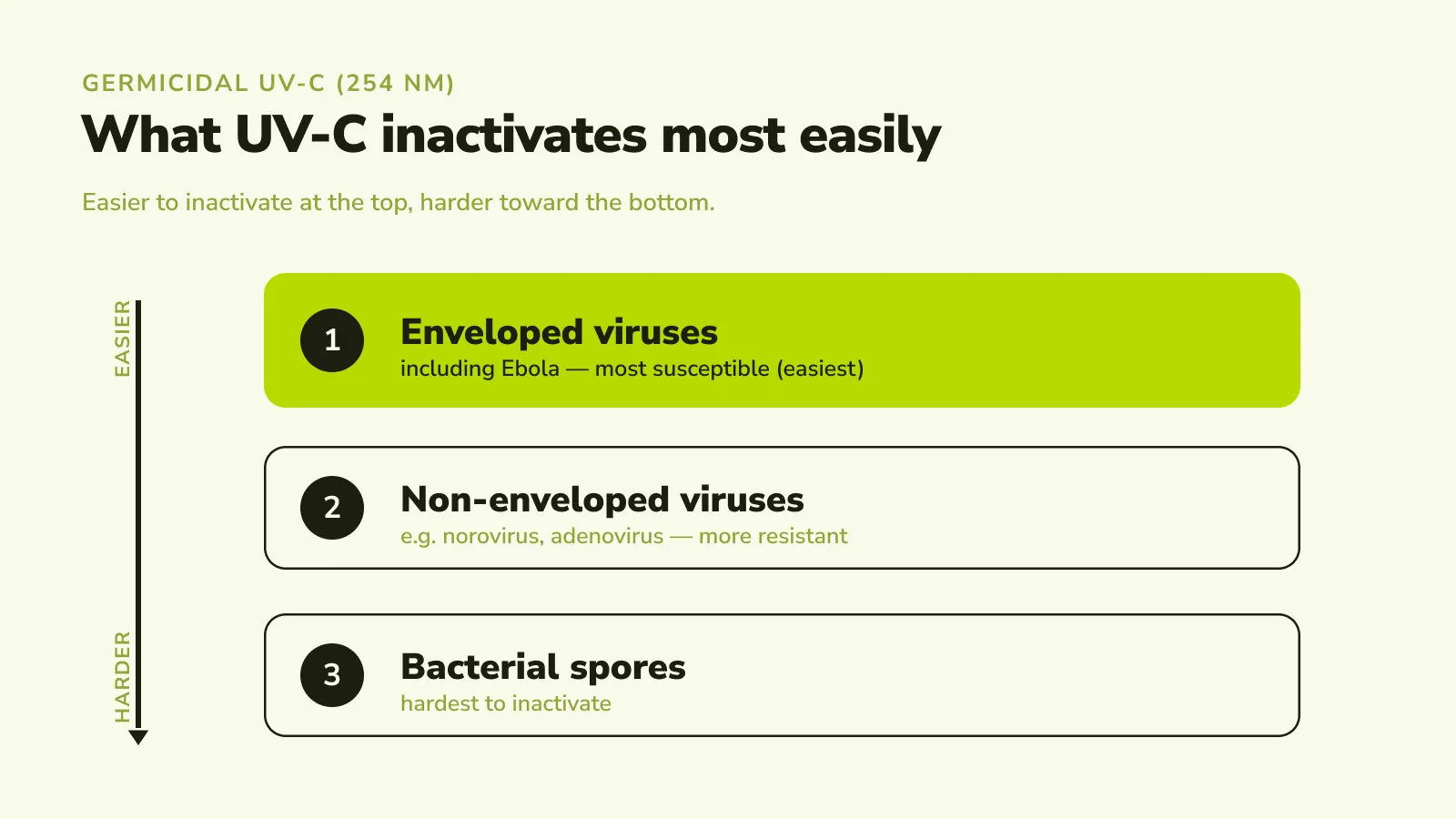
The Ebola virus is an enveloped, single-stranded RNA virus, and single-stranded RNA viruses are among the virus types most readily inactivated by germicidal UV-C (254 nm). In a controlled study that irradiated live Ebola dried on a surface, the virus proved only moderately UV-resistant, less resistant than Lassa virus tested under the same conditions.5
Three lines of evidence support this, and they converge on the same conclusion.
First, Ebola itself has been measured. In a controlled study, live Ebola virus was dried onto non-porous surfaces and exposed to ultraviolet radiation. Ebola was inactivated more readily than Lassa virus tested under identical conditions, placing it well within the reach of germicidal UV-C on a surface.5 The study also found that a small fraction of virions, a few percent, resisted longer than the rest, which is exactly why a measured, adequate dose matters more than a brief pass.
Second, the mechanism is well understood. UV-C at 254 nm damages the genetic material of a microbe so it can no longer replicate. The single-stranded RNA genome of viruses like Ebola offers little protection against that damage. In controlled studies of the enveloped virus SARS-CoV-2, surface-dried virus was reduced by more than 6 log (a 99.9999% reduction) at a dose of about 3.5 mJ/cm² of 254 nm UV-C,6 and roughly 12.5 mJ/cm² achieved a 3-log reduction in suspension.7 Among viruses, enveloped types are generally inactivated at lower UV-C doses than many non-enveloped ones.8
Third, official guidance treats Ebola as an easy target for surface disinfection. The CDC states plainly that "enveloped viruses such as Ebola are susceptible to a broad range of hospital disinfectants used to disinfect hard, non-porous surfaces".3 UV-C is one such no-touch surface-disinfection method, applied to the same hard, non-porous surfaces after they have been cleaned.
The practical question is whether every exposed surface actually receives that germicidal dose. Delivering it consistently, across the whole room and every cycle, is what the ROZOR Disinfection Robot is built to do.
What can UV-C do, and what does it not replace?
The evidence points one way. Ebola is the kind of single-stranded RNA virus that UV-C inactivates readily, and its own surface UV data place it only moderately resistant;5 the mechanism is well understood; dose data from other enveloped viruses are consistent;678 and CDC guidance agrees that enveloped viruses like Ebola are susceptible to standard hospital surface disinfection.3 Together they place Ebola well within reach of germicidal UV-C on a pre-cleaned surface that receives an adequate dose.
What UV-C does not do is replace the rest of the bundle. It is a no-touch step for environmental surface disinfection, and the ROZOR Disinfection Robot works alongside manual cleaning, PPE, and isolation rather than in place of them. Its job is to add a consistent germicidal dose to the surfaces that cleaning can miss.
Where does UV-C fit in the cleaning process?
WHO and CDC guidance for Ebola care puts environmental cleaning and disinfection among the core measures that reduce in-hospital transmission, alongside isolation, PPE, and safe waste handling.113 Manual cleaning does the essential first job: it removes visible soil and the bulk of contamination, which is what lets any disinfection step work. But manual cleaning depends on reaching every surface, every time, with the right contact time. High-touch points get missed, shadowed areas get skipped, and pressure on room turnover works against thoroughness.
A no-touch UV-C cycle is the layer that addresses that variability. After the room is manually cleaned, the ROZOR Disinfection Robot delivers a consistent, measured dose of 254 nm light to exposed surfaces, including the ones a rushed wipe-down can miss. For the general no-touch principle there is trial evidence in bacteria: adding automated UV to standard terminal cleaning was associated with roughly a 30% reduction in the acquisition of key multidrug-resistant organisms in a multi-centre randomised trial.9 Real-world deployments point the same way; in one hospital intensive care unit, adding automated UV disinfection was followed by a significant fall in new MRSA acquisition.10 Those trials measured bacteria rather than viruses, but they establish the principle that matters here: automated UV-C reliably reaches what a manual wipe-down leaves behind, the same way every cycle.
UV-C vs manual cleaning: what does each one do?
| Comparison aspect | Manual cleaning (essential first step) | No-touch UV-C (adjunct, after cleaning) |
|---|---|---|
| Main job | Removes visible soil and bulk contamination | Delivers a measured germicidal dose to exposed surfaces |
| Reaches | Wherever the cloth reaches; depends on the person and the time available | Every surface in the light path, including easily missed high-touch points |
| Consistency | Varies with workload, training, and turnover pressure | The same documented cycle in every room |
| Chemical use | Required | None during the UV step |
| On its own | Can leave shadowed or skipped surfaces | Cannot remove soil; needs a clean surface to work |
| Together | The bulk removal that makes disinfection possible | The verification layer that closes the gaps |
The two are not alternatives. Manual cleaning makes the surface ready, and UV-C treats what remains.
Why does a moving emitter matter?
Whether a surface is disinfected comes down to dose, and two physical laws limit what any single fixed lamp can deliver.
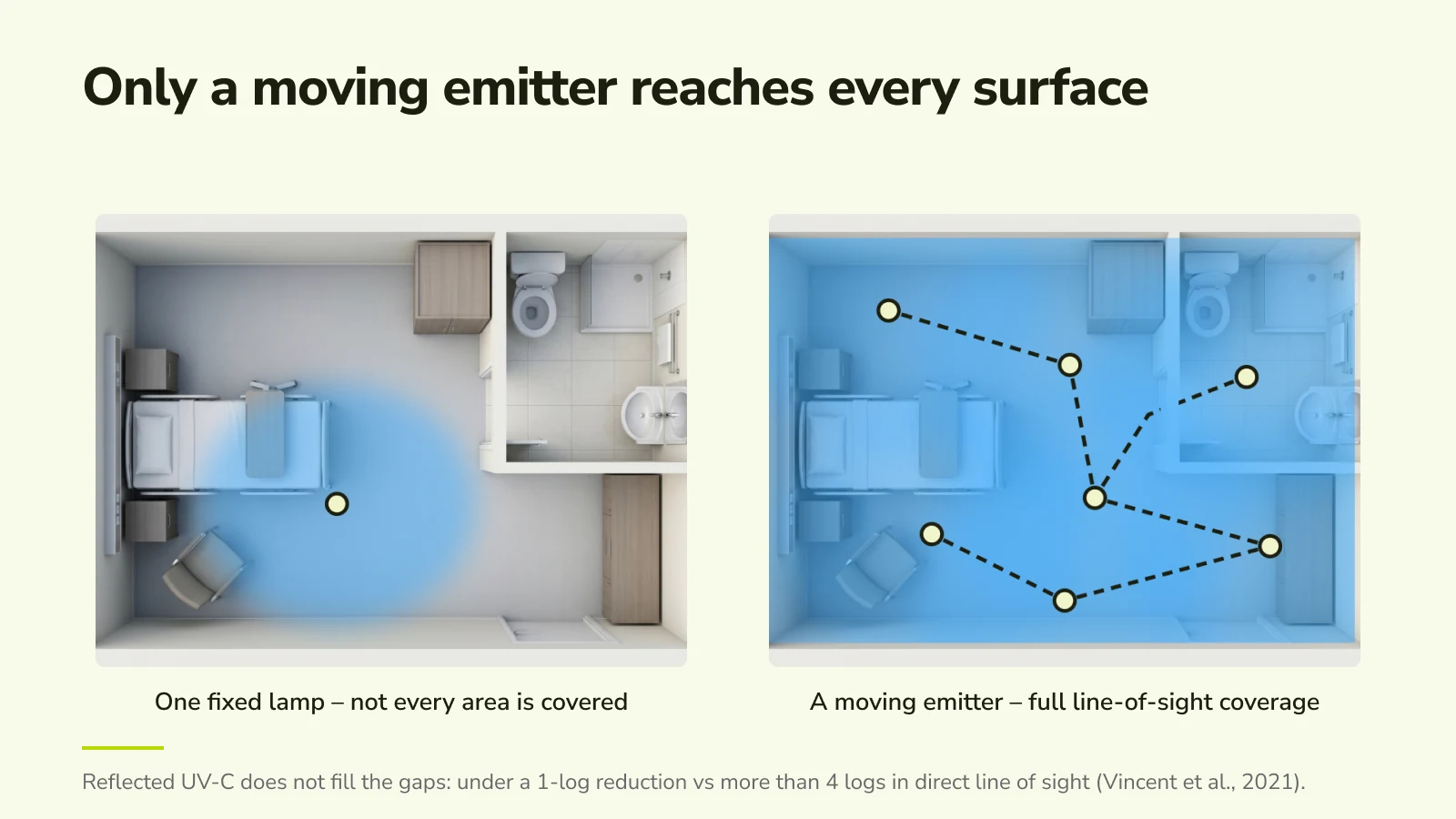
The first is distance. UV-C dose falls with the square of the distance from the source, so a surface twice as far from the lamp receives only about a quarter of the energy, and a surface across the room receives a small fraction of it.15 The second is shadow. UV-C travels only in straight lines, so any solid object, a bed, a monitor, an over-bed table, casts a shadow, and the surfaces inside that shadow receive no direct dose at all.15 Reflected light does not rescue them: reflected-only exposure achieves under a 1-log reduction, against more than 4 logs in direct line of sight.16
A single fixed lamp, however powerful, is therefore blind to whatever it cannot see from its one position. The way to close those gaps is not a brighter lamp but a moving one: an emitter that travels through the room and treats it from multiple positions brings every surface into direct line of sight at an adequate distance, the shadowed and high-touch points included. This is exactly the role the ROZOR Disinfection Robot is built for.
This is the difference between a device that covers part of a room and one that covers all of it, the same way every cycle.
How does the ROZOR Disinfection Robot deliver this?
The ROZOR Disinfection Robot is the moving emitter this layer calls for: an autonomous, mapped 254 nm UV-C cycle that runs after your EVS team has cleaned the room. Because it navigates the space itself, it treats the room from multiple positions to reach high-touch and shadowed surfaces, rather than dosing from a single fixed spot, and it delivers the same treatment pattern every time. It operates as a no-touch cycle in an unoccupied room, with safety sensing so the cycle runs only when no one is present, which also means a machine, not a member of staff, spends the exposure time in the contaminated space.
Every cycle is logged, per room, producing the kind of documented, repeatable record that infection prevention teams and accreditation surveyors can actually show. And we hold our own work to a defined benchmark: the ROZOR Disinfection Robot aligns its efficacy validation to the method set out in BS 8628:2022, the British Standard for quantitative testing of automated UV-C disinfection.13 That standard exists precisely because, before it, there was no common way to compare UV disinfection claims. Building validation around it is how we keep our own claims measurable rather than promotional.
The robot does not replace your cleaners or your protocol. It takes the repeatable, higher-exposure task off people and performs it consistently, so your team is freed to focus where their judgment matters most.
What does this mean for hospitals and IPC teams?
For an infection prevention team, the outbreak reframes an existing question: is your environmental disinfection capacity part of your preparedness plan, or only your PPE and isolation? Readiness includes the room. In a high-consequence isolation setting, the value of a no-touch step is not only the added assurance on the surface. It is also that the ROZOR Disinfection Robot, not a person, spends the cycle time in the contaminated space, which reduces staff exposure during terminal disinfection.
For leadership and accreditation leads, particularly across the Gulf, the case connects to standards you already answer to. A documented, repeatable disinfection cycle produces the kind of audit-ready evidence that JCI, CBAHI, and GAHAR surveyors look for under infection prevention and facility-safety requirements. Preparedness that can be shown, per room and per cycle, is preparedness a board and a surveyor can both trust. Outbreaks test not only healthcare systems but the environments that support them, and the environment is something a hospital can plan for in advance.
If you are reviewing your environmental disinfection readiness, we are glad to walk through how a validated UV-C step fits your existing bundle. See the ROZOR Disinfection Robot.
Frequently asked questions
Does UV-C kill the Ebola virus?
The Ebola virus is an enveloped, single-stranded RNA virus, a type germicidal UV-C inactivates readily, and live Ebola dried on a surface has been measured as only moderately UV-resistant. Taken with the mechanism, dose data from other enveloped viruses, and CDC guidance, that places Ebola well within reach of germicidal UV-C on a pre-cleaned surface. Applied as a no-touch step after manual cleaning, it adds a consistent germicidal dose to the surfaces cleaning can miss.
How long does Ebola survive on hospital surfaces?
Under hospital-like conditions, studies have shown the Ebola virus remaining viable for up to about 8 days on plastic and around 4 days on stainless steel, and longer in liquids such as blood. Cooler, drier indoor conditions extend survival compared with hot, humid outdoor settings.
Can UV-C replace manual cleaning for Ebola?
No. UV-C is a no-touch adjunct, not a replacement. Manual cleaning removes the visible soil and bulk contamination that any disinfection step depends on. UV-C is applied afterwards to deliver a consistent germicidal dose to the surfaces that cleaning may miss. Both steps are needed.
Why does a moving emitter disinfect better than a fixed lamp?
UV-C dose falls with distance and is blocked by shadows, so a single fixed lamp cannot dose the surfaces it has no clear line of sight to, and reflected light does not fill the gaps. A moving emitter treats the room from multiple positions, bringing shadowed and high-touch surfaces into direct line of sight. The ROZOR Disinfection Robot is an autonomous moving emitter, so it delivers that coverage the same way every cycle.
Is the ROZOR robot tested to a UV disinfection standard?
The ROZOR Disinfection Robot aligns its efficacy validation to the method defined in BS 8628:2022, the British Standard for quantitative testing of automated UV-C disinfection efficacy. We use the standard as the benchmark our cycles are built to demonstrate, which keeps our claims measurable and comparable rather than promotional.
Is UV-C the same as high-level disinfection?
No. High-level disinfection is a specific term for reprocessing semi-critical medical devices (such as endoscopes). UV-C room disinfection is environmental surface disinfection: an adjunct to terminal cleaning of the patient environment, not a device-reprocessing method.
Why does the environment matter so much in this outbreak?
The 2026 strain (Bundibugyo) has no approved vaccine or proven treatment, so measures that break transmission directly carry more weight. Because the virus can persist on high-touch surfaces for days, thorough environmental cleaning and disinfection is one of the core defences named by WHO and CDC.
Sources
- WHO. Ebola disease outbreak news and PHEIC declaration, 2026. https://www.who.int/emergencies/disease-outbreak-news
- CDC. 2026 Ebola outbreak situation summary. https://www.cdc.gov/ebola/situation-summary/index.html
- CDC. Interim guidance for environmental infection control in hospitals (viral hemorrhagic fevers). https://www.cdc.gov/viral-hemorrhagic-fevers/hcp/infection-control/environmental-infection-control-hospitals.html
- Fischer R. et al. "Ebola Virus Stability on Surfaces and in Fluids in Simulated Outbreak Environments." Emerging Infectious Diseases (CDC), 2015. https://wwwnc.cdc.gov/eid/article/21/7/15-0253_article
- Sagripanti J.L., Lytle C.D. "Sensitivity to ultraviolet radiation of Lassa, vaccinia, and Ebola viruses dried on surfaces." Archives of Virology, 2011; 156(3):489-494. https://doi.org/10.1007/s00705-010-0847-1
- Gidari A. et al. "SARS-CoV-2 Survival on Surfaces and the Effect of UV-C Light." Viruses, 2021. https://www.ncbi.nlm.nih.gov/pmc/articles/PMC8532508/
- "Systematic evaluating and modeling of SARS-CoV-2 UVC disinfection." Scientific Reports, 2022. https://www.nature.com/articles/s41598-022-09930-2
- Tseng C.C., Li C.S. "Inactivation of Viruses on Surfaces by Ultraviolet Germicidal Irradiation." Journal of Occupational and Environmental Hygiene, 2007; 4(6):400-405. https://pmc.ncbi.nlm.nih.gov/articles/PMC7196698/
- Anderson D.J. et al. "Enhanced terminal room disinfection and acquisition of multidrug-resistant organisms (BETR-D)." The Lancet, 2017. https://pubmed.ncbi.nlm.nih.gov/28104287/
- Kitagawa H. et al. "Pulsed xenon ultraviolet disinfection to reduce multidrug-resistant organisms in an intensive care unit." Hospital before-after study, 2020. https://www.ncbi.nlm.nih.gov/pmc/articles/PMC6988210/
- WHO. Infection prevention and control guideline for Ebola and Marburg diseases, 2023. https://iris.who.int/
- Bin S.Y. et al. "Environmental Contamination and Viral Shedding in MERS Patients During MERS-CoV Outbreak in South Korea." Clinical Infectious Diseases, 2016; 62(6):755-760.
- BSI. "BS 8628:2022. Disinfection using ultraviolet radiation. Methods for quantitative testing of automated ultraviolet disinfection activities by direct illumination." 2022. https://standardsdevelopment.bsigroup.com/projects/2019-00332
- Saudi public-health readiness coverage (Public Health Authority, Weqaya), 2026. Arab News; Saudi Gazette. https://www.arabnews.com/
- Kowalski W. Ultraviolet Germicidal Irradiation Handbook: UVGI for Air and Surface Disinfection. Springer, 2009. (Inverse-square dose falloff and line-of-sight shadowing.)
- Vincent M. et al. "Contribution of reflected UV-C to surface disinfection." Photochemistry and Photobiology, 2021; 97(3):552-559. (Reflected-only <1-log vs >4-log in direct line of sight.)