UV-C disinfection uses short-wavelength ultraviolet light (200 to 280 nm) to damage the DNA and RNA inside bacteria, viruses and fungi. The light forms molecular bonds called dimers in the genome, so the microbe can no longer replicate or cause infection. It is a no-touch step used after manual cleaning, not a replacement for it.
Ultraviolet light has been used to disinfect air, water and surfaces for decades. In a hospital it shows up as a tall lamp on a mobile robot that treats a room after the cleaning team has finished. To decide where it fits in your programme, it helps to understand what the light actually does to a microbe, why one specific wavelength does the work, and what has to be true for it to be effective. This guide walks through the mechanism in plain language.
What is UV-C light?
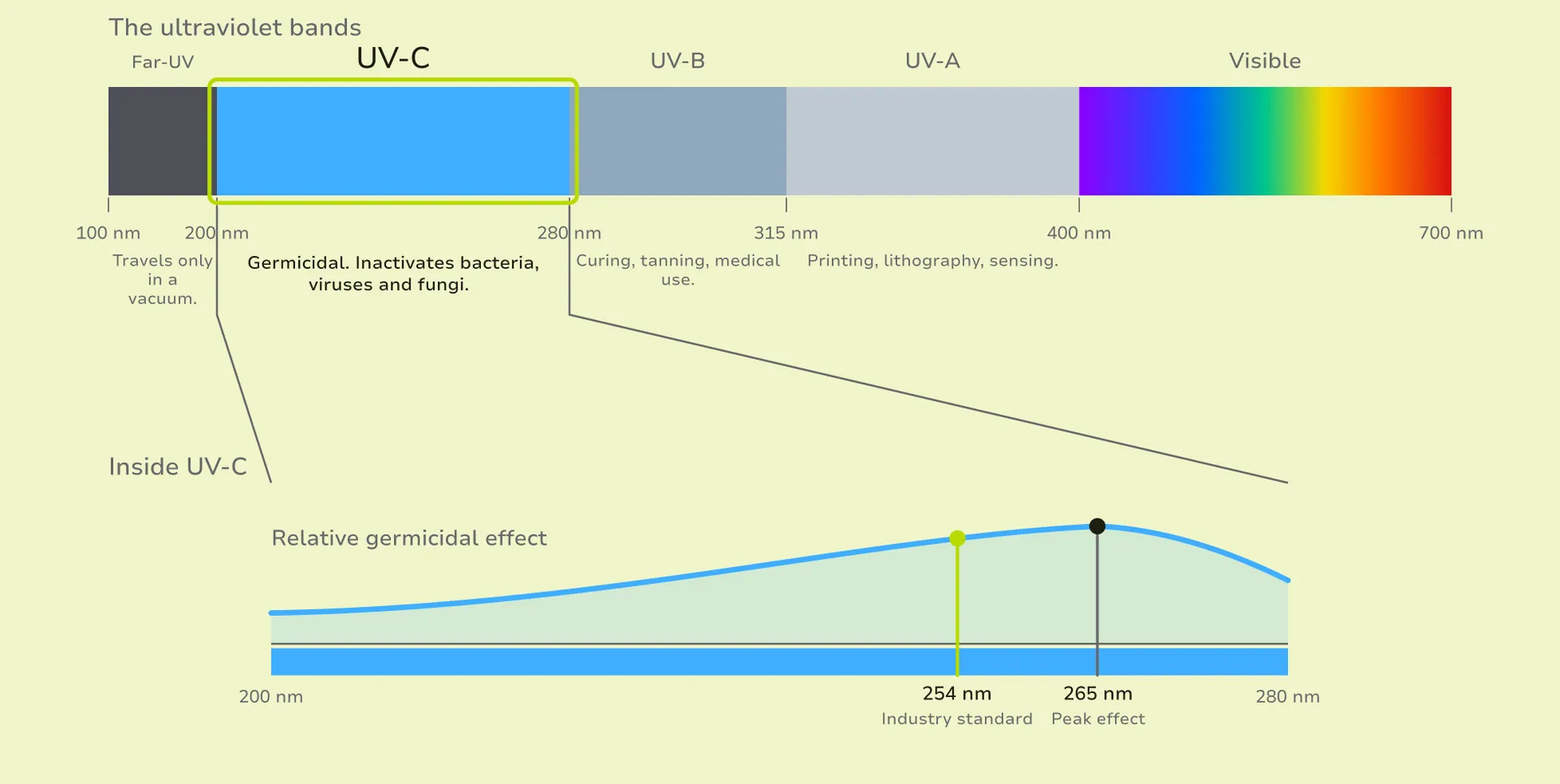
Ultraviolet is the band of energy just beyond the violet end of visible light. It is usually divided into three parts by wavelength: UVA (315 to 400 nm), UVB (280 to 315 nm) and UV-C (100 to 280 nm).7 The shorter the wavelength, the more energy it carries, which is why UV-C is the most powerful of the three against microorganisms.
Is UV-C the same as the UV in sunlight?
No. The ultraviolet that reaches the ground in daylight is almost entirely UVA and UVB. Solar UV-C is absorbed high in the atmosphere by oxygen and the ozone layer and never reaches the surface.10 The UV-C used for disinfection is therefore generated by a lamp, not borrowed from sunlight.
Why is UV-C called "germicidal"?
Of the three bands, UV-C (roughly 200 to 280 nm) is the most effective at inactivating microorganisms, which is why the U.S. Environmental Protection Agency describes it as "the most germicidal part of the UV spectrum".1 That is the band a disinfection robot uses, and specifically one wavelength within it, as the next sections explain.
How does UV-C actually work on germs?
Every microbe carries its genetic instructions in DNA or RNA. Germicidal UV-C is absorbed directly by those nucleic acids, and that is where the damage happens.1
What UV-C does to a microbe's DNA and RNA
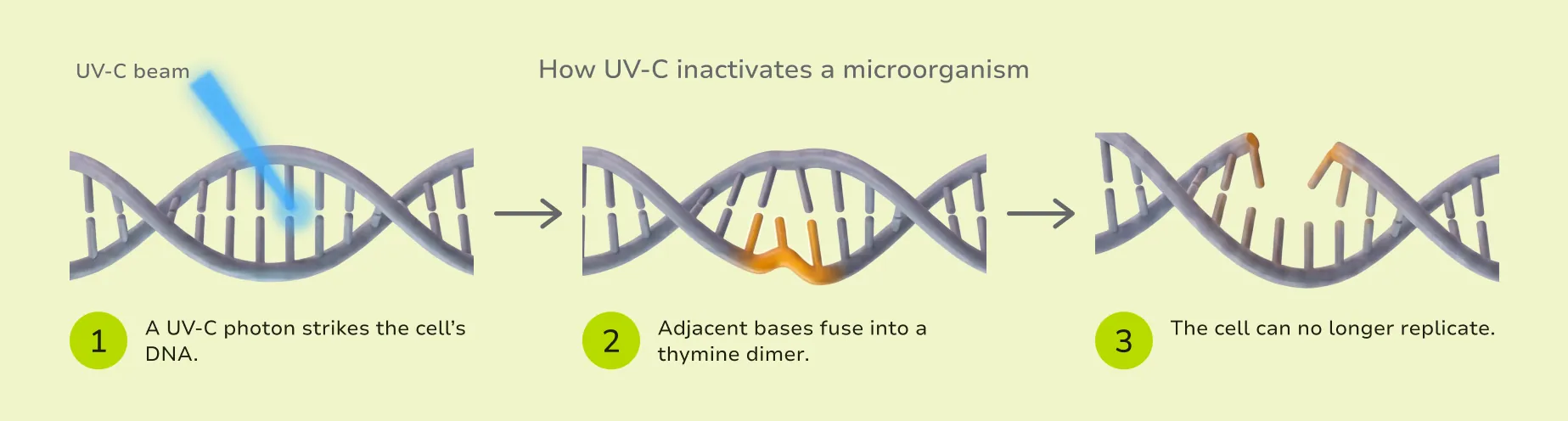
DNA and RNA are built from a sequence of chemical "letters". Two of those letters, the pyrimidines, are sensitive to UV-C. When a UV-C photon is absorbed, two neighbouring pyrimidines fuse into a single linked pair called a dimer.2 A dimer is like a knot in the genetic tape: the cell's machinery reaches it and can no longer read the code past that point.
Why "inactivate" is more accurate than "kill"
A UV-C dose does not blow a microbe apart. When researchers exposed a coronavirus to UV-C and looked closely, the genome was damaged while the outer envelope and proteins stayed largely intact.3 Similar work on an RNA virus found the genetic material, not the shell, was the main target.4 The microbe is still physically there, but it can no longer replicate, and a microbe that cannot replicate cannot establish an infection. This is why the accurate term is "inactivate".
Why 254 nm? The wavelength hospitals use
DNA and RNA absorb ultraviolet most strongly at around 260 to 270 nm.5 The conventional germicidal source is a low-pressure mercury lamp, which emits almost all of its energy at 253.7 nm, usually rounded to 254 nm.89 That sits very close to the genome's absorption peak, so a mature, efficient 254 nm lamp delivers the damage where it counts. Decades of use have made it the workhorse of hospital UV-C.
What about far-UVC (222 nm) and UV-LEDs?
Other sources exist. Far-UVC at 222 nm is being studied for use in occupied spaces, and UV-LEDs can be tuned to wavelengths around 265 to 280 nm.11 These are different tools suited to different jobs. The ROZOR Disinfection Robot uses continuous 254 nm UV-C and operates in a vacated room, so it is not a 222 nm occupied-space device, and the two should not be confused.
What decides whether UV-C works? Dose, distance and line of sight
UV-C is not all-or-nothing. It delivers a measured amount of light, and three things decide whether that amount is enough.
What is a "UV dose"?
The dose a surface receives (its fluence) is the intensity of the light multiplied by how long the surface is exposed.9 More intensity, or more time, means a higher dose. Every claim about what UV-C can do rests on delivering an adequate dose to the surface in question.
What does "log reduction" mean?
Disinfection results are counted in "logs". Each log is a tenfold cut in the number of surviving microbes: 1-log removes 90 percent, 2-log removes 99 percent, and 6-log removes 99.9999 percent.9 Higher log reductions need higher doses. A fuller explanation of log reduction and what the percentages really mean is coming as a companion guide in this pillar.
Why can't a single lamp reach every surface?
UV-C travels in straight lines and cannot bend around objects. A surface that faces away from the lamp, or sits in the shadow of a bedrail or an overbed table, receives far less light than one in direct view, and the U.S. Food and Drug Administration notes that shadowed areas are not disinfected.15 Intensity also falls quickly as distance grows. This is why the position of the source, and whether it moves through the room, has such a large effect on the real dose delivered. Why a moving emitter beats a static lamp is the subject of a dedicated companion guide in this pillar.
Which germs does UV-C work best against?
Microbes are not equally easy to inactivate. Enveloped viruses, such as influenza and coronaviruses, and ordinary vegetative bacteria are relatively susceptible and go down at modest doses.5 Bacterial spores are the hard case. The spore of Clostridioides difficile, for example, wraps its DNA in protective proteins and sits dormant, so it needs a higher dose and a longer exposure than a virus does.6 A well-designed UV-C cycle is planned around the toughest target expected in the room, not the easiest.
Where UV-C fits in hospital cleaning (and where it doesn't)
This is the part that matters most for an infection prevention team.
UV-C is an adjunct, not a replacement
UV-C light cannot lift dust, blood or organic soil off a surface, and it only reaches what it can see. For both reasons it is used as a second step, after a person has manually cleaned and disinfected the room, never instead of that step.12 National guidance is consistent: physical cleaning to remove soil comes first, and no-touch technologies supplement it.13 A useful way to think about it is that the cleaning team does the essential work, and UV-C adds a consistent, no-touch pass on top.
Does it actually reduce infections?
Used that way, the evidence is encouraging. A multicentre randomised trial known as BETR-D found that adding UV-C to standard terminal cleaning was associated with about a 30 percent lower rate of patients acquiring key multidrug-resistant organisms.14 The benefit was clear for that grouped outcome and not statistically significant for Clostridioides difficile on its own, so the honest reading is that UV-C strengthens a cleaning programme rather than guaranteeing any single result.
Is UV-C safe?
Yes, when it is used correctly, and the whole design follows from one fact.
Why the robot only runs in an empty room
The same energy that damages a microbe's DNA can harm human eyes and skin on direct exposure, which is why the FDA cautions against direct human exposure to UV-C.15 International bodies set limits on how much 254 nm exposure is safe over a working day.16 So an autonomous UV-C robot runs only in a vacated room, with motion sensors and interlocks that stop the cycle the moment someone enters. The people are out while the light works, and the room is ready when they return.
See how the ROZOR Disinfection Robot puts this to work. It delivers no-touch UV-C disinfection as an adjunct to your cleaning programme, physical AI for critical environments. Learn more about the ROZOR Disinfection Robot.
Frequently asked questions
Does UV-C work on viruses as well as bacteria?
Yes. UV-C damages the genetic material of viruses, bacteria and fungi alike. Enveloped viruses such as influenza and coronaviruses are among the more susceptible microbes.
Is UV-C radiation dangerous to people?
Direct exposure to 254 nm UV-C can injure eyes and skin, so a disinfection robot runs only in a vacated room with safety interlocks. Used that way, it is safe for staff and patients.
Can UV-C replace cleaning with disinfectant?
No. UV-C cannot remove dust, blood or organic soil, so it is applied after manual cleaning as an added no-touch step, not as a replacement.
How long does a UV-C cycle take?
It depends on the dose the room needs, the size of the space, and the microbes being targeted. Tougher targets such as bacterial spores need longer exposure than an enveloped virus does.
Does UV-C leave any residue?
No. UV-C is light, not a chemical, so it leaves no residue behind on treated surfaces.
Sources
- U.S. Environmental Protection Agency. "Disinfecting Surfaces with UV Light to Reduce Exposure to SARS-CoV-2." https://www.epa.gov/emergency-response-research/disinfecting-surfaces-uv-light-reduce-exposure-sars-cov-2
- Goodsell D.S. "The Molecular Perspective: Ultraviolet Light and Pyrimidine Dimers." The Oncologist, 2001; 6(3):298-299. https://doi.org/10.1634/theoncologist.6-3-298
- Lo C-W, Matsuura R, Iimura K, et al. "UVC disinfects SARS-CoV-2 by induction of viral genome damage without apparent effects on viral morphology and proteins." Scientific Reports, 2021; 11:13804. https://doi.org/10.1038/s41598-021-93231-7
- Koma T, Doi N, Suzuki A, et al. "Major target for UV-induced complete loss of HIV-1 infectivity: a model study of single-stranded RNA enveloped viruses." Frontiers in Virology, 2022; 2:994842. https://doi.org/10.3389/fviro.2022.994842
- Mawatari K, Kadomura-Ishikawa Y, Emoto T, et al. "Viral Inactivation by Light-Emitting Diodes: Action Spectra Reveal Genomic Damage as the Primary Mechanism." Viruses, 2025; 17(8):1065. https://doi.org/10.3390/v17081065
- Setlow P. "Photochemistry and Photobiology of the Spore Photoproduct: A 50-Year Journey." Photochemistry and Photobiology, 2015; 91(6):1263-1290. https://doi.org/10.1111/php.12506
- ISO 21348:2007. Space environment (natural and artificial): process for determining solar irradiances (definitions of the UVA, UVB and UV-C spectral bands).
- Illuminating Engineering Society, Photobiology Committee. "IES Committee Report CR-2-20: Germicidal Ultraviolet (GUV)." 2020. https://www.ies.org/standards/committee-reports/ies-committee-report-cr-2-20-faqs/
- International Ultraviolet Association. "UV FAQs." https://iuva.org/UV-FAQs/
- U.S. Environmental Protection Agency. "Basic Ozone Layer Science." https://www.epa.gov/ozone-layer-protection/basic-ozone-layer-science
- Buonanno M, Welch D, Shuryak I, Brenner D.J. "Far-UVC light (222 nm) efficiently and safely inactivates airborne human coronaviruses." Scientific Reports, 2020; 10:10285. https://doi.org/10.1038/s41598-020-67211-2
- Weber D.J., Rutala W.A., Anderson D.J., Sickbert-Bennett E.E. "No touch methods for health care room disinfection: focus on clinical trials." American Journal of Infection Control, 2023; 51(11S):A134-A143. https://doi.org/10.1016/j.ajic.2023.04.003
- Rutala W.A., Weber D.J., and the Healthcare Infection Control Practices Advisory Committee (HICPAC). "Guideline for Disinfection and Sterilization in Healthcare Facilities, 2008" (updated). U.S. Centers for Disease Control and Prevention. https://www.cdc.gov/infection-control/media/pdfs/guideline-disinfection-h.pdf
- Anderson D.J., Chen L.F., Weber D.J., et al. "Enhanced terminal room disinfection and acquisition and infection caused by multidrug-resistant organisms and Clostridium difficile (the BETR-D study): a cluster-randomised, multicentre, crossover study." The Lancet, 2017; 389(10071):805-814. https://doi.org/10.1016/S0140-6736(16)31588-4
- U.S. Food and Drug Administration. "UV Lights and Lamps: Ultraviolet-C Radiation, Disinfection, and Coronavirus" (Internet Archive snapshot, 2023). https://web.archive.org/web/20230419153101/https://www.fda.gov/medical-devices/coronavirus-covid-19-and-medical-devices/uv-lights-and-lamps-ultraviolet-c-radiation-disinfection-and-coronavirus
- International Commission on Non-Ionizing Radiation Protection (ICNIRP). "Guidelines on Limits of Exposure to Ultraviolet Radiation of Wavelengths Between 180 nm and 400 nm." Health Physics, 2004. https://www.icnirp.org/cms/upload/publications/ICNIRPUV2004.pdf