A UV-C dose is the germicidal light a surface actually receives: irradiance, the light's intensity at that spot, multiplied by exposure time, measured in mJ/cm². Intensity falls sharply with distance by the inverse-square law and as a surface tilts away by the cosine law, so a fixed lamp under-doses far and oblique surfaces in one cycle.
When you evaluate a UV-C robot, almost every efficacy claim rests on one number: the UV-C dose delivered to the surface. Understand how that dose is built and how quickly it drains across a room, and you can tell a realistic claim from an optimistic one. This article covers the dose equation, the two laws that govern how much light reaches each surface, how much dose different organisms need, and why the geometry of the room decides whether a lamp reaches the corners. It is a companion to our overview of how UV-C disinfection works; here we go one level deeper into dose.
What determines a UV-C dose?
The dose a surface receives, known formally as fluence, is the intensity of the UV-C light at that point multiplied by how long the surface is exposed to it.1 The intensity term is called irradiance (or fluence rate), and dose is usually reported in millijoules per square centimetre, mJ/cm².2 More intensity, or more time, means a higher dose.
That simple product carries a practical warning. Two surfaces in the same room, treated in the same cycle for the same number of minutes, can receive very different doses, because the irradiance reaching each one differs. Time is shared across the whole room; irradiance is not. So the surface that receives the least light governs whether the cycle worked, and UV-C efficacy becomes a question of where the light lands and how strong it is when it gets there. Delivered dose is a measured quantity, not a number you can read off a lamp's wattage.3
How does distance affect UV-C dose?
Irradiance falls off with distance according to the inverse-square law: double the distance from the source and intensity drops to about a quarter, so the same exposure time delivers roughly a quarter of the dose; triple the distance and it drops to about a ninth.4 This is the single biggest reason a surface across the room is under-dosed compared with one beside the lamp. Engineering bodies model germicidal UV output on exactly this law, and note that objects in the beam path cast shadows on the surfaces behind them.5 Room-scale measurement work puts it plainly: the flux "decreases according to the distance from the lamp, following an inverse square law."6
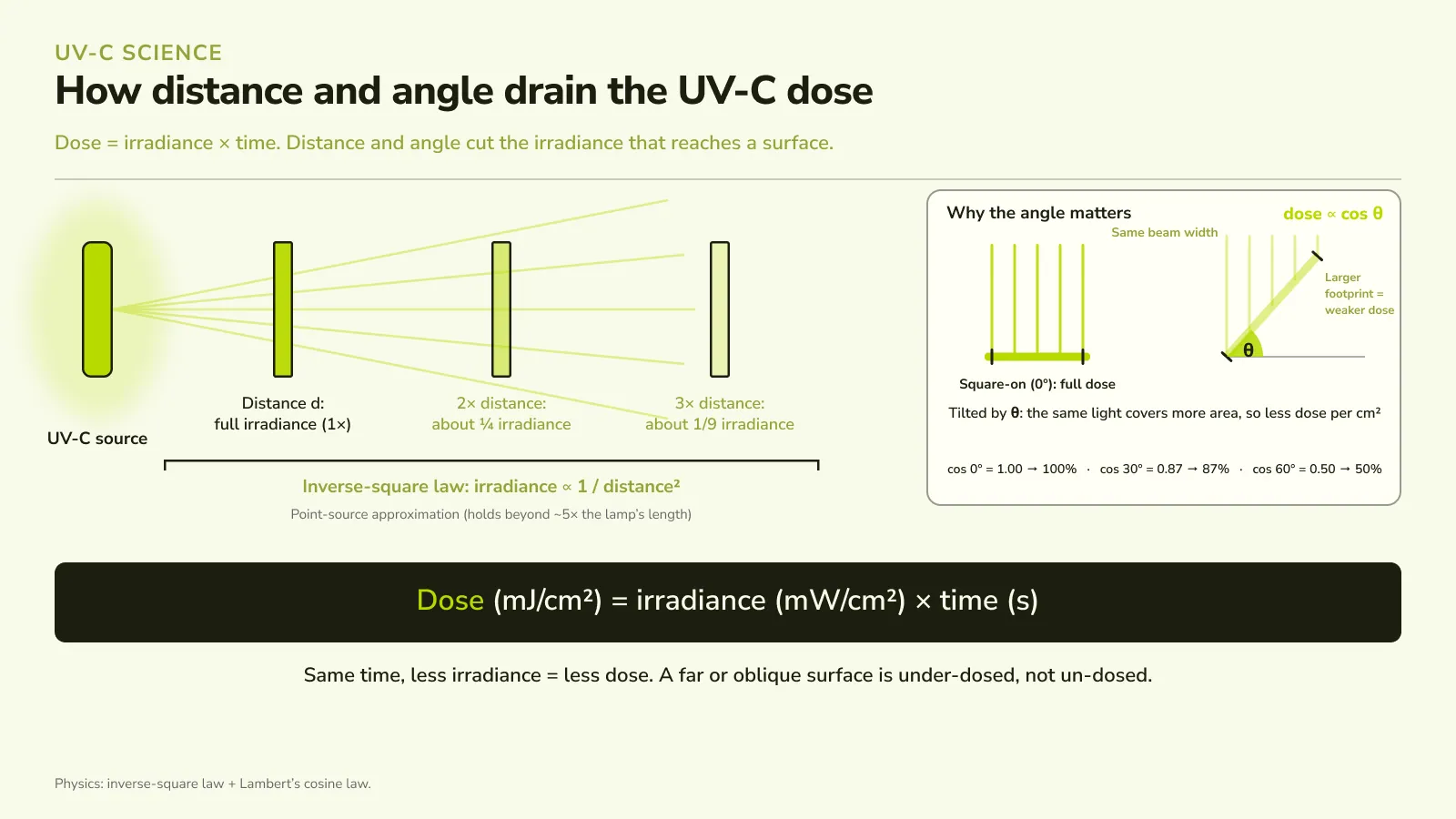
One honest caveat: the inverse-square law is a point-source approximation. It holds well once a surface is farther from the lamp than roughly five times the lamp's longest dimension; very close to a long tube, the lamp behaves more like a line source and the fall-off is gentler.4 For the room-scale distances that decide whether a corner gets dosed, the inverse-square picture is the right one to reason with.
How does the angle of a surface affect UV-C dose?
Distance is only half the geometry. The irradiance a surface receives also depends on the angle at which the light strikes it, following Lambert's cosine law: the flux intercepted per unit area is proportional to the cosine of the angle between the light and the surface's perpendicular.4 A surface facing the lamp square-on collects the full intensity; the same surface tilted away spreads that light over a larger area and collects less per square centimetre.
The effect is measurable. In one controlled study, irradiance fell from about 10.2 to 6.2 mW/cm² as a sensor was tilted, and curved surfaces angled away from the source received only about 60 percent of the dose a flat, square-on surface received in the same time.7 That measurement was made on an N95 respirator inside a UV chamber, not a hospital room, so read it as the angle principle in action rather than a room-scale figure. The principle carries into the room: a bedrail's underside and the side of a monitor turned away from the lamp sit oblique and intercept less dose than a surface pointed straight at the source. And because UV-C travels in straight lines and most hospital surfaces reflect it poorly, a surface the lamp cannot see directly depends on weak reflected light. It receives less, not necessarily nothing, but "less" is often below what the target organism needs.
| UV-C dose variable | Effect on delivered dose | How it scales |
|---|---|---|
| Distance from the lamp | Irradiance drops steeply as a surface sits farther from the source. | Inverse-square law: irradiance ∝ 1 / distance². Double the distance and the same exposure delivers about a quarter of the dose.4 |
| Angle of the surface | A surface tilted away from the lamp spreads the light over more area and collects less per square centimetre. | Cosine law: irradiance ∝ cos θ. Curved, angled-away surfaces received about 60 percent of a square-on surface's dose in one study.7 |
| Exposure time | More time adds dose, but only on a surface the light already reaches. | Linear: dose = irradiance × time. Time is shared across the room, so it cannot rescue a far or shadowed surface.1 |
How much UV-C dose is enough?
There is no single kill number. The dose required to inactivate a microbe depends on the organism, and the range is wide. A NIST-published critical review of UV fluence requirements across bacteria, viruses, protozoa and spores lays out the ordering clearly: ordinary vegetative bacteria and enveloped viruses go down at relatively low doses, while bacterial spores need far more.8 A widely used practitioner table puts numbers on the easy end, roughly 7 mJ/cm² for about a 4-log reduction of E. coli, and much higher figures for spores.9
Treat those as illustrative floors, not surface specifications. Most were measured in suspension or water columns, where the light reaches the target cleanly; a real surface adds shadow, angle and reflectivity losses, so the delivered dose has to clear a higher bar than the lab floor.89 You will also see "40 mJ/cm² gives at least a 4-log reduction" quoted; that is a water and air benchmark, useful only to illustrate the dose-to-log relationship, never a hospital-surface guarantee.1
The practical consequence: the toughest target expected in a room, usually a bacterial spore such as Clostridioides difficile, sets the dose the cycle must deliver, to the worst-positioned surface, not the best one. Surface measurements bear this out. Around 22 mJ/cm² (about 45 minutes in one bench setup) drove C. difficile spores and MRSA down by more than 2 to 3 logs; cut the dose and the spore kill dropped off.10
Why does a fixed UV-C lamp under-dose corners and far surfaces?
Put distance, angle and time together and you can see why a lamp parked in one spot struggles to dose a whole room evenly. The clearest single dataset comes from measurements around a mobile UV-C device from one fixed position. Irradiance measured about 9.89 × 10⁻⁴ W/cm² on a surface 1.3 m away in direct line of sight, and about 1.12 × 10⁻⁵ W/cm² on a shaded surface 3.3 m away, roughly 88 times lower. Over a 5-minute cycle the delivered dose fell from about 359,000 to about 4,000 µWsec/cm² between those two surfaces, and kill collapsed with it: spores inactivated near the lamp saw essentially no reduction at the far shaded site in the same time.11
That is the whole problem in one measurement. The far, shaded, oblique surface is where the dose budget runs out first, and adding time does not rescue it within a practical cycle, because the surface that needs the most dose is receiving the least irradiance. Independent work agrees: kill "declined substantially as distance increased," with only modest reductions at 10 feet from the source.12 The time axis matches too: vegetative bacteria reached more than a 3-log reduction in about 15 minutes, but C. difficile spores needed roughly 50 minutes for a comparable result, about three times the exposure, in the same room with the same lamp.13 More time buys more dose, but only where irradiance is already reaching the surface. A systematic review of UV disinfection across high-touch surfaces confirms the pattern in working rooms: the most consistent reductions on flat, well-exposed surfaces, and reduced, variable efficacy on complex or hand-held items such as bed controls and assist bars.14 The regulator's version is the same: UV-C effectiveness depends on dose, which depends on duration and distance, and shadowed or blocked areas are not disinfected.15
How do you make sure every surface gets a killing dose?
If distance and angle drain the dose, the fix is to change the geometry, not just run the lamp longer. Three things do that.
First, position. Bringing the source closer and more square-on to a surface raises its irradiance directly, through both the inverse-square and the cosine terms, so it accumulates a killing dose in less time. Efficacy standards encode this: BS 8628:2022, a recognised method for testing automated UV-C devices, places the device at a specified distance and position from the challenge surfaces, the standards world's admission that efficacy is defined at a stated geometry.16 A single fixed position can only be square-on to a few surfaces at once.
Second, coverage. Treating a room from more than one position, or moving the emitter through the space, gives previously shadowed and oblique surfaces their own line of sight and their own close pass, so no surface is permanently stuck at the far, dark end of the dose gradient. This is the reasoning behind a mapped, moving-emitter approach rather than a single static tower.
Third, measurement. Because you cannot infer delivered dose from lamp wattage alone, it has to be verified. Converting measured irradiance into delivered fluence with geometry corrections is well established,3 and modern systems distribute UV sensors through the room to confirm the dose each area received, precisely because computing it from lamp power and distance alone fails in a real space.6 Verified dosimetry turns "the cycle ran for X minutes" into "these surfaces received a sufficient dose."
The ROZOR Disinfection Robot is built around this: the emitter is positioned and moved to shorten the distance and improve the angle to more of the room's surfaces, and the delivered dose is planned and confirmed, not assumed. The aim is a killing dose reaching the surfaces a fixed lamp would leave in shadow. For a fuller comparison, see our article on why a moving emitter matters.
Where UV-C dose fits: an adjunct after cleaning
One boundary holds around everything above. A killing dose only matters on a surface that has already been physically cleaned. UV-C cannot lift blood, dust or organic soil, and national guidance is consistent that surfaces are cleaned of soil first, with no-touch technologies added as a second step.1718 The professional consensus positions no-touch UV-C as an adjunct to manual cleaning, never a replacement.17 Getting the dose right makes that adjunct pass reliable; it does not remove the cleaning that comes before it. Many real-world UV failures are simply dose failures, a hand-held wand held too far away or moved too fast, which is why regulators have acted against devices making absolute disinfection claims.19
Understood this way, dose is not a marketing figure. It is the physical budget that decides whether a UV-C cycle did its job on the surface that mattered least, and the geometry of the room, distance, angle, and coverage, decides how that budget is spent.
See how the ROZOR Disinfection Robot puts this to work. It delivers no-touch UV-C disinfection as an adjunct to your cleaning programme, physical AI for critical environments. Learn more about the ROZOR Disinfection Robot.
Frequently asked questions
What is a UV-C dose measured in?
Dose, or fluence, is measured in millijoules per square centimetre (mJ/cm²). It equals the irradiance at the surface, its intensity in mW/cm², multiplied by the exposure time in seconds.
Does doubling the exposure time double the dose?
On a given surface, yes. But time is shared across the whole room while irradiance is not, so a longer cycle cannot rescue a far or shadowed surface that is receiving almost no light to begin with.
How much does distance reduce UV-C dose?
Irradiance follows the inverse-square law, so roughly, doubling the distance cuts intensity to about a quarter and tripling it to about a ninth for the same time. In one room measurement the delivered dose fell about 88-fold between a near, direct surface and a far, shaded one.
Why does the angle of a surface matter?
Irradiance falls with the cosine of the angle between the light and the surface, so a surface tilted away intercepts less light per unit area. One measurement found curved, angled-away surfaces received only about 60 percent of the dose of a flat, square-on surface.
How much UV-C dose is needed to disinfect?
It depends on the organism. Vegetative bacteria and enveloped viruses need relatively low doses; bacterial spores such as C. difficile need much more. Published thresholds are illustrative ranges, not fixed surface specifications, because most were measured in suspension rather than on real surfaces.
Can UV-C replace manual cleaning if the dose is high enough?
No. UV-C cannot remove organic soil and only reaches what it can illuminate, so it is a no-touch step applied after manual cleaning, never instead of it.
Sources
- International Ultraviolet Association. "UV FAQs." https://iuva.org/UV-FAQs/
- Kowalski W. "Ultraviolet Germicidal Irradiation Handbook: UVGI for Air and Surface Disinfection." Springer, 2009. https://doi.org/10.1007/978-3-642-01999-9
- Bolton J.R., Linden K.G. "Standardization of Methods for Fluence (UV Dose) Determination in Bench-Scale UV Experiments." Journal of Environmental Engineering, 2003; 129(3):209-215. https://doi.org/10.1061/(ASCE)0733-9372(2003)129:3(209)
- Wiśniewski A., Skarżyński K., Pracki P., et al. "Surface Disinfection Systems with UV-C Lamps: Verification Measurements and Design Procedure Proposal." LEUKOS, 2025; 21(2):125-140. https://doi.org/10.1080/15502724.2024.2392569
- Illuminating Engineering Society, Photobiology Committee. "IES Committee Report CR-2-20: Germicidal Ultraviolet (GUV)." 2020. https://www.ies.org/standards/committee-reports/ies-committee-report-cr-2-20-faqs/
- Cullinan M.F., Scott R., Linogao J., et al. "Development and Demonstration of a Wireless Ultraviolet Sensing Network for Dose Monitoring and Operator Safety in Room Disinfection Applications." Sensors, 2023; 23(5):2493. https://doi.org/10.3390/s23052493
- Kohli I., Lyons A.B., Golding B., et al. "UVC Germicidal Units: Determination of Dose Received and Parameters to be Considered for N95 Respirator Decontamination and Reuse." Photochemistry and Photobiology, 2020; 96(5):1083-1087. https://doi.org/10.1111/php.13322
- Masjoudi M., Mohseni M., Bolton J.R. "Sensitivity of Bacteria, Protozoa, Viruses, and Other Microorganisms to Ultraviolet Radiation." Journal of Research of the National Institute of Standards and Technology, 2021; 126:126021. https://doi.org/10.6028/jres.126.021
- Malayeri A.H., Mohseni M., Cairns B., Bolton J.R. "Fluence (UV Dose) Required to Achieve Incremental Log Inactivation of Bacteria, Protozoa, Viruses and Algae." IUVA News, 2016; 18(3):4-6. https://www.iuva.org/resources/Resource%20Documents/Malayeri-Fluence%20Required%20to%20Achieve%20Incremental%20Log%20Inactivation%20of%20Bacteria,%20Protozoa,%20Viruses%20and%20Algae.pdf
- Nerandzic M.M., Cadnum J.L., Pultz M.J., Donskey C.J. "Evaluation of an automated ultraviolet radiation device for decontamination of Clostridium difficile and other healthcare-associated pathogens in hospital rooms." BMC Infectious Diseases, 2010; 10:197. https://doi.org/10.1186/1471-2334-10-197
- Boyce J.M., Farrel P.A., Towle D., Fekieta R., Aniskiewicz M. "Impact of Room Location on UV-C Irradiance and UV-C Dosage and Antimicrobial Effect Delivered by a Mobile UV-C Light Device." Infection Control & Hospital Epidemiology, 2016; 37(6):667-672. https://doi.org/10.1017/ice.2016.35
- Nerandzic M.M., Fisher C.W., Donskey C.J. "Sorting through the Wealth of Options: Comparative Evaluation of Two Ultraviolet Disinfection Systems." PLOS ONE, 2014; 9(9):e107444. https://doi.org/10.1371/journal.pone.0107444
- Rutala W.A., Gergen M.F., Weber D.J. "Room Decontamination with UV Radiation." Infection Control & Hospital Epidemiology, 2010; 31(10):1025-1029. https://doi.org/10.1086/656244
- Resendiz M., Blanchard D., West G.F. "A systematic review of the germicidal effectiveness of ultraviolet disinfection across high-touch surfaces in the immediate patient environment." Journal of Infection Prevention, 2023; 24(4):166-177. https://doi.org/10.1177/17571774231159388
- U.S. Food and Drug Administration. "UV Lights and Lamps: Ultraviolet-C Radiation, Disinfection, and Coronavirus" (Internet Archive snapshot, 2023). https://web.archive.org/web/20230419153101/https://www.fda.gov/medical-devices/coronavirus-covid-19-and-medical-devices/uv-lights-and-lamps-ultraviolet-c-radiation-disinfection-and-coronavirus
- BSI. "BS 8628:2022. Disinfection using ultraviolet radiation. Methods for quantitative testing of automated ultraviolet disinfection activities by direct illumination." 2022. https://webstore.ansi.org/standards/bsi/bs86282022
- Weber D.J., Rutala W.A., Anderson D.J., Sickbert-Bennett E.E. "No touch methods for health care room disinfection: focus on clinical trials." American Journal of Infection Control, 2023; 51(11S):A134-A143. https://doi.org/10.1016/j.ajic.2023.04.003
- Rutala W.A., Weber D.J., and the Healthcare Infection Control Practices Advisory Committee (HICPAC). "Guideline for Disinfection and Sterilization in Healthcare Facilities, 2008" (updated). U.S. Centers for Disease Control and Prevention. https://www.cdc.gov/infection-control/media/pdfs/guideline-disinfection-h.pdf
- Health Canada. "Ultraviolet (UV) lights and wands falsely claiming to disinfect against COVID-19." https://recalls-rappels.canada.ca/en/alert-recall/ultraviolet-uv-lights-and-wands-falsely-claiming-disinfect-against-covid-19