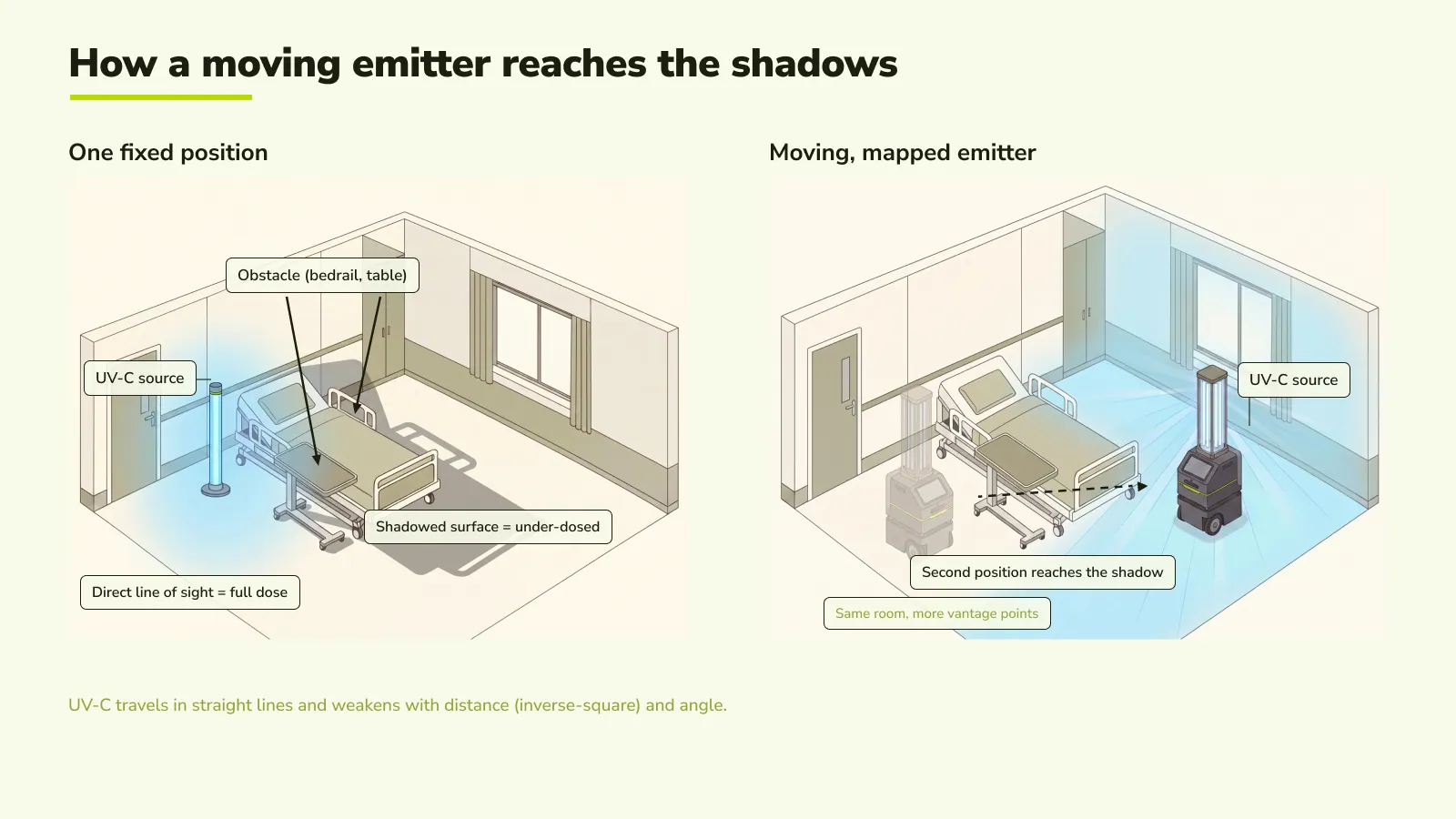
UV-C shadowing is the shortfall in germicidal dose on a surface an object blocks from the lamp's direct beam. Because UV-C travels in straight lines and weakens with distance and angle, a single fixed lamp under-doses shaded, distant surfaces in one cycle. Moving a mapped emitter closer to more of the room raises the real dose delivered.
If you are comparing UV-C systems, the question underneath most of the marketing is a physical one: can the light actually reach every surface you need it to reach, at a high enough dose, in one cycle? A lamp that sits in a corner treats what it can see very well and treats the rest of the room much less well. This article walks through the physics of UV-C shadowing, what the measured numbers look like in a real hospital room, and why a source that moves through the space covers more of it than one that stands still. It builds on our explainer on how UV-C disinfection works.
What is UV-C shadowing?
UV-C shadowing is the shortfall in germicidal dose on any surface that an object blocks from the lamp's direct beam. Germicidal UV-C behaves like visible light: it travels in straight lines and cannot bend around a bedrail, an overbed table or the far side of a monitor. A surface tucked behind one of those objects sits in an optical shadow and receives only the weaker, indirect light that scatters onto it. The engineering bodies that set germicidal-UV guidance name this directly. The Illuminating Engineering Society states that objects can obstruct germicidal UV and result in shadowing, and it stresses monitoring the dose actually delivered rather than assuming it.1
Why can't UV-C bend around objects?
Light has no way to route itself around an obstacle. Whatever a surface cannot "see" of the lamp, it does not receive as direct dose. That is why the position of the source matters so much: two surfaces the same distance from the same lamp can receive very different doses simply because one faces the lamp and the other faces away or sits behind something. The U.S. Food and Drug Administration makes the same point in its public guidance, noting that UV-C effectiveness depends on dose, and therefore on duration, distance and wavelength, and that areas blocked from the light are not disinfected the way exposed areas are.7
Why does a fixed lamp under-dose part of the room?
Two independent physical effects pull the dose down as you move away from the lamp's best line of sight, and they compound.
Why does dose fall sharply with distance?
The dose a surface receives is its light intensity multiplied by exposure time.2 Intensity is not constant across a room. It falls with the square of the distance from the source, so a surface twice as far away receives roughly a quarter of the intensity, and one three times as far receives about a ninth. To hold the dose steady at the far surface, you would have to extend the cycle by the same large factor, which a single fixed cycle does not do.
Why does dose also fall with angle?
A surface square-on to the lamp intercepts the beam fully. A surface raked at a steep angle intercepts far less of the same beam, spread thinly across its face. This angle-of-incidence loss stacks on top of the distance loss, so an oblique, distant surface is penalised twice.
What does this look like in a real room?
The clearest measurement of this comes from a study by Boyce and colleagues, who placed sensors around an occupied-style hospital room and ran a mobile UV-C device from one fixed position. Irradiance measured about 9.89 × 10⁻⁴ W/cm² on a surface 1.3 m away in direct line of sight, and about 1.12 × 10⁻⁵ W/cm² on a shaded surface 3.3 m away, roughly 88 times lower. Over a five-minute cycle the delivered dose fell from about 358,667 to about 4,047 µWsec/cm² across those two points.4 The kill tracked the dose. From that single position, MRSA reduction dropped from more than 4 log on direct surfaces to as little as 1 to 3 log on shaded ones, and Clostridioides difficile spores, the hardest target, showed no measurable reduction at the shaded far site within five minutes.4 A separate evaluation found the same pattern with distance: kill declined substantially as distance grew, and at longer range the direct beam alone reached only modest reductions.5 These are the two most-cited authors in the field summarising the same physical picture: achievable dose varies strongly by location within a room.3
Do shadowed surfaces get no UV-C at all?
No, and this distinction matters for an honest specification. A shaded surface is not sealed off from the light. It still receives reflected and scattered UV bouncing off walls, ceiling and nearby surfaces, so it accumulates some dose, just far less than a surface in direct view. In one study, indirect surfaces reached high reductions but needed a much longer exposure to get there than surfaces in the direct beam.6 So the accurate way to describe a fixed lamp is that it under-doses shaded, distant and oblique surfaces within a single cycle, not that it delivers nothing to them. The practical consequence is the same: within the time you actually run the cycle, part of the room is left below the dose its toughest target needs.
Mobile vs stationary UV-C disinfection: how does movement change coverage?
If distance and line of sight are what limit a fixed lamp, then the direct answer is to change both, by bringing the source to more of the room. That is the case for a mobile, mapped emitter over a single stationary one.
| Coverage factor | Fixed single-position lamp | Moving, mapped emitter |
|---|---|---|
| Line of sight | One vantage point; whatever it cannot see stays shadowed | Multiple vantage points; surfaces shaded from one are exposed from another |
| Distance | Far surfaces sit at low intensity for the whole cycle | Source moves closer to more surfaces, raising their intensity |
| Angle | Fixed geometry; oblique surfaces stay oblique | Changing position improves the angle on more surfaces |
| Real-room dose | High near and in-line, low far and shaded | More even dose across the room's surfaces |
The measured coverage of moving 254 nm devices supports this. A mobile, repositioning UV-C robot added after standard cleaning cut the share of positive high-touch surfaces from 64.3% to 17.5% in hospital critical areas.9 A mobile, autonomous 254 nm robot reached 99.9% and higher inactivation of SARS-CoV-2 on walls and floors in a simulated room, with the reductions varying by exposure geometry and falling at shadowed sites such as under a table, exactly as the shadow-law physics predicts.10 And a field study of an autonomous mobile robot added to routine cleaning decontaminated 96.9% of sampled surfaces, against 50% after manual cleaning alone.11
One honest limit belongs here. There is no single study that reports a clean measured "one fixed position gives X log, moving gives Y log" recovery number. The case for repositioning rests on the dose physics above plus the way these devices are actually run. Researchers have shown that the test method itself, including how many positions the device runs from, changes the measured reduction, which is why a single fixed position under-reports real-room performance.8 Manufacturers of stationary devices recommend running multiple cycles from repositioned locations for the same reason.4 Treat the moving-emitter advantage as strong inference from dose physics and protocol, not as a measured two-position log.
How does ROZOR approach it?
The ROZOR Disinfection Robot is built around this principle. It maps the room, then treats surfaces from more than one vantage point, so a surface shadowed from one position is in direct line of sight from another, and the source spends part of the cycle closer to surfaces that a corner lamp would only reach at long range. The aim is not a bigger headline percentage; it is a more even delivered dose across the real surfaces in the room, and coverage you can defend when you audit it. There is a recognised efficacy standard for automated UV-C disinfection, BS 8628:2022, and it tests activity by direct illumination, so it measures line-of-sight performance rather than certifying that shadows are cleared.12 Coverage is something you design for and verify, not something the standard hands you.
Is UV-C still an adjunct, not a replacement?
Moving the emitter improves coverage; it does not change what UV-C is for. UV-C cannot lift dust, blood or organic soil off a surface, and even a moving source cannot guarantee a high dose to every recessed rim or the underside of every object in one pass. The same field study that reported 96.9% coverage still found shadowed areas, such as under a plate rim, that needed the manual step to finish the job.11 So UV-C, moving or fixed, is a no-touch second step after a person has manually cleaned the room, never a replacement for it.13 Used that way, the evidence for the category is encouraging. A multicentre randomised trial known as BETR-D found that adding UV-C to standard terminal cleaning was associated with about a 30% lower rate of patients acquiring key multidrug-resistant organisms, though that trial used a stationary tower, so it speaks to UV-C as an adjunct rather than to any moving advantage.14 The honest reading is that better coverage strengthens the pass UV-C adds, and the cleaning team's work remains the foundation underneath it.
See how the ROZOR Disinfection Robot puts this to work. It delivers no-touch UV-C disinfection as an adjunct to your cleaning programme, physical AI for critical environments. Learn more about the ROZOR Disinfection Robot.
Frequently asked questions
What is UV-C shadowing in disinfection?
It is the shortfall in germicidal dose on a surface that an object blocks from the lamp's direct beam. Because UV-C travels in straight lines, a surface behind a bedrail or table receives only weaker, indirect light, so it gets a lower dose in one cycle than a surface facing the lamp.
Does a moving UV-C emitter eliminate shadows completely?
No. Moving the source to more positions exposes surfaces that were shadowed from one vantage point and raises the dose on distant surfaces, so coverage is more even. Deeply recessed areas can still fall short, which is why UV-C stays an adjunct to manual cleaning.
Do shadowed surfaces receive any UV-C at all?
Yes, but much less. They still collect reflected and scattered UV, so they accumulate some dose, just far below a directly exposed surface and often below what the toughest target needs within the cycle you run.
Is mobile UV-C disinfection better than a stationary lamp?
For coverage, the physics favours movement: distance and line of sight limit a fixed position, and moving the source addresses both. Mobile 254 nm robots achieve high, more even surface reductions in studies, though no single trial reports a clean two-position kill comparison, so the advantage is best stated as inference from dose physics and protocol.
How far can UV-C reach effectively?
There is no single fixed range. Effective distance depends on the lamp's output, the dose the target needs and the cycle time, and intensity falls with the square of the distance. Kill has been shown to decline substantially as distance grows, which is why proximity through movement matters.
Sources
- Illuminating Engineering Society, Photobiology Committee. "IES Committee Report CR-2-20: Germicidal Ultraviolet (GUV)." 2020. https://www.ies.org/standards/committee-reports/ies-committee-report-cr-2-20-faqs/
- Kowalski W. Ultraviolet Germicidal Irradiation Handbook: UVGI for Air and Surface Disinfection. Springer, 2009. https://doi.org/10.1007/978-3-642-01999-9
- Boyce J.M., Donskey C.J. "Understanding ultraviolet light surface decontamination in hospital rooms: A primer." Infection Control & Hospital Epidemiology, 2019; 40(9):1030-1035. https://doi.org/10.1017/ice.2019.161
- Boyce J.M., Farrel P.A., Towle D., Fekieta R., Aniskiewicz M. "Impact of room location on UV-C irradiance and UV-C dosage and antimicrobial effect delivered by a mobile UV-C light device." Infection Control & Hospital Epidemiology, 2016; 37(6):667-672. https://doi.org/10.1017/ice.2016.35
- Nerandzic M.M., Fisher C.W., Donskey C.J. "Sorting through the wealth of options: comparative evaluation of two ultraviolet disinfection systems." PLOS ONE, 2014; 9(9):e107444. https://doi.org/10.1371/journal.pone.0107444
- Rutala W.A., Gergen M.F., Weber D.J. "Room decontamination with UV radiation." Infection Control & Hospital Epidemiology, 2010; 31(10):1025-1029. https://doi.org/10.1086/656244
- U.S. Food and Drug Administration. "UV Lights and Lamps: Ultraviolet-C Radiation, Disinfection, and Coronavirus" (Internet Archive snapshot, 2023). https://web.archive.org/web/20230419153101/https://www.fda.gov/medical-devices/coronavirus-covid-19-and-medical-devices/uv-lights-and-lamps-ultraviolet-c-radiation-disinfection-and-coronavirus
- Cadnum J.L., Nerandzic M.M., Donskey C.J., et al. "Effect of variation in test methods on performance of ultraviolet-C radiation room decontamination." Infection Control & Hospital Epidemiology, 2016; 37(5):555-560. https://doi.org/10.1017/ice.2015.349
- Casini B., Tuvo B., Scarpaci M., et al. "Implementation of an environmental cleaning protocol in hospital critical areas using a UV-C disinfection robot." International Journal of Environmental Research and Public Health, 2023; 20(5):4284. https://doi.org/10.3390/ijerph20054284
- Lorca-Oró C., Vila J., Pleguezuelos P., et al. "Rapid SARS-CoV-2 inactivation in a simulated hospital room using a mobile and autonomous robot emitting ultraviolet-C light." Journal of Infectious Diseases, 2022; 225(4):587-592. https://doi.org/10.1093/infdis/jiab551
- Füszl A., Zatorska B., Van den Nest M., Ebner J., Presterl E., Diab-Elschahawi M. "The use of a UV-C disinfection robot in the routine cleaning process: a field study in an academic hospital." Antimicrobial Resistance & Infection Control, 2021; 10:84. https://doi.org/10.1186/s13756-021-00945-4
- BSI. BS 8628:2022, "Disinfection using ultraviolet radiation. Methods for quantitative testing of automated ultraviolet disinfection activities by direct illumination." British Standards Institution, 2022. https://webstore.ansi.org/standards/bsi/bs86282022
- Weber D.J., Rutala W.A., Anderson D.J., Sickbert-Bennett E.E. "No touch methods for health care room disinfection: focus on clinical trials." American Journal of Infection Control, 2023; 51(11S):A134-A143. https://doi.org/10.1016/j.ajic.2023.04.003
- Anderson D.J., Chen L.F., Weber D.J., et al. "Enhanced terminal room disinfection and acquisition and infection caused by multidrug-resistant organisms and Clostridium difficile (the BETR-D study): a cluster-randomised, multicentre, crossover study." The Lancet, 2017; 389(10071):805-814. https://doi.org/10.1016/S0140-6736(16)31588-4