UV-C and chemical disinfection are complementary, not rivals. Manual chemical cleaning removes organic soil and reaches surfaces a person can wipe, which UV-C cannot. No-touch UV-C adds a residue-free pass over surfaces it can see, with no established route for microbes to resist it. It works after manual cleaning as an adjunct that cuts chemical reliance without replacing it.
If you are comparing UV-C vs chemical disinfection for your environmental cleaning programme, it helps to start with the point most marketing skips: the two methods do different jobs. National guidance treats manual cleaning as the essential first step and no-touch technologies such as UV-C as an adjunct on top of it, never a substitute.1 This guide walks through what each method does, where each falls short, how they compare surface by surface, and why the strongest programmes use both. It also answers the question clinicians ask most often, which is whether UV-C is safer than chemicals for the staff who apply them.
What does each method actually do?
The clearest way to compare them is to ask what each one is physically able to do, and where that ability stops.
Manual chemical cleaning (bleach, QUATs, hydrogen peroxide, phenolics)
Manual cleaning with a liquid disinfectant is the foundation of environmental hygiene. Physical wiping is the only step that lifts organic soil, dust and debris off a surface, and national guidance requires that soil be removed before any disinfectant or UV can act.2 It also reaches into the places a cloth can touch that a light source cannot.
Its limits are about consistency, not capability. A disinfectant only works if the surface is kept visibly wet for the full label contact time, and agents such as sodium hypochlorite are inactivated by organic matter, so soil has to come off first.3 Execution is also uneven in practice: using an invisible fluorescent marker, one widely cited study found only about 47 percent of high-touch surfaces had actually been cleaned at baseline.4 Chemicals work well, but only on the surfaces someone actually wipes, correctly, for long enough.
No-touch UV-C (254 nm)
A UV-C robot uses short-wavelength ultraviolet light at 254 nm to damage the DNA and RNA inside microbes so they can no longer replicate. Our pillar guide on how UV-C disinfection works covers the mechanism in detail. Because it runs automatically over a whole room, it delivers a consistent dose to every surface in its line of sight, which is exactly where manual cleaning is most variable.
Its limits are the mirror image of chemistry's. UV-C cannot remove soil, so it needs a pre-cleaned surface to be effective.1 It travels in straight lines, so shadowed or occluded areas are under-dosed, and the U.S. Food and Drug Administration notes that shadowed areas are not disinfected.5 The same energy that damages a microbe harms human eyes and skin, so the robot runs only in a vacated room.5 UV-C is a dose-driven, line-of-sight adjunct that supplements manual cleaning rather than standing in for it.6
UV-C vs chemical disinfection: a side-by-side comparison
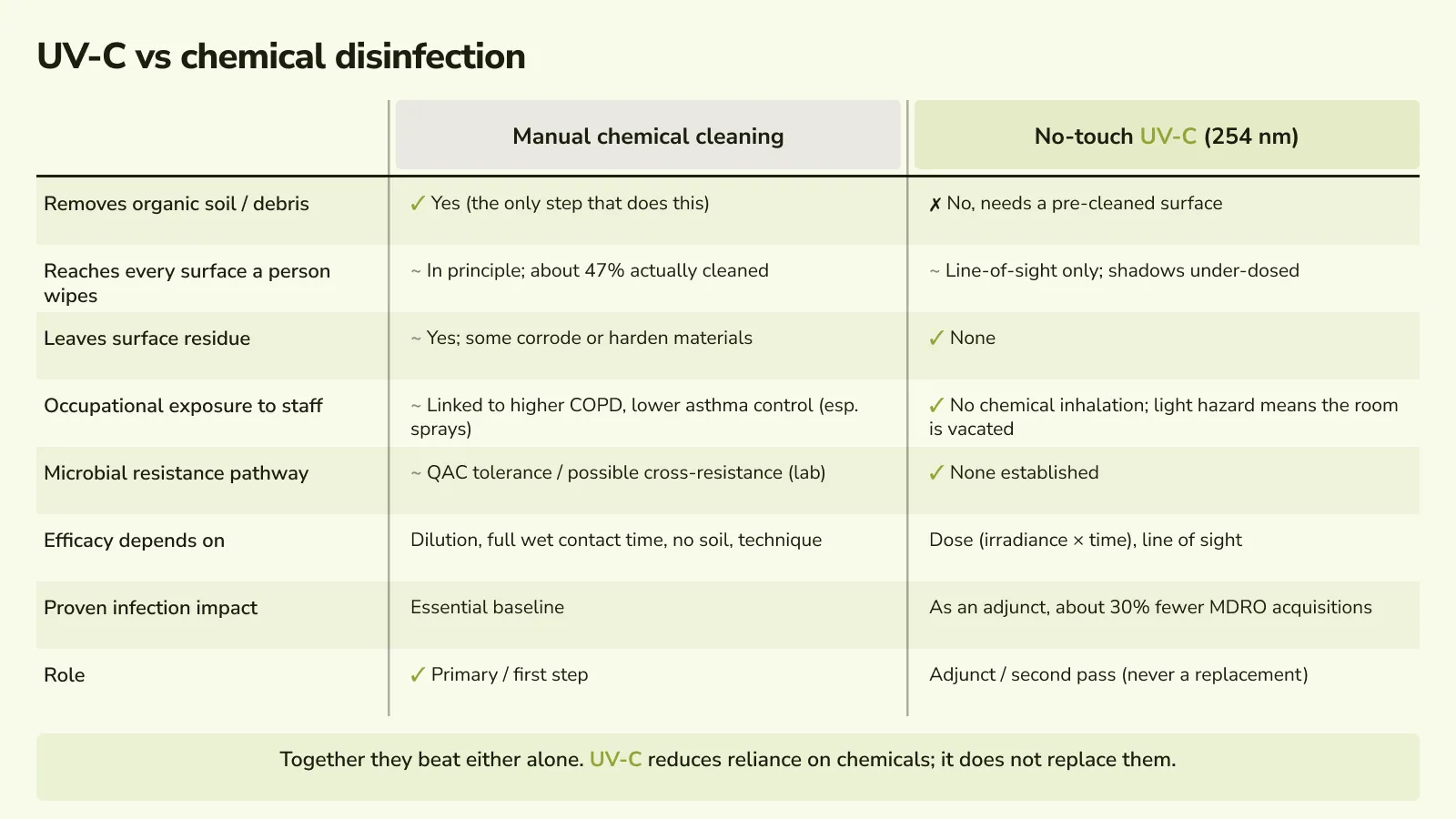
The table below sets the two methods against each other on the dimensions that matter to an infection prevention programme. Read it as a division of labour, not a scoreboard.
| Comparison dimension | Manual chemical cleaning (bleach / QUATs / H₂O₂ / phenolics) | No-touch UV-C (254 nm) |
|---|---|---|
| Removes organic soil, dust, debris | Yes. Physical wiping is the only step that does this2 | No. Cannot remove soil; needs the surface pre-cleaned1 |
| Reaches every surface a person wipes | In principle, but inconsistently executed (about 47 percent of high-touch surfaces actually cleaned)4 | Line-of-sight only; shadowed areas are under-dosed56 |
| Leaves surface residue | Yes, chemical residue; some agents corrode or harden materials7 | No residue; the energy leaves nothing behind7 |
| Occupational exposure to staff | Associated with respiratory burden: higher COPD rate11, worse asthma control, especially with sprays12; balance: the new-asthma signal is null13; hazards are agent-specific10 | No chemical inhalation; eye and skin hazard from the light, so it runs only in a vacated, interlocked room5 |
| Microbial resistance pathway | QAC tolerance plus possible antibiotic cross-resistance under sub-lethal exposure in the lab; real-world impact unproven14 | No established resistance pathway; physical DNA damage, not a selectable target14 |
| Efficacy depends on | Correct dilution, full wet contact time, no soil inactivation, operator technique3 | Delivered dose (irradiance × time), distance and line of sight56 |
| Proven infection impact | The essential baseline, removing soil and bioburden | As an adjunct on top of chemical cleaning, cut MDRO acquisition by about 30 percent15 |
| Role | Primary, first step, always required29 | Adjunct, second pass, never a replacement81 |
Does UV-C leave residue like chemicals do?
No. UV-C is light, not a chemical, so it leaves nothing on the surface once the lamp switches off. The ideal-disinfectant criteria that Rutala and Weber describe explicitly favour agents that are residue-free and material-compatible, and liquid chemicals fall short on both counts: alcohols can harden plastic and crack rubber, and chlorine compounds can corrode and damage surfaces with repeated use.7 That is one of the clearest reasons it reduces reliance on chemicals: every surface UV-C treats as a second pass is a surface that did not need another wet application.
Is UV-C safer than chemicals for staff?
This is the question the people who run turnover ask first. Manual disinfection means daily hands-on contact with chemicals, and the occupational evidence is worth stating precisely. In a large prospective cohort of nurses, regular use of surface disinfectants was associated with roughly a 38 percent higher rate of chronic obstructive pulmonary disease.11 Among nurses who already had asthma, weekly disinfectant use was associated with worse asthma control, and spray application made it worse still.12 Balance matters here: in the same body of work, surface-only disinfection was not significantly linked to new-onset asthma, so the honest reading is an association with some respiratory outcomes, not proof that chemicals cause disease.13 Different agents also carry different, agent-specific hazards.10
For the surfaces it treats, UV-C removes that chemical inhalation exposure entirely. Its own hazard is the light itself: direct 254 nm exposure harms eyes and skin, which is exactly why the robot runs in a vacated, interlocked room with no one inside.5 The trade is a real and favourable one. Staff face fewer chemical applications, and the light's hazard is engineered out by keeping people out of the room while it works. UV-C does not replace the cleaning your team does, it takes the repeat pass off their plate so their skilled work is the part that stays.
Can microbes become resistant to disinfectants?
This is where the two methods diverge most. Repeated sub-lethal exposure to quaternary ammonium compounds can select for tolerant bacteria through efflux pumps, membrane changes and biofilms, and laboratory studies show a correlation with antibiotic cross-resistance via shared efflux mechanisms and mobile genetic elements.14 The honest bound is important: the same review concludes there is insufficient real-world evidence to say that frequent QAC use has driven widespread antibiotic resistance, so it is a concern the literature is watching, not a proven crisis.14
UV-C works differently. It damages the genome physically rather than acting on a selectable biochemical target, so it has no established microbial resistance pathway.14 For an infection prevention team building a durable bundle, that is a structural argument for keeping a non-chemical layer in the mix alongside the chemistry.
When to use UV-C, and when to use chemicals
Use chemical cleaning always, and first. It is the only step that removes organic soil, blood and debris, and it is required on every surface a person can reach.21 Reserve UV-C for the second, no-touch pass in a vacated room, where it earns its place: terminal cleaning after a discharge, rooms that held patients with multidrug-resistant organisms or spores, and the high-touch, line-of-sight surfaces that manual cleaning reaches inconsistently.9 UV-C does not decide anything on its own; it adds consistency where hand cleaning is variable. The sequence is fixed, never reversed: clean the soil off first, then run UV-C over what remains.
How do UV-C and chemical cleaning work together?
Leading guidance frames environmental disinfection as a bundle, in which manual cleaning is the critical first step and no-touch technology is one layer added on top.98 The outcome evidence supports the pairing rather than either method alone. In the BETR-D cluster-randomised trial, adding UV-C on top of standard quaternary-ammonium terminal cleaning was associated with roughly a 30 percent lower rate of patients acquiring key multidrug-resistant organisms, though the benefit was clear for that grouped outcome and not statistically significant for Clostridioides difficile on its own.15 A field study of an autonomous 254 nm robot added to routine cleaning found 96.9 percent of surfaces decontaminated, compared with 50 percent after manual cleaning alone, while shadowed rims still needed the manual step, a reminder that neither method is complete without the other.16
The practical takeaway for an infection prevention programme is simple. Manual chemical cleaning does the job UV-C cannot, and UV-C adds the pass chemicals cannot. Together they lower how much a programme has to lean on chemicals for consistency, without pretending a room can be made ready with light alone. That is the ROZOR position too: our UV-C robot is built as a no-touch adjunct to a sound cleaning programme, not a replacement for it.
See how the ROZOR Disinfection Robot fits your cleaning programme. It delivers no-touch UV-C disinfection as an adjunct to your cleaning programme, physical AI for critical environments. Learn more about the ROZOR Disinfection Robot.
Frequently asked questions
Is UV-C safer than chemicals?
For the surfaces it treats, UV-C removes the chemical inhalation exposure that surface-disinfectant use has been associated with, including higher COPD rates and worse asthma control in nurses. Its own hazard, the light, is managed by running only in a vacated, interlocked room. It reduces reliance on chemicals rather than eliminating them.
Can UV-C replace chemical cleaning?
No. UV-C cannot remove dust, blood or organic soil and only reaches what it can see, so it is applied after manual cleaning as an added no-touch step, not as a substitute.
Does UV-C leave any residue?
No. UV-C is light, so it leaves no chemical film on treated surfaces and adds no material wear from a disinfectant.
Do disinfectant chemicals cause antibiotic resistance?
Laboratory studies link repeated sub-lethal exposure to quaternary ammonium compounds with tolerance and possible antibiotic cross-resistance, but there is insufficient real-world evidence to confirm a widespread effect, so it is a watched concern. UV-C has no established resistance pathway.
Which is more effective, UV-C or chemical disinfection?
They are not measured on the same axis. Chemical cleaning is the essential baseline; adding UV-C on top of it was associated with about 30 percent fewer MDRO acquisitions in the BETR-D trial, so the strongest result comes from using both.
Sources
- Boyce J.M. "Modern technologies for improving cleaning and disinfection of environmental surfaces in hospitals." Antimicrobial Resistance & Infection Control, 2016; 5:10. https://doi.org/10.1186/s13756-016-0111-x
- Rutala W.A., Weber D.J., and the Healthcare Infection Control Practices Advisory Committee (HICPAC). "Guideline for Disinfection and Sterilization in Healthcare Facilities, 2008" (updated). U.S. Centers for Disease Control and Prevention. https://www.cdc.gov/infection-control/media/pdfs/guideline-disinfection-h.pdf
- U.S. Centers for Disease Control and Prevention. "Cleaning and Disinfecting with Bleach." https://www.cdc.gov/hygiene/about/cleaning-and-disinfecting-with-bleach.html
- Carling P.C., Briggs J.L., Perkins J., Highlander D. "Improved cleaning of patient rooms using a new targeting method." Clinical Infectious Diseases, 2006; 42(3):385-388. https://doi.org/10.1086/499361
- U.S. Food and Drug Administration. "UV Lights and Lamps: Ultraviolet-C Radiation, Disinfection, and Coronavirus" (Internet Archive snapshot, 2023). https://web.archive.org/web/20230419153101/https://www.fda.gov/medical-devices/coronavirus-covid-19-and-medical-devices/uv-lights-and-lamps-ultraviolet-c-radiation-disinfection-and-coronavirus
- Boyce J.M., Donskey C.J. "Understanding ultraviolet light surface decontamination in hospital rooms: A primer." Infection Control & Hospital Epidemiology, 2019; 40(9):1030-1035. https://doi.org/10.1017/ice.2019.161
- Rutala W.A., Weber D.J. "Disinfection and Sterilization in Health Care Facilities: An Overview and Current Issues." Infectious Disease Clinics of North America, 2021; 35(3):575-607. https://doi.org/10.1016/j.idc.2021.04.004
- Weber D.J., Rutala W.A., Anderson D.J., Sickbert-Bennett E.E. "No touch methods for health care room disinfection: focus on clinical trials." American Journal of Infection Control, 2023; 51(11S):A134-A143. https://doi.org/10.1016/j.ajic.2023.04.003
- Rutala W.A., Weber D.J. "Best practices for disinfection of noncritical environmental surfaces and equipment in health care facilities: A bundle approach." American Journal of Infection Control, 2019; 47S:A96-A105. https://doi.org/10.1016/j.ajic.2019.01.014
- Ng M.K., Mont M.A. "Beyond quaternary ammonium compounds: Evaluating the harms of non-QAC disinfectant agents in healthcare and industry." GMS Hygiene and Infection Control, 2025; 20:Doc62. https://doi.org/10.3205/dgkh000591
- Dumas O., Varraso R., Boggs K.M., et al. "Association of Occupational Exposure to Disinfectants With Incidence of Chronic Obstructive Pulmonary Disease Among US Female Nurses." JAMA Network Open, 2019; 2(10):e1913563. https://doi.org/10.1001/jamanetworkopen.2019.13563
- Dumas O., Wiley A.S., Quinot C., et al. "Occupational exposure to disinfectants and asthma control in US nurses." European Respiratory Journal, 2017; 50(4):1700237. https://doi.org/10.1183/13993003.00237-2017
- Dumas O., Boggs K.M., Quinot C., et al. "Occupational exposure to disinfectants and asthma incidence in US nurses: A prospective cohort study." American Journal of Industrial Medicine, 2020; 63(1):44-50. https://doi.org/10.1002/ajim.23067
- Boyce J.M. "Quaternary ammonium disinfectants and antiseptics: tolerance, resistance and potential impact on antibiotic resistance." Antimicrobial Resistance & Infection Control, 2023; 12:32. https://doi.org/10.1186/s13756-023-01241-z
- Anderson D.J., Chen L.F., Weber D.J., et al. "Enhanced terminal room disinfection and acquisition and infection caused by multidrug-resistant organisms and Clostridium difficile (the BETR-D study): a cluster-randomised, multicentre, crossover study." The Lancet, 2017; 389(10071):805-814. https://doi.org/10.1016/S0140-6736(16)31588-4
- Fuszl A., Zatorska B., Van den Nest M., et al. "The use of a UV-C disinfection robot in the routine cleaning process: a field study in an academic hospital." Antimicrobial Resistance & Infection Control, 2021; 10:84. https://doi.org/10.1186/s13756-021-00945-4