A disinfection documentation audit is how you prove a room was cleaned and disinfected, not only that someone was assigned to do it. The recognised checks on terminal cleaning (direct observation, environmental cultures, fluorescent markers and ATP) each measure something different and each has limits, so surveyor-ready evidence combines records, monitoring with feedback and trending.
You can sign a room back into service in a few minutes. Proving it was disinfected takes more than that signature. If a surveyor, an outbreak investigation, or your quality committee asks how you know the terminal clean in bed 4 reached the surfaces that matter, the honest answer for most programmes is that they trust the process rather than measure it. In our pillar on standards and evidence, this piece is about the evidence you keep: why a cleaned room is not self-evidently a clean one, the recognised ways to prove terminal cleaning and what each honestly shows, what surveyor-ready evidence looks like, and where an automated no-touch step's cycle records add an objective, timestamped layer.
Why isn't a cleaned room enough on its own?
The gap between a room that was cleaned and a room that is clean is a measurement problem, not a moral one. The principle infection prevention has settled on is blunt: unmeasured cleaning is unmanaged cleaning. When high-touch surfaces are audited rather than assumed, roughly 40 to 50 percent of them turn out not to have been adequately cleaned during standard manual terminal disinfection.1
That figure is not a verdict on the people doing the work. Terminal cleaning is done under real time pressure, against a long checklist of surfaces and a fast room-turnover clock, in rooms full of shadowed and awkward-to-reach spots. When researchers marked high-touch surfaces with a fluorescent gel before terminal cleaning across 36 acute-care hospitals, only about 48 percent had been wiped at baseline; the same programme, with structured feedback and repeated auditing, raised that to 77 percent.2 The number moved not by working cleaners harder but by measuring the system around them and feeding the result back. A surface that looks spotless can still carry a reservoir, which is the separate problem we cover in visual cleanliness versus disinfection.
The stakes behind that record are not administrative. In the largest randomised trial of enhanced terminal disinfection, adding a UV-C cycle to standard quaternary-ammonium cleaning was associated with about a 30 percent lower rate of acquiring or being infected by four multidrug-resistant organisms combined, among patients later admitted to those rooms (risk ratio 0.70, 95% CI 0.50 to 0.98; 2017).3 In the same trial, adding UV-C on top of a bleach protocol did not further lower C. difficile infection specifically (risk ratio 1.00, 95% CI 0.57 to 1.75), a null we report as plainly as the headline figure and unpack in our review of what the UV-C evidence actually shows. Read together, they make one point for documentation: what happens during a terminal clean measurably shapes what the next patient meets, so being able to prove the clean happened is patient-safety work, not paperwork.
How do hospitals monitor terminal cleaning?
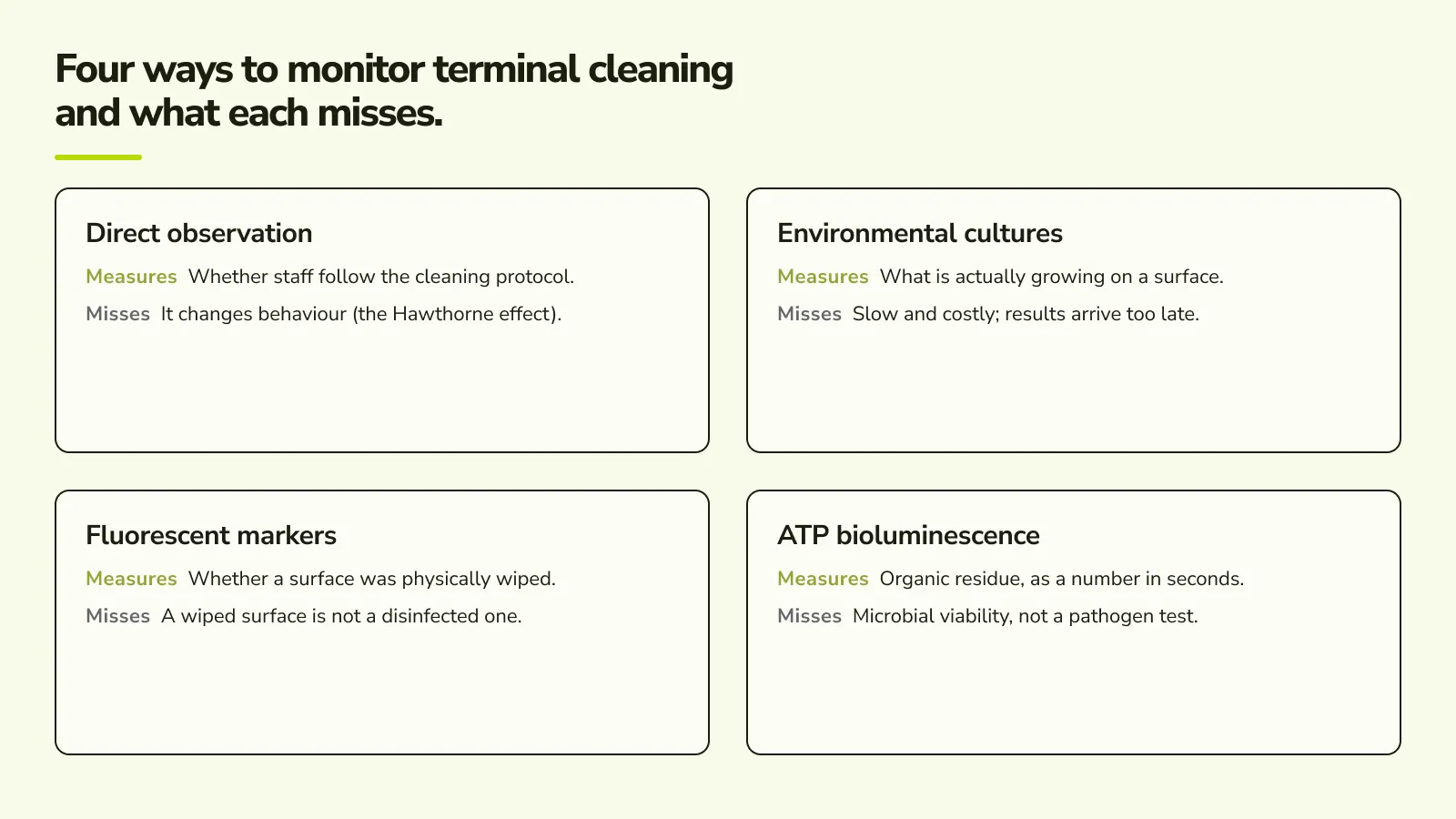
If you want to manage cleaning, you have to measure it, and the field has a recognised toolkit for monitoring environmental cleaning. The CDC's options for evaluating environmental cleaning catalogue four practical methods, each answering a slightly different question.4
Direct observation watches whether staff follow the cleaning protocol. It is the fullest picture of practice, but it is labour-intensive and prone to the Hawthorne effect: people clean differently when they know they are being watched.
Environmental cultures, meaning aerobic colony counts or targeted sampling for a specific organism, measure what is actually growing on a surface. They come closest to the outcome you care about, but they are slow and costly and the result arrives long after the room is back in use.
Fluorescent markers are an invisible gel dabbed onto high-touch surfaces before cleaning and checked afterwards under UV light. What they measure is process: whether the surface was physically wiped. They are cheap, objective and excellent for feedback, but a wiped surface is not the same as a disinfected one.
ATP bioluminescence swabs a surface and reads adenosine triphosphate as relative light units, giving a number in seconds. It is fast, quantifiable and recordable, which is why it spread quickly for routine monitoring.5
ATP's speed comes with a limit worth stating plainly, because it is easy to oversell. ATP measures organic residue, not microbial viability: a low reading means a surface is clean of organic soil, not that it is free of pathogens.6 In a head-to-head study of visual, ATP and microbiological assessment, visual inspection did not reflect ATP values or microbial contamination, and the authors were candid that neither ATP nor visual assessment reliably predicted S. aureus on the surface.7 The honest way to use ATP is as a cleanliness benchmark, not a pathogen detector. Each of the four methods is a proxy for something different, so the audit trail that convinces a surveyor is built from the right combination, not any single one.
What does monitoring with feedback actually achieve?
Monitoring earns its place only when the result is fed back and acted on, and that is where the numbers move. The same 36-hospital programme that found 48 percent of surfaces cleaned at baseline reached 77 percent once results were shared with environmental-services teams and re-audited on a cycle.2 The mechanism is quality improvement, not surveillance: a measured baseline, feedback to the people who can change it, a repeat measurement, and a trend line that either climbs or shows where to look.
This is also why monitoring is not an optional extra bolted onto cleaning. The best-practice framework for disinfecting noncritical surfaces describes a five-part bundle: a clear policy, the right product selection, staff education, compliance monitoring with feedback, and no-touch room-decontamination technology as an adjunct to manual cleaning.8 Monitoring with feedback is a named component of that bundle, sitting alongside the cleaning itself. A programme that cleans but never measures has built only part of it.
What does surveyor-ready evidence look like?
Put the pieces together and "surveyor-ready" stops being a mystery. It is not a single certificate; it is a record that shows what was done, when, by which method, and how the result is trending, available on demand rather than reconstructed the week before a survey.
Accreditation frameworks describe this expectation in their own vocabulary. Joint Commission International's 8th-edition standards, effective January 2025, organise a hospital's obligations under named chapters including Quality and Patient Safety and Management of Information, the parts of the manual concerned with measuring quality and with keeping data accurate, timely and retrievable.9 A cleaning-monitoring programme with a baseline, feedback and a trend line is the kind of measured, documented process those chapters expect, and we go deeper on that mapping in our piece on UV-C disinfection and JCI accreditation.
Other standards are more concrete about cleaning specifically. England's national standards of healthcare cleanliness set out a formal audit framework: six functional-risk categories that set cleaning frequency and audit targets by clinical-area risk, with transparent scoring and star-rated trending over time.10 The perioperative standard from AORN ties environmental cleaning to surgical-site-infection prevention and calls for monitoring, competency verification and documentation of cleaning as expected practice, not aspiration.11 Underneath all of them sits the older CDC and HICPAC environmental guidance that separates routine daily cleaning from terminal cleaning and disinfection and classifies surfaces by contamination risk, which is the vocabulary any cleaning record has to attest to.12 The common thread is the same across every framework: keep the record, feed it back, show the trend.
Where do an automated cycle's records fit?
Everything so far measures the manual clean. An automated no-touch step adds a different kind of evidence, because a machine records its own work in a way a hurried human process cannot. This is the layer a no-touch system such as the ROZOR Disinfection Robot is built to contribute.
Where a fluorescent marker tells you a surface was wiped and an ATP swab gives you a spot reading, a UV-C robot that logs its cycles can produce a structured, timestamped record of the terminal disinfection cycle itself. In principle a system like this can capture, for every cycle, the room or cycle identifier, the start and end time, the UV-C dose or exposure delivered from each mapped position, the operator who initiated it, and a pass-or-fail result against the target set for that space. That record is objective in a way an observation is not, generated automatically rather than transcribed, and it accrues into the trend line an accreditation chapter on managing information expects. It does not replace the cultures or markers that check the manual clean; it documents the second, no-touch pass that ran after it.
Two honest boundaries keep this claim clean. A cycle record proves a dose was delivered to the positions the emitter reached, which is a surface-exposure record, not a measured infection outcome and not a guarantee about a shadowed surface the light never saw. And the specific fields any given device logs vary by manufacturer, so ask a vendor exactly what its system records and whether that record exports in a form your quality committee can audit. The reason to document an automated pass is the reason to document the manual clean: an intervention you can prove you delivered is one you can defend, improve and trend.
What this means for your documentation
The through-line for your programme is straightforward. A cleaned room is a claim; a documented, monitored, trending clean is evidence. Manual cleaning misses a structural share of surfaces under time pressure, so measure it rather than assume it. No single method is sufficient alone, so combine them: markers and observation for process, cultures and ATP for state. Feed the results back, because that moves the number. And where a no-touch cycle runs after the manual clean, capture its record too, so the second pass is as auditable as the first, which matters most in the high-acuity and outbreak-relevant spaces we cover in terminal disinfection in high-risk areas.
Do that, and the question that opened this article answers itself. When someone asks how you know bed 4 was disinfected, you will not have to trust the process. You will be able to show it: what was done, when, by which method, and where the trend is heading. That is a position you can defend to a surveyor, a board and a skeptical colleague alike.
See how the ROZOR Disinfection Robot documents the no-touch pass in your prevention bundle. It delivers no-touch UV-C disinfection as an adjunct to your cleaning programme, physical AI for critical environments. Learn more about the ROZOR Disinfection Robot.
Frequently asked questions
What is a disinfection documentation audit?
It is the evidence trail that shows a room was cleaned and disinfected rather than simply assigned for cleaning: the records, monitoring results and trends that prove the terminal clean happened and met its standard. It matters because unmeasured cleaning is unmanaged cleaning, and roughly 40 to 50 percent of high-touch surfaces are missed under standard manual terminal disinfection when no one checks.
How do hospitals monitor terminal cleaning?
The recognised toolkit has four methods: direct observation of practice, environmental cultures that measure what is growing on a surface, fluorescent markers that show whether a surface was physically wiped, and ATP bioluminescence that reads organic residue as a fast, recordable number. Each measures something different, so most programmes combine them.
Does ATP testing tell you a surface is free of pathogens?
No. ATP bioluminescence measures organic residue, not microbial viability, so a low reading means a surface is free of soil, not free of pathogens. In head-to-head testing neither ATP nor visual assessment reliably predicted S. aureus on a surface, which is why ATP is best used as a cleanliness benchmark rather than a pathogen detector.
Does monitoring cleaning actually improve it?
Yes, when the results are fed back. Across 36 hospitals, the share of high-touch surfaces adequately cleaned at terminal cleaning rose from about 48 percent at baseline to 77 percent once results were shared with teams and re-audited. Compliance monitoring with feedback is a named component of the best-practice disinfection bundle.
What counts as surveyor-ready cleaning evidence?
A record that shows what was cleaned, when, by which method and how the result is trending, kept routinely rather than reconstructed before a survey. Formal audit frameworks such as England's national standards of healthcare cleanliness model this with risk-based frequencies, transparent scoring and trending, and perioperative standards call for monitoring, competency verification and documentation of cleaning as expected practice.
Can an automated UV-C robot's records replace cleaning audits?
No. A UV-C robot that logs its cycles documents the no-touch pass that runs after the manual clean, producing a timestamped, objective record of the disinfection cycle; it does not remove soil and only treats surfaces its light reaches, so it complements the cultures, markers and observation that check the manual clean rather than replacing them.
Sources
- Carling PC, Bartley JM. "Evaluating hygienic cleaning in health care settings: what you do not know can harm your patients." American Journal of Infection Control 2010;38(5 Suppl 1):S41-S50. https://pubmed.ncbi.nlm.nih.gov/20569855/
- Carling PC, Parry MF, Rupp ME, Po JL, Dick B, Von Beheren S. "Improving cleaning of the environment surrounding patients in 36 acute care hospitals." Infection Control & Hospital Epidemiology 2008;29(11):1035-1041. https://pubmed.ncbi.nlm.nih.gov/18851687/
- Anderson DJ, Chen LF, Weber DJ, et al. "Enhanced terminal room disinfection and acquisition and infection caused by multidrug-resistant organisms and Clostridium difficile (the Benefits of Enhanced Terminal Room Disinfection study, BETR-D): a cluster-randomised, multicentre, crossover study." The Lancet 2017;389(10071):805-814. https://pubmed.ncbi.nlm.nih.gov/28104287/
- Guh A, Carling P; Centers for Disease Control and Prevention. "Options for Evaluating Environmental Cleaning." Atlanta: CDC; 2010. https://www.cdc.gov/infection-control/php/evaluating-environmental-cleaning/index.html
- Boyce JM, Havill NL, Dumigan DG, Golebiewski M, Balogun O, Rizvani R. "Monitoring the effectiveness of hospital cleaning practices by use of an adenosine triphosphate bioluminescence assay." Infection Control & Hospital Epidemiology 2009;30(7):678-684. https://pubmed.ncbi.nlm.nih.gov/19489715/
- Shama G, Malik DJ. "The uses and abuses of rapid bioluminescence-based ATP assays." International Journal of Hygiene and Environmental Health 2013;216(2):115-125. https://pubmed.ncbi.nlm.nih.gov/22541898/
- Mulvey D, Redding P, Robertson C, et al. "Finding a benchmark for monitoring hospital cleanliness." Journal of Hospital Infection 2011;77(1):25-30. https://pubmed.ncbi.nlm.nih.gov/21129820/
- Rutala WA, Weber DJ. "Best practices for disinfection of noncritical environmental surfaces and equipment in health care facilities: A bundle approach." American Journal of Infection Control 2019;47(Suppl):A96-A105. https://doi.org/10.1016/j.ajic.2019.01.014
- Joint Commission International. "Accreditation Standards for Hospitals, 8th Edition, official sample pages (Contents and Summary of Changes)." Oakbrook Terrace, IL: Joint Commission Resources; 2024. https://digitalassets.jointcommission.org/api/public/content/assets/3/7/ebjcih24_sample_pages.pdf
- NHS England. "National standards of healthcare cleanliness 2025." Published 5 February 2025. https://www.england.nhs.uk/long-read/national-standards-of-healthcare-cleanliness-2025/
- Link T. "Guidelines in Practice: Environmental Cleaning." AORN Journal 2021;113(5):487-499. https://pubmed.ncbi.nlm.nih.gov/33929738/
- Sehulster L, Chinn RYW; CDC / HICPAC. "Guidelines for environmental infection control in health-care facilities." MMWR Recommendations and Reports 2003;52(RR-10):1-42. https://pubmed.ncbi.nlm.nih.gov/12836624/