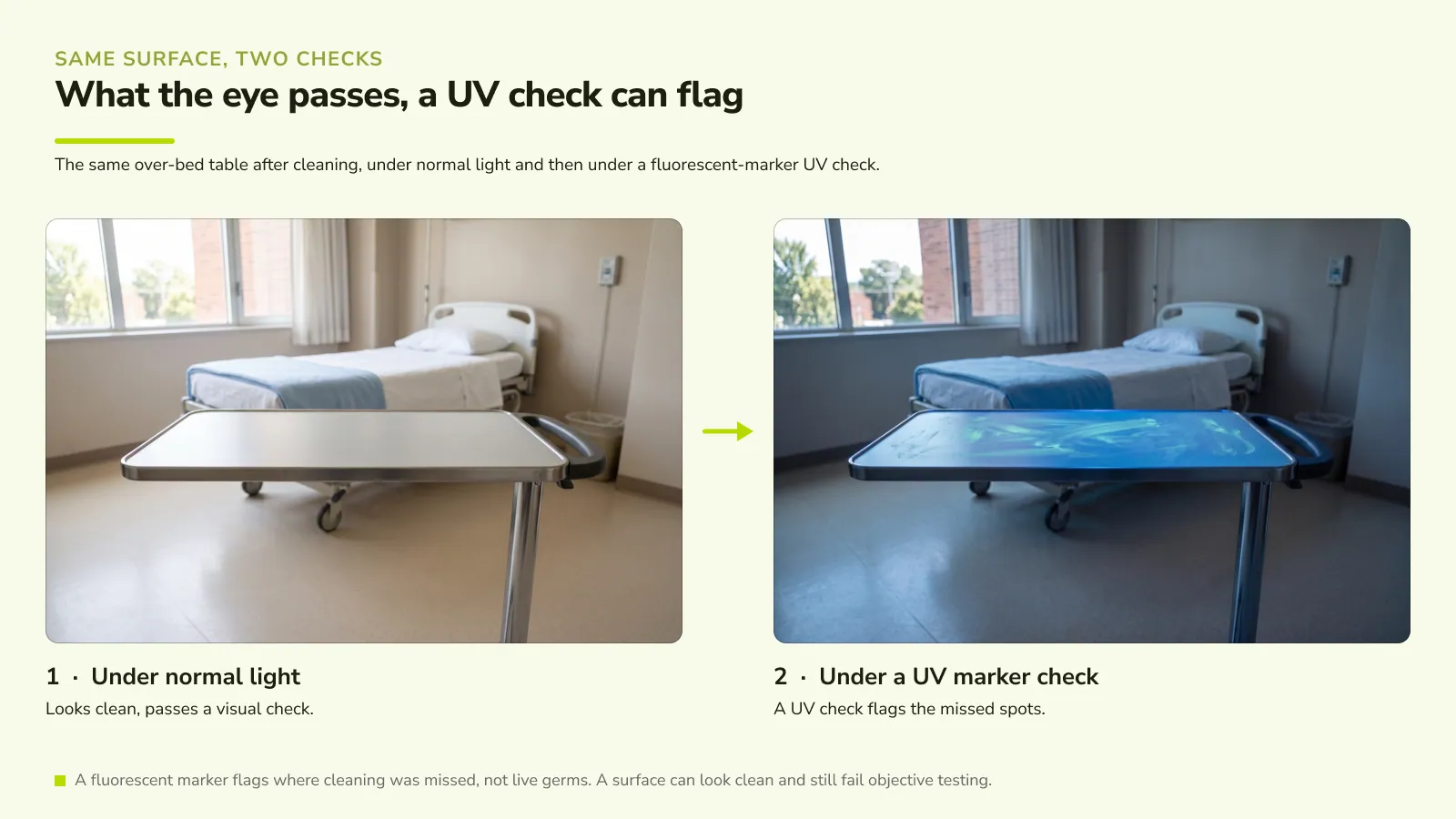
Visual cleanliness and disinfection are not the same: a hospital room can look clean and still carry pathogens on high-touch surfaces. Visual inspection checks appearance, not the microbial or organic load a surface holds. That is why a measured, no-touch disinfection pass is added after manual cleaning, as a consistent layer over what the eye cannot see.
You have signed off rooms that looked spotless. The bed rail gleamed, the over-bed table was wiped, the floor was dry, and nothing about the room told you otherwise. Appearance is the first check most environmental audits still rely on, and it is a reasonable one for gross soil. It is also the check that a contaminated surface passes most easily. This article is for the moment you want to know what a visual pass actually tells you, what it does not, and what to add when the stakes are high. It sits alongside our wider piece on hospital-acquired infections and the surface reservoirs that feed them.
Can a hospital room look clean and still be contaminated?
Yes, and this is the finding to hold onto: how a surface looks and what lives on it are only loosely related. The clearest illustration comes from an early, careful evaluation. Griffith and colleagues assessed hospital surfaces three ways at once, visually, microbiologically, and by adenosine triphosphate (ATP), after cleaning. Judged against published standards, 70 percent and 76 percent of sites were unacceptable, yet visual assessment flagged only 18 percent of them.1 Treat that as one study, from a single institution in the year 2000, and read it as a direction rather than a fixed rate: there is no universal "X percent of clean-looking surfaces are contaminated" constant to quote. What the study shows is that the eye missed the large majority of the contamination the other methods found.
The pattern holds for the organisms that matter most on your wards. In an intensive-care study, conventional cleaning did not clear the environmental MRSA reservoir; surfaces that had been through the normal clean still yielded MRSA.2 The organism most people picture when they think about a stubborn surface, Clostridioides difficile, behaves the same way, and we cover it in depth in our piece on C. difficile and environmental disinfection. A surface that looks finished can still hold a viable reservoir, so appearance alone cannot confirm the reservoir is gone.
Why doesn't visual inspection catch contamination?
Because it is measuring the wrong thing. Visual cleanliness, microbial contamination, and organic residue are three separate properties of a surface, and the eye reads only the first. A head-to-head comparison of monitoring methods found that visual assessment did not track ATP readings or microbiological contamination, including Staphylococcus aureus: a surface could look clean and still return a high organic or microbial signal, and the reverse also happened.3
It helps to separate two steps that a visual pass quietly blends together. Cleaning removes visible soil and organic matter; disinfection then inactivates the organisms that cleaning leaves behind. The foundational guidance keeps them distinct, surfaces are physically cleaned first, then treated with a disinfectant matched to the organisms of concern, with a sporicidal agent where spore-formers are in play.4 The distinction also fixes the vocabulary: in the Spaulding framework, most patient-room surfaces are non-critical and need only low-level disinfection, while "high-level disinfection" is a term of art reserved for semi-critical instruments, never a room or a UV cycle.5 A visual check can tell you soil was removed. It was never designed to tell you the second step worked.
How much gets missed in a normal terminal clean?
Start with what standard practice already expects: routine daily cleaning and terminal cleaning are different jobs, and surfaces are graded by contamination risk so the highest-risk sites get the most attention.6 Even with that structure, a consistent share of high-touch surfaces goes untreated on any given terminal clean.
When researchers used fluorescent markers to audit thoroughness across 36 hospitals, only about 48 percent of standardised high-touch surfaces were adequately cleaned at baseline; with structured feedback and repeat auditing, that rose to 77 percent.7 An independent evaluation across 23 hospitals found mean terminal-cleaning thoroughness of 49 percent, ranging from 35 to 81 percent between sites.8 A wider synthesis put the same figure at roughly 40 to 50 percent of high-touch surfaces not adequately cleaned under standard manual protocols, and framed the lesson bluntly: unmeasured cleaning is unmanaged cleaning.9
Read that gap correctly, because it is easy to read it wrong. It is a structural finding about systems and time pressure rather than about the people doing the work. Terminal cleaning happens against a fast turnover clock, a long list of surfaces, and a room full of shadowed, awkward spots. The proof that it is structural is in the numbers themselves: what raised thoroughness from 48 to 77 percent was measurement and feedback, not working the team harder.7 The gap closes when you change the system around the clean, which is exactly the case for measuring it in the first place, and the subject of our companion piece on the disinfection audit trail.
So how do you actually know a surface is clean?
You measure it, and you choose the measure knowing what it can and cannot tell you. The CDC's toolkit for evaluating environmental cleaning catalogues the practical options and their trade-offs: direct observation, environmental cultures or aerobic colony counts, fluorescent-marker gels, and ATP bioluminescence.10 Each answers a different question. Direct observation watches whether the process was followed. Fluorescent markers show whether a surface was physically wiped, a process proxy, not a microbial one. Environmental cultures come closest to the microbial question but are slow and sample only the spots you swab.
ATP is the one most often over-read, so it is worth being precise. ATP bioluminescence measures the total organic residue left on a surface, the adenosine triphosphate from any biological material, as a proxy for how well it was cleaned. Read as a pathogen assay it is misused: a low reading means little residue, not confirmed absence of viable organisms.11 The head-to-head study above is candid on the same point, proposing an ATP benchmark for cleanliness while showing that neither ATP nor visual assessment reliably predicted S. aureus on the surface.3 So ATP earns its place as a cleanliness benchmark you can record and trend, not as a test for a specific pathogen. The honest bottom line is that no single method verifies a surface is free of viable pathogens at the point of care; each measures a different, useful proxy, and appearance is the weakest of them. The practical response is to layer the measures rather than trust any one of them, and to add a disinfection step that does not depend on appearance at all, which is where a measured no-touch pass comes in.
Where does verified no-touch disinfection come in?
This is where a measured, no-touch pass changes what you can rely on. The manual clean comes first and stays first: it removes the soil that no light can remove, and it does the work of physically wiping high-touch sites. A no-touch ultraviolet-C (UV-C) cycle is then added after that clean, in the vacated room, as a second and consistent pass over the surfaces the light reaches.
The surface evidence for that pass is measured and specific. In real patient rooms, an automated 254 nm UV-C device reduced surface bioburden by more than 1 log, with mean reductions of 1.68 log for VRE, 1.16 log for C. difficile, and 1.35 log across all targets combined (p<0.0001).12 In 25 discharged rooms, a mobile UV-C unit cut recoverable C. difficile spores on high-touch surfaces by a mean of 1.8 to 2.9 logs, with the reduction depending on direct line of sight.13 Both are surface-contamination results, recoverable organisms on the sites the light reached, not infection-rate outcomes; for how that surface effect relates to patient outcomes, and where the evidence is strong versus conditional, see our review of the UV-C disinfection evidence, and for the underlying mechanism, how UV-C disinfection works.
The word "verified" here carries a specific, limited meaning. No in-room method certifies a surface germ-free, UV-C included. What a no-touch pass adds is measurement and repeatability where a visual sign-off offers neither: the dose is delivered to mapped positions on a defined cycle, free of the turnover-clock pressure that produces the manual gap, and the same result runs every time. The direction of that value is backed up where cleaning has been strengthened and measured: enhanced, monitored cleaning has been shown to shrink the residual environmental reservoir and the excess risk a prior room occupant leaves behind.14 This is the point that the "looks clean" instinct hides: the issue is never how hard your team cleans, it is that appearance was never a test of what survives on a surface. A no-touch UV-C step, such as the pass delivered by the ROZOR Disinfection Robot, adds a measured layer to answer the question the eye cannot.
What this means on the ward
The picture is coherent, and it respects the people in it. Your visual audit is worth keeping for what it does well, catching gross soil and confirming the room was turned over. It simply cannot stand in for the microbial question, because appearance and contamination track only loosely, and roughly half of high-touch surfaces slip through a rushed manual clean for reasons of time and layout, not effort.
So build the layers that each cover a different gap. Keep the manual clean strong and well-resourced, since it removes soil that no device can and reaches surfaces out of any emitter's line of sight. Add measured monitoring, markers, ATP, or cultures, so cleaning is managed by data rather than by appearance. Then add a consistent no-touch UV-C pass where the reservoir and the stakes are highest, typically terminal cleans in high-acuity and outbreak-relevant spaces. None of this reframes your team as the weak link; the gap is structural, and the answer is a better-instrumented system with a measured pass on top. A room that looks clean is a good start. A room you have cleaned, measured, and given a documented no-touch pass is one you can defend to a skeptical peer.
See how the ROZOR Disinfection Robot fits your prevention bundle. It delivers no-touch UV-C disinfection as an adjunct to your cleaning programme, physical AI for critical environments. Learn more about the ROZOR Disinfection Robot.
Frequently asked questions
Can a hospital room look clean and still have germs?
Yes. In one careful evaluation, visual assessment judged only 18 percent of sites unacceptable after cleaning, while microbiological and ATP methods judged 70 and 76 percent unacceptable against published standards. Conventional cleaning has also been shown to leave an environmental MRSA reservoir in place. Appearance and contamination track only loosely, so a spotless-looking surface can still hold viable organisms.
What is the difference between visual cleanliness and disinfection?
Cleaning removes visible soil and organic matter; disinfection then inactivates the organisms cleaning leaves behind. Standard guidance keeps the two steps distinct, clean first, then apply a disinfectant matched to the organisms of concern. A visual check assesses the first step, not whether the second worked.
Does ATP testing prove a surface is disinfected?
No. ATP bioluminescence measures organic residue as a proxy for cleaning, not microbial viability; read as a pathogen test it is misused. It is a useful, recordable cleanliness benchmark, but it does not confirm a specific pathogen is absent.
How much of a hospital room is missed during terminal cleaning?
Marker studies consistently find roughly 40 to 50 percent of high-touch surfaces are not adequately cleaned under standard manual protocols, about 48 percent adequately cleaned at baseline in one 36-hospital study. This is a systems and time-pressure finding: structured feedback raised the same measure to 77 percent.
How do you verify a surface is actually clean?
You measure it with a method suited to the question, direct observation, fluorescent markers, environmental cultures, or ATP, each with known limits. No single in-room method confirms a surface is free of viable pathogens, so cleanliness is managed by monitoring and trending rather than by a single pass-or-fail test.
Does UV-C disinfection replace manual cleaning?
No. UV-C is a no-touch adjunct applied after the manual clean, never instead of it, because it cannot remove soil and only reaches surfaces in its line of sight. In real rooms it reduced recoverable surface contamination by more than 1 log, a surface result added on top of cleaning.
Sources
- Griffith CJ, Cooper RA, Gilmore J, Davies C, Lewis M. "An evaluation of hospital cleaning regimes and standards." Journal of Hospital Infection 2000;45(1):19-28. https://pubmed.ncbi.nlm.nih.gov/10833340/
- Hardy KJ, Oppenheim BA, Gossain S, Gao F, Hawkey PM. "A study of the relationship between environmental contamination with methicillin-resistant Staphylococcus aureus (MRSA) and patients' acquisition of MRSA." Infection Control & Hospital Epidemiology 2006;27(2):127-132. https://pubmed.ncbi.nlm.nih.gov/16465628/
- Mulvey D, Redding P, Robertson C, et al. "Finding a benchmark for monitoring hospital cleanliness." Journal of Hospital Infection 2011;77(1):25-30. https://pubmed.ncbi.nlm.nih.gov/21129820/
- Rutala WA, Weber DJ, and the Healthcare Infection Control Practices Advisory Committee (HICPAC). "Guideline for Disinfection and Sterilization in Healthcare Facilities, 2008" (updated). U.S. Centers for Disease Control and Prevention. https://www.cdc.gov/infection-control/hcp/disinfection-and-sterilization/index.html
- Rutala WA, Weber DJ. "A rational approach to disinfection and sterilization of patient care items (the Spaulding classification)." U.S. Centers for Disease Control and Prevention. https://www.cdc.gov/infection-control/hcp/disinfection-sterilization/rational-approach.html
- Sehulster L, Chinn RYW; CDC / HICPAC. "Guidelines for environmental infection control in health-care facilities." MMWR Recommendations and Reports 2003;52(RR-10):1-42. https://pubmed.ncbi.nlm.nih.gov/12836624/
- Carling PC, Parry MF, Rupp ME, Po JL, Dick B, Von Beheren S. "Improving cleaning of the environment surrounding patients in 36 acute care hospitals." Infection Control & Hospital Epidemiology 2008;29(11):1035-1041. https://pubmed.ncbi.nlm.nih.gov/18851687/
- Carling PC, Parry MM, Von Beheren SM; Healthcare Environmental Hygiene Study Group. "Identifying opportunities to enhance environmental cleaning in 23 acute care hospitals." Infection Control & Hospital Epidemiology 2008;29(1):1-7. https://pubmed.ncbi.nlm.nih.gov/18171180/
- Carling PC, Bartley JM. "Evaluating hygienic cleaning in health care settings: what you do not know can harm your patients." American Journal of Infection Control 2010;38(5 Suppl 1):S41-S50. https://pubmed.ncbi.nlm.nih.gov/20569855/
- Guh A, Carling P; CDC Environmental Evaluation Workgroup. "Options for Evaluating Environmental Cleaning." Atlanta: U.S. Centers for Disease Control and Prevention; December 2010. https://www.cdc.gov/infection-control/php/evaluating-environmental-cleaning/index.html
- Shama G, Malik DJ. "The uses and abuses of rapid bioluminescence-based ATP assays." International Journal of Hygiene and Environmental Health 2013;216(2):115-125. https://pubmed.ncbi.nlm.nih.gov/22541898/
- Anderson DJ, Gergen MF, Smathers E, et al. "Decontamination of targeted pathogens from patient rooms using an automated ultraviolet-C-emitting device." Infection Control & Hospital Epidemiology 2013;34(5):466-471. https://pmc.ncbi.nlm.nih.gov/articles/PMC3703853/
- Boyce JM, Havill NL, Moore BA. "Terminal decontamination of patient rooms using an automated mobile UV light unit." Infection Control & Hospital Epidemiology 2011;32(8):737-742. https://pubmed.ncbi.nlm.nih.gov/21768755/
- Datta R, Platt R, Yokoe DS, Huang SS. "Environmental cleaning intervention and risk of acquiring multidrug-resistant organisms from prior room occupants." Archives of Internal Medicine 2011;171(6):491-494. https://pubmed.ncbi.nlm.nih.gov/21444840/