JCI accreditation infection control expectations run through several chapters of the 8th edition, not one: prevention of infections, patient safety, care, facilities, leadership, information, and the new sustainability standards. No product achieves compliance for you. A documented no-touch UV-C disinfection cycle, run after manual cleaning, supports the environmental-cleaning evidence those chapters ask a surveyor to see.
If you are readying a hospital for a Joint Commission International survey, you already know the work is not one box to tick. Environmental cleaning and disinfection surface in more places than most vendors admit, and the 8th edition, effective from 1 January 2025, adds two chapters that touch the topic in new ways. This article maps the chapters environmental disinfection reaches and shows where a documented no-touch UV-C step supports each. It is written for the person who has to defend that programme to a surveyor and to a board, so every claim here is deliberately bounded: a device can strengthen your evidence, it cannot pass your survey for you. If you want the wider problem those surveys exist to address, our overview of hospital-acquired infections sets the scene.
What does JCI's 8th edition expect around infection prevention and the environment?
JCI organises its 8th-edition hospital standards into five sections: accreditation participation requirements, patient-centered standards, health-care-organization management standards, a new global health impact section, and the academic medical center standards.1 Two chapters are new to this edition. Health Care Technology gathers the expectations around electronic records, telehealth and cybersecurity, and Global Health Impact sets out environmental-sustainability standards developed with the International Hospital Federation's Geneva Sustainability Centre.2
None of these chapters is an "environmental disinfection" chapter, and that is the point worth internalising before you invest in any technology. Infection prevention runs through the standards as a thread, not a silo. The World Health Organization frames it the same way: any single intervention is one component of a multimodal infection-prevention programme, never a substitute for the rest.3 So the honest question is a narrower one. It is which chapters expect documented environmental cleaning and disinfection, and how a no-touch step contributes to the evidence each one asks you to show.
Which JCI chapters does environmental disinfection touch?
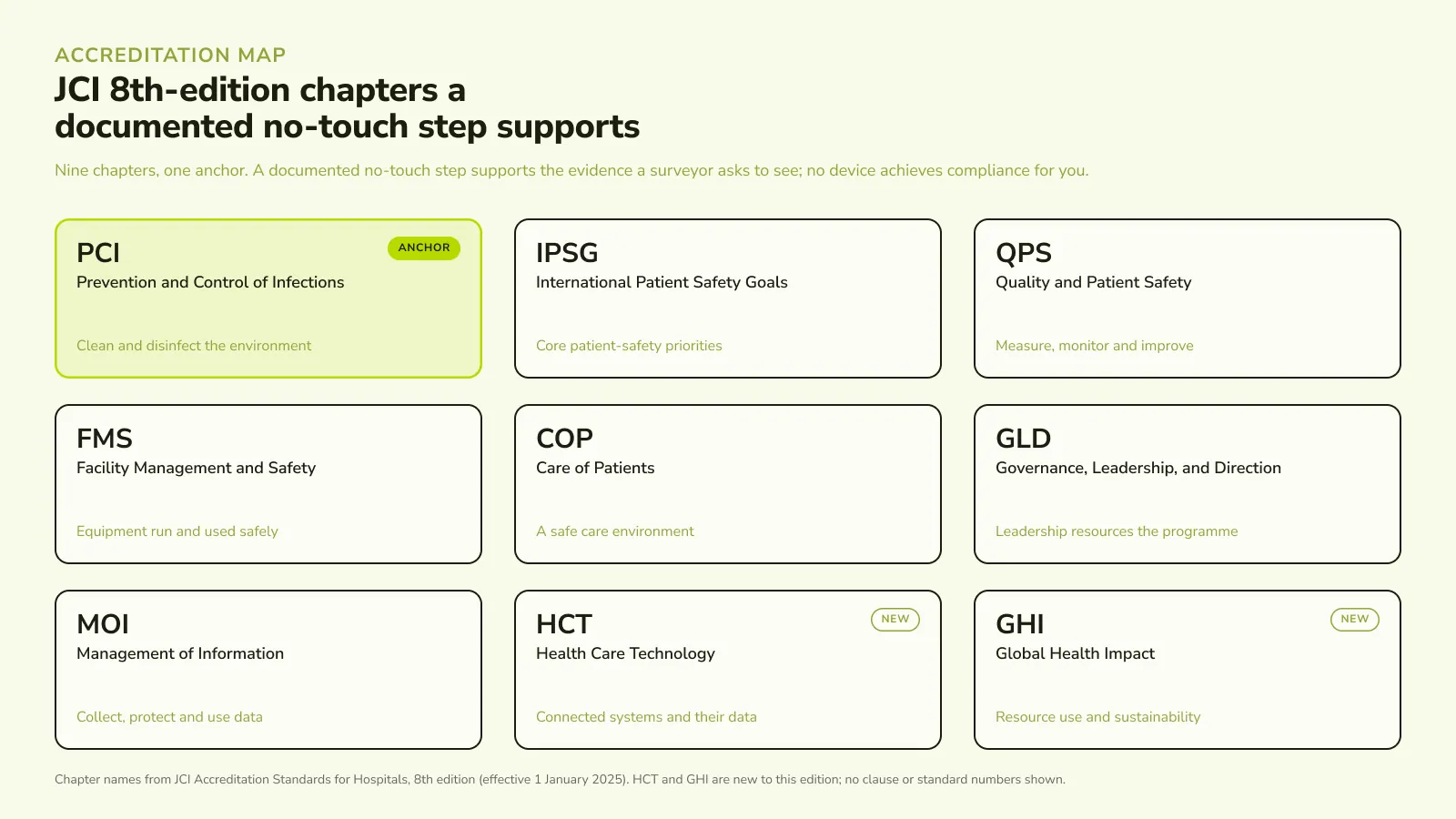
Nine chapters carry an expectation that environmental cleaning and disinfection help satisfy. One is the anchor; the rest touch it from their own angle.
Prevention and Control of Infections, the anchor chapter
Prevention and Control of Infections (PCI) is where environmental hygiene lives most directly. A hospital is expected to run an infection-prevention programme that lowers the risk of transmission, and cleaning and disinfecting the physical environment is a routine part of that programme. The foundational guidance every programme is built on sets the sequence: surfaces are physically cleaned to remove soil, then treated with a disinfectant matched to the organisms of concern, with a sporicidal agent where spore-formers are a risk.4 A no-touch step never changes that sequence. It runs after the manual clean, on the non-critical surfaces a patient room is full of, which is why it is described as low-level, no-touch disinfection and never as "high-level disinfection," a term reserved for semi-critical instruments.5 The terminal clean, the deeper clean between patients, is the moment a UV-C cycle plugs into, and standards already separate that terminal clean from routine daily cleaning and grade surfaces by contamination risk.6
A widely used best-practice framework places no-touch room-decontamination technology inside a five-part bundle, alongside policy, product selection, staff education, and compliance monitoring with feedback, and it is explicit that the technology is an adjunct to manual cleaning, not a replacement for it.7 That distinction matters to a surveyor, because it signals you understand where the tool sits in your programme.
The clinical evidence for that adjunct is real, and representing it accurately is itself an accreditation-friendly posture. In the largest randomised trial of UV-C in hospital rooms, adding a UV-C cycle to standard terminal cleaning was associated with about a 30 percent lower rate of patients acquiring or being infected by four target multidrug-resistant organisms combined, in the room-exposed population (risk ratio 0.70, 95% CI 0.50 to 0.98; published 2017).8 The same trial is equally worth citing for what it did not show: adding UV-C on top of a bleach protocol, already sporicidal, did not further lower Clostridioides difficile infection specifically (risk ratio 1.00, 95% CI 0.57 to 1.75). A 2023 meta-analysis found the same pattern for the infection endpoint, with no significant reduction in C. difficile infection (incidence rate ratio 0.90) but a significant reduction for gram-negative rod infections (incidence rate ratio 0.82).9 The honest reading, which our companion article on what the UV-C evidence really says sets out in full, is a documented adjunct that strengthens a terminal-cleaning programme against several organisms, with an effect on C. difficile infection that is not established. A surveyor trusts the programme that states both halves. That is also why the no-touch pass earns its place most clearly in your highest-risk terminal cleans, the setting we cover in terminal disinfection in high-risk areas.
The patient-safety, care, facility and leadership chapters
Around that anchor, several chapters touch environmental disinfection from their own angle. International Patient Safety Goals (IPSG) sets the hospital's core safety priorities, and lowering avoidable transmission is a patient-safety aim a documented environmental step supports. Care of Patients (COP) expects care to be delivered in a way that keeps patients safe, and the environment that care happens in is part of that. Facility Management and Safety (FMS) is where a disinfection device itself sits, because it is equipment that has to be operated, maintained and used safely, including the ultraviolet-safety controls that keep staff clear of an active cycle. Governance, Leadership, and Direction (GLD) is the chapter your own decision answers to, since leadership is expected to resource the infection-prevention programme and set its quality priorities, and investing in a documented no-touch step is exactly that kind of resourcing decision. That decision is easier to defend when the device itself comes from a documented quality system: the ROZOR Disinfection Robot, for instance, is built under ISO 13485 medical-device quality management and ISO 9001, the kind of documented quality system that supports the accreditation-grade rigor surveyors expect of the equipment a programme brings in.
Across all of them, one expectation recurs: cleaning is not only done, it is documented, monitored and verified. Guidance for perioperative environmental cleaning, for instance, ties cleaning directly to surgical-site-infection prevention and calls for monitoring, competency verification and documentation of the cleaning process as expected practice.10 Three further chapters, Quality and Patient Safety, Management of Information and Health Care Technology, turn on the documentation a no-touch cycle can produce, and the new Global Health Impact chapter turns on the resources it can save. Those four are worth their own sections below.
How does the robot's documentation support the quality and information chapters?
Three chapters share a theme: they ask you to manage what you measure. Quality and Patient Safety (QPS) is the single 8th-edition chapter carrying both quality-improvement and patient-safety content, so despite some coverage describing a "new patient safety chapter," there is no standalone patient-safety chapter to map to.1 It asks you to measure the processes that matter, monitor them, and improve them. Management of Information (MOI) governs how you collect, protect and use data across the hospital. Health Care Technology (HCT), new to this edition, sets expectations around the connected systems the hospital runs and the data they produce.2
Environmental cleaning is one of the processes worth measuring. The recognised CDC toolkit for evaluating environmental cleaning catalogues the monitoring methods hospitals use, from direct observation to fluorescent markers and adenosine-triphosphate testing, and frames monitoring with feedback as a quality-improvement activity rather than a one-off audit.11 The best-practice bundle makes the same point, with compliance monitoring and feedback as one of its five parts.7 Cleaning happens across your hospital every day; capturing it as data a surveyor can review is the harder part.
This is where a no-touch device's own records become useful. A UV-C robot that records its cycle data, for example the room identifier, the cycle time, the delivered dose, a timestamp and the operator, gives your quality and information chapters something concrete to point to: a consistent, machine-generated record of where a validated cycle ran and when. The ROZOR Disinfection Robot delivers that no-touch 254 nm UV-C pass after the manual clean, and our companion article on the disinfection audit trail goes deeper on what a cycle record can contain and how it feeds your monitoring. Handled well, that kind of log supports Quality and Patient Safety by giving you a process you can measure and trend, supports Management of Information as data you collect and protect, and intersects Health Care Technology to the extent it is a connected device producing and storing data. It does not achieve compliance with any of them. It gives you evidence to bring to the survey.
How does reducing chemical reliance support the new sustainability chapter (GHI)?
Global Health Impact (GHI) is the genuinely new one, and it is why environmental sustainability now sits inside an accreditation survey at all. Developed with the International Hospital Federation's Geneva Sustainability Centre, it sets expectations around resource use, waste management, and the responsible use of medical supplies, among others.12 For an infection-prevention lead, that last item is the hook, because chemical disinfectants are a medical supply with a cost, a waste stream and a handling burden.
A no-touch UV-C pass can reduce how much chemical disinfectant a terminal clean relies on, since a consistent second pass over the surfaces the light reaches does some of the work that would otherwise be met by more product, applied more often. It reduces reliance; it does not eliminate it. The manual clean, with its chemistry, stays the foundation, because a light-based step cannot remove soil and only reaches what it illuminates. Framed honestly, a documented no-touch step contributes to the intent behind GHI, a hospital using fewer resources to reach the same infection-prevention result, without pretending to be a sustainability programme on its own.
How does this map to Accreditation Canada, CBAHI and GAHAR?
The pattern is not unique to JCI, which matters if you already operate under more than one framework or expect to. Accreditation Canada's Qmentum Global infection-prevention-and-control standards frame an IPC programme you plan, implement and evaluate, and its routine practices explicitly include cleaning and disinfection of the physical environment.13 In Saudi Arabia, accreditation by the Central Board for Accreditation of Healthcare Institutions (CBAHI) is mandatory, infection prevention is a core component of its essential safety requirements, and accreditation has been associated with measurable improvement in environmental-cleaning compliance.14 In Egypt, the General Authority for Healthcare Accreditation and Regulation (GAHAR) publishes hospital standards with a dedicated infection-prevention chapter that addresses environmental cleaning and disinfection directly, including per-area cleaning and disinfectant use.15
The through-line is the same everywhere. Each framework expects an infection-prevention programme in which environmental cleaning and disinfection are done, documented and monitored. A documented no-touch UV-C step supports that expectation under any of them, for the same reason and with the same limit. It strengthens the environmental-cleaning evidence; it does not stand in for the programme.
What this means for your accreditation preparation
If you are readying a hospital for a survey, the practical map is straightforward. Environmental cleaning and disinfection are not confined to one chapter, so treat them as a thread that runs through your infection-prevention, patient-safety, facility, quality, information and sustainability evidence. Keep the manual clean strong, because it is the foundation every standard is built on and no technology removes soil for it. Add a documented no-touch pass where the risk and the reservoir are highest, typically your terminal cleans in high-acuity and outbreak-relevant spaces. And keep the record, because across every chapter and every framework, the recurring ask is the same: show that cleaning is done, and show how you know.
Represent the evidence for that no-touch step exactly as it stands. In the largest randomised trial it was associated with a lower rate of acquiring several multidrug-resistant organisms, its effect on C. difficile infection specifically was not shown, and its value is as a consistent, documented adjunct to a clean your team still runs by hand. A surveyor, like the infection-prevention lead who has read the trials, trusts the programme that does not overstate. That posture, more than any device, is what turns a stack of activity into accreditation-ready evidence you can defend to your board and your surveyor alike.
See how a documented no-touch UV-C cycle fits your accreditation evidence. The ROZOR Disinfection Robot delivers no-touch UV-C disinfection as an adjunct to your cleaning programme, physical AI for critical environments. Learn more about the ROZOR Disinfection Robot.
Frequently asked questions
Does UV-C disinfection help with JCI accreditation?
It can support it, but no device achieves compliance on its own. Environmental cleaning and disinfection run through several 8th-edition chapters, and a documented no-touch UV-C cycle, applied after manual cleaning, adds consistent, recordable evidence to the infection-prevention programme those chapters expect.
Which JCI 8th-edition chapter covers infection prevention?
Prevention and Control of Infections is the anchor chapter, and it is where cleaning and disinfecting the physical environment sits as a routine part of the programme. Related expectations also appear in the patient-safety, care, facility, leadership, quality, information and sustainability chapters, so environmental disinfection spans several chapters rather than sitting in one.
Is there a standalone patient safety chapter in the JCI 8th edition?
No. Quality and Patient Safety (QPS) is the single chapter carrying both quality-improvement and patient-safety content, so there is no separate patient-safety chapter to map to, even though some summaries describe a 'new patient safety chapter.'
What are the new chapters in the JCI 8th edition?
Two: Health Care Technology (HCT), covering electronic records, telehealth and cybersecurity, and Global Health Impact (GHI), the environmental-sustainability chapter developed with the International Hospital Federation's Geneva Sustainability Centre. Both are new to the edition that took effect on 1 January 2025.
Does no-touch UV-C disinfection reduce infections for accreditation purposes?
The evidence is real but bounded, and it should be presented that way. The largest randomised trial linked adding UV-C to terminal cleaning with about a 30 percent lower rate of acquiring four multidrug-resistant organisms combined (risk ratio 0.70), while the same trial and a 2023 meta-analysis found no significant reduction in C. difficile infection specifically. Treat it as a documented adjunct, not a guaranteed outcome.
Does this apply to Accreditation Canada, CBAHI and GAHAR?
Yes. Accreditation Canada's Qmentum Global standards, Saudi Arabia's CBAHI and Egypt's GAHAR each frame environmental cleaning and disinfection within an infection-prevention programme, so a documented no-touch step supports the same expectation under each.
Sources
- Joint Commission International. "Accreditation Standards for Hospitals, 8th Edition" (official sample pages: Contents and Summary of Changes). Joint Commission Resources; 2024. ISBN 978-1-63585-347-6. https://digitalassets.jointcommission.org/api/public/content/assets/3/7/ebjcih24_sample_pages.pdf
- Joint Commission International. "JCI Publishes 8th Edition of International Accreditation Standards for Hospitals and Academic Medical Centers." Press release, July 2024. https://www.jointcommission.org/en-us/knowledge-library/news/2024-07-jci-publishes-8th-edition-of-international-accreditation-standards
- World Health Organization. "Guidelines on core components of infection prevention and control programmes at the national and acute health care facility level." Geneva: WHO; 2016. https://www.who.int/publications/i/item/9789241549929
- Rutala WA, Weber DJ, and the Healthcare Infection Control Practices Advisory Committee (HICPAC). "Guideline for Disinfection and Sterilization in Healthcare Facilities, 2008" (updated). U.S. Centers for Disease Control and Prevention. https://www.cdc.gov/infection-control/hcp/disinfection-and-sterilization/index.html
- Rutala WA, Weber DJ. "A rational approach to disinfection and sterilization: the Spaulding classification." U.S. Centers for Disease Control and Prevention. https://www.cdc.gov/infection-control/hcp/disinfection-sterilization/rational-approach.html
- Sehulster L, Chinn RYW; CDC and HICPAC. "Guidelines for environmental infection control in health-care facilities." MMWR Recommendations and Reports 2003;52(RR-10):1-42. https://pubmed.ncbi.nlm.nih.gov/12836624/
- Rutala WA, Weber DJ. "Best practices for disinfection of noncritical environmental surfaces and equipment in health care facilities: A bundle approach." American Journal of Infection Control 2019;47(Suppl):A96-A105. https://doi.org/10.1016/j.ajic.2019.01.014
- Anderson DJ, Chen LF, Weber DJ, et al. "Enhanced terminal room disinfection and acquisition and infection caused by multidrug-resistant organisms and Clostridium difficile (the Benefits of Enhanced Terminal Room Disinfection study): a cluster-randomised, multicentre, crossover study." The Lancet 2017;389(10071):805-814. https://pubmed.ncbi.nlm.nih.gov/28104287/
- Sun YL, Wu Q, Liu J, Wang Q. "Effectiveness of ultraviolet-C disinfection systems for reduction of multi-drug resistant organism infections: a systematic review and meta-analysis." Epidemiology and Infection 2023;151:e149. https://pmc.ncbi.nlm.nih.gov/articles/PMC10540170/
- Link T. "Guidelines in Practice: Environmental Cleaning." AORN Journal 2021;113(5):487-499. https://pubmed.ncbi.nlm.nih.gov/33929738/
- Guh A, Carling P; CDC Environmental Evaluation Workgroup. "Options for Evaluating Environmental Cleaning." Atlanta: U.S. Centers for Disease Control and Prevention; December 2010. https://www.cdc.gov/infection-control/php/evaluating-environmental-cleaning/index.html
- AFYA Medical Information. "The New Global Health Impact (GHI) Standard in JCI 8th Edition." 2024. https://www.afyami.com/en/post/the-new-global-health-impact-ghi-standard-in-jci-8th-edition
- Accreditation Canada. "Infection Prevention and Control Standards" (Qmentum Global). https://accreditation.ca/standards/
- Almutairi AF, Alsaiari SR, Alsaqri AS, et al. "An Overview of the Central Board for the Accreditation of Healthcare Institutions in Saudi Arabia: A Narrative Review." Cureus 2025. https://pmc.ncbi.nlm.nih.gov/articles/PMC12635948/
- General Authority for Healthcare Accreditation and Regulation (GAHAR). "Handbook for Hospital Standards" (Edition 2021). Egypt. https://www.gahar.gov.eg/upload/gahar-handbook-for-hospital-standards-edition-2021-secured--1.pdf