UV-C disinfection evidence splits into two questions. On surfaces, the answer is well documented: a 254 nm cycle cuts recoverable bacteria and spores by measured logs wherever its light reaches. On infections the benefit is real but conditional, strongest for several multidrug-resistant organisms combined, unproven for C. difficile alone, and always an adjunct after manual cleaning.
If you are weighing a UV-C system for your programme, you have probably hit the same problem: two vendors quote two very different numbers, and both say they are citing the evidence. The stakes are real, since roughly 7 of every 100 patients in high-income care acquire at least one hospital-acquired infection,1 and the marketing around UV-C often runs ahead of the literature. This article is the honest read: it separates what the studies firmly establish from what they only suggest, so you can appraise any UV-C claim, ours included, on its merits.
Does UV-C disinfection actually reduce infections?
The honest answer begins by splitting the question, because "does UV-C work" is really two questions the literature answers very differently.
The first is a surface question: after a cycle, how much less recoverable contamination is left on the surfaces the light reached? That is measured in log reductions of colony-forming units, and it turns on the physics of the light reaching the target, which our hub on how UV-C disinfection works covers. The second is a clinical question: do patients in those rooms go on to acquire fewer infections? That is measured in rate ratios between groups, and it turns on trial design.
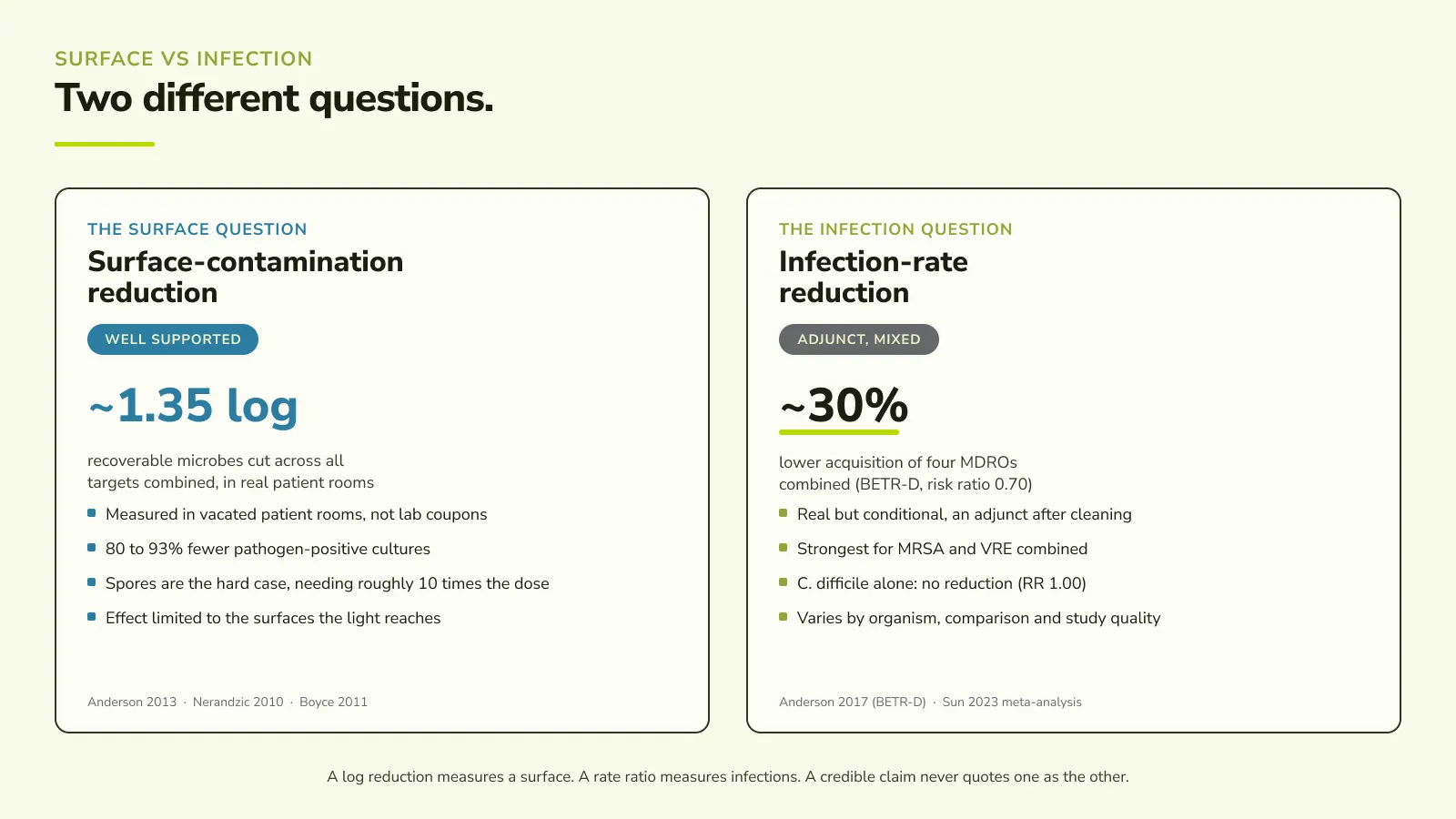
The most common way UV-C is oversold is to quote a surface number as though it settled the clinical one. Keep the two apart and the picture is clear: the surface answer is a well-documented yes, the infection answer a conditional yes that depends on the organism, the comparison and the study's quality.
How strong is the evidence that UV-C reduces surface contamination?
This is the strongest claim UV-C can make, and it has been measured in real patient rooms, not just laboratory coupons: a 254 nm cycle run in a vacated room measurably lowers the recoverable microbial load on the surfaces its light reaches.
In those rooms, an automated 254 nm device reduced surface bioburden by at least a log (about 1.68 log for VRE, 1.16 for C. difficile, 1.35 for all targets combined), holding above a log on both directly and indirectly exposed surfaces.2 A whole-room study cut the share of pathogen-positive cultures in clinical rooms by 80 to 93 percent.3 Pooled carrier tests show the geometry behind this: about 4.71 log for MRSA on directly exposed carriers against 4.27 log on shadowed ones, and 3.41 against 2.01 log for C. difficile spores.4 Each log is a tenfold cut (a 2 log reduction removes 99 percent), explained in what log reduction means.
Those numbers carry the central caveat, and it points at how the technology should be used. UV-C only disinfects what its light reaches, and the dose a surface needs rises with the organism: bacterial spores take 5 to 10 times the exposure of the vegetative cells they come from,5 and C. difficile spores in particular needed about 10 times longer than vegetative MRSA or VRE for a comparable 3 log reduction, depending on direct line of sight.6 Since the delivered dose is irradiance multiplied by time, distance and shadowing change how much a surface receives,7 so the rule is about geometry: a surface the light reaches directly, for long enough, gets a large, reproducible reduction, while a shadowed one gets less, and emitter position and cycle length decide the outcome far more than lamp power. The organisms that persist longest on surfaces, MRSA among them, are what a geometry-aware pass catches (MRSA on hospital surfaces).
What do the clinical trials show about infections?
The harder endpoint is the one a purchaser ultimately cares about: does that surface reduction translate into fewer infections? The evidence here is real but more limited, and best read with its qualifications.
The strongest single piece is the BETR-D trial, the largest cluster-randomised study of UV-C in hospital rooms. Among patients later admitted to a room whose prior occupant had carried one of four target organisms (MRSA, VRE, multidrug-resistant Acinetobacter or C. difficile), the arm that added UV-C to standard quaternary ammonium cleaning had about a 30 percent lower rate of acquiring or being infected by those four organisms combined (risk ratio 0.70, 95% CI 0.50 to 0.98, published 2017).8 The same trial also asked a harder question and answered it honestly: adding UV-C on top of a bleach protocol did not further lower C. difficile infection specifically, a null stratum (risk ratio 1.00, 95% CI 0.57 to 1.75, p=0.997). The 30 percent is a combined-organism result in the room-exposed population, driven by the more UV-susceptible MRSA and VRE, and the trial does not license a per-organism figure. Stating the null as plainly as the headline is what earns the headline its credibility.
A hospital-wide secondary analysis of the same trial shows how population-dependent this is: across the whole hospital the overall reduction shrank to non-significant (risk ratio 0.89, p=0.052), carried by C. difficile and VRE while MRSA showed none (risk ratio 1.08), a different population that must never be blended with the primary result.9
Broader syntheses agree. The most current C. difficile-specific meta-analysis found no significant infection reduction for C. difficile (incidence rate ratio 0.90, 95% CI 0.62 to 1.32) or VRE (0.72), and a significant reduction only for gram-negative rods (0.82, 95% CI 0.68 to 0.99).10 A focused review of no-touch trials explains why the field can look stronger than it is: most report reduced colonisation or infection in the next occupant, but most use before-and-after designs that cannot rule out other simultaneous changes.11 The most recent systematic review, covering 25 studies through mid-2023, finds UV disinfection lowers healthcare-associated infections with an effect that varies by setting and pathogen and is most convincing as an adjunct to cleaning.12
What about C. difficile specifically?
C. difficile earns its own section, because it is where the surface-versus-infection distinction matters most.
On surfaces, UV-C's effect on C. difficile is well established. Across 25 real discharged patient rooms, an automated mobile UV-C cycle cut recoverable C. difficile spores on high-touch surfaces by a mean of 1.8 to 2.9 log, depending on direct line of sight.13 That is roughly a 98 to 99.9 percent reduction in recoverable spores on the surfaces it reaches, added to what the manual clean removed.
On infection, a C. difficile-specific benefit has not been demonstrated, and the reason is more favourable to UV-C than it first looks. The BETR-D C. difficile stratum compared bleach plus UV-C against bleach alone.8 Bleach is already sporicidal, the strongest routine option against C. difficile spores, so the null does not mean UV-C failed against it. It means adding UV-C to an already-sporicidal clean produced no further drop in C. difficile infection, a much narrower statement. The pooled evidence agrees that no C. difficile infection reduction has been shown,10 and an earlier, smaller pooled analysis that did report a drop mixed UV with hydrogen-peroxide vapour, leaned on before-after studies, and has not been confirmed by the larger, more recent evidence,14 so it should not be quoted on its own. The guideline bodies agree: the 2017 IDSA and SHEA guidance found "limited data" to recommend automated terminal disinfection for C. difficile prevention,15 and the 2022 multi-society compendium lists it among the unresolved issues, with insufficient evidence to recommend for or against it.16 The consistent reading: use UV-C to drive down the C. difficile spore reservoir a manual clean leaves on reachable surfaces, and do not promise a C. difficile infection reduction the trials have not shown, as C. difficile and environmental disinfection develops.
Why do some UV-C infection claims look too good to be true?
If you have seen a UV-C system advertised as cutting infections by 50, 60 or 70 percent, this is why that figure deserves care. The largest headline percentages almost always come from a different technology than continuous 254 nm UV-C, tested with a weaker design.
Most come from pulsed-xenon devices, which emit a broad-spectrum flash rather than continuous 254 nm light. A pooled analysis of them reported roughly a 27 percent drop in C. difficile infection and a 21 percent drop in MRSA, but every study used a before-and-after design, the authors deliberately excluded continuous 254 nm systems, and the C. difficile and MRSA results were unstable on sensitivity analysis.17 The often-quoted "up to 70 percent" figure for C. difficile is a single best-case pulsed-xenon result, which is why the systematic reviews decline to headline it.12 Two problems compound: a pulsed-xenon result does not transfer to a 254 nm device, because the wavelength, delivery and dose differ, and a before-and-after study credits the device with every other change happening at the same time, which is why the reviews flag these numbers as low-certainty.11 The device technology you are evaluating is a real efficacy variable, not a marketing detail, a point we set out in not all UV-C devices are equal.
So where does UV-C actually fit?
The evidence supports a specific, defensible role, and the guideline literature describes it consistently: UV-C is a no-touch adjunct that runs after manual cleaning, never a replacement for it.
The clearest framing is the best-practice bundle for environmental surfaces, which names five components: a clear policy, product selection, staff education, compliance monitoring with feedback, and no-touch room decontamination as an adjunct to manual cleaning.18 The agencies use the same word. The CDC's Candida auris guidance calls no-touch devices such as germicidal UV a supplement to standard cleaning and disinfection,19 and the WHO frames any single intervention as one part of a multimodal IPC programme rather than a substitute for one.20 The reason is physical as much as regulatory: UV-C cannot lift soil and reaches only what its light touches, so it needs a sound manual clean to remove the organic load first. A surface that looks clean can still hold a viable reservoir after a routine wipe, the gap a second pass is designed to close and the subject of visual cleanliness versus disinfection.
Read this way, the surface and infection evidence reinforce each other. That is what a device such as the ROZOR Disinfection Robot is built for: a mobile 254 nm UV-C cycle run in the vacated room after your team has finished the manual clean, positioned to reach the high-touch surfaces that carry the most risk. That device's own efficacy is separately validated to BS 8628:2022, a recognized quantitative test method for automated UV-C disinfection, which is distinct from the published literature this article reviews.
What this means when you appraise a vendor's evidence
You now have the frame to read any UV-C claim, ours included. A few questions separate a defensible claim from a marketing one.
First, ask which endpoint the number describes: a log reduction is a surface measurement and says nothing on its own about infections, while a rate ratio depends entirely on the trial behind it. Second, ask about the device and design: a figure from a pulsed-xenon device or before-and-after study does not predict what a continuous 254 nm system will do in a controlled comparison. Third, ask what dose reached the target surface, since the delivered dose is the master variable and different organisms need different fluence for the same reduction;21 a vendor should state the dose at a given distance, not just the lamp's raw output. Fourth, hold the claim to the standard the field uses: surfaces are cleaned first, then disinfected with a method matched to the organism, and no-touch UV-C is the adjunct that follows.22
For a leadership or procurement reader, this rigour is not academic: an evidence claim you can defend to a skeptical IPC colleague also holds up to a board weighing the capital and a surveyor asking how your environmental programme is monitored, which we take up in UV-C disinfection and JCI accreditation. The strongest position a UV-C claim can hold is the honest one: strong on surfaces, conditional on infections, always a documented adjunct to a sound manual clean. That position survives scrutiny, and this decision deserves it.
See how the ROZOR Disinfection Robot fits your prevention bundle. The ROZOR Disinfection Robot delivers no-touch UV-C disinfection as an adjunct to your cleaning programme, physical AI for critical environments. Learn more about the ROZOR Disinfection Robot.
Frequently asked questions
Does UV-C disinfection reduce infections?
It can, conditionally. The largest randomised trial, BETR-D, found that adding UV-C to terminal cleaning lowered acquisition of four multidrug-resistant organisms combined by about 30 percent (risk ratio 0.70, 95% CI 0.50 to 0.98). The benefit varies by organism and study design and is best described as an adjunct effect, strongest for several MDROs together and unproven for C. difficile alone: the trial's own C. difficile stratum showed no reduction (risk ratio 1.00, 95% CI 0.57 to 1.75), and the pooled evidence agrees.
Is UV-C disinfection effective at reducing surface contamination?
Yes, and this is its best-supported claim. In real patient rooms a 254 nm cycle reduced surface bioburden by at least a log, about 1.35 log across all targets combined, and whole-room studies report 2 to 3 log reductions of spores and MRSA with 80 to 93 percent fewer pathogen-positive cultures, on the surfaces the light reaches.
Does UV-C reduce C. difficile?
On surfaces, yes: UV-C cut recoverable C. difficile spores on high-touch surfaces by 1.8 to 2.9 log across 25 discharged rooms. On infection, a C. difficile-specific reduction has not been demonstrated, because the largest trial added UV-C on top of an already-sporicidal bleach clean and saw no further drop, and the pooled evidence agrees.
Are the "UV-C cuts infections by up to 70 percent" claims true?
Treat them with care. The largest percentages generally come from pulsed-xenon devices, not continuous 254 nm UV-C, and from before-and-after studies that cannot exclude other simultaneous changes. The "up to 70 percent" figure is a single best-case pulsed-xenon result that systematic reviews decline to headline.
Is UV-C disinfection a replacement for manual cleaning?
No. Guideline bodies describe no-touch UV-C as a supplement or adjunct that runs after manual cleaning, never in place of it, because UV-C cannot lift soil and only treats surfaces its light reaches. The WHO frames any single intervention as one part of a multimodal IPC programme.
What evidence should I ask a UV-C vendor for?
Ask which endpoint each number describes, a surface log reduction or an infection rate ratio, what dose the cycle delivers at a stated distance, and whether any infection figure comes from a continuous 254 nm device in a controlled study rather than a pulsed-xenon or before-and-after one. Surfaces are cleaned first, then disinfected; UV-C is the adjunct that follows.
Sources
- World Health Organization. "Global report on infection prevention and control." Geneva: WHO; 2022. https://www.who.int/publications/i/item/9789240051164
- Anderson DJ, Gergen MF, Smathers E, et al. "Decontamination of targeted pathogens from patient rooms using an automated ultraviolet-C-emitting device." Infection Control & Hospital Epidemiology 2013;34(5):466-471. https://pmc.ncbi.nlm.nih.gov/articles/PMC3703853/
- Nerandzic MM, Cadnum JL, Pultz MJ, Donskey CJ. "Evaluation of an automated ultraviolet radiation device for decontamination of Clostridium difficile and other healthcare-associated pathogens in hospital rooms." BMC Infectious Diseases 2010;10:197. https://pmc.ncbi.nlm.nih.gov/articles/PMC2910020/
- Weber DJ, Rutala WA, Anderson DJ, Sickbert-Bennett EE, Kanamori H. "Effectiveness of ultraviolet devices and hydrogen peroxide systems for terminal room decontamination: Focus on clinical trials." American Journal of Infection Control 2016;44(5 Suppl):e77-e84. https://pubmed.ncbi.nlm.nih.gov/27131140/
- Coohill TP, Sagripanti JL. "Overview of the inactivation by 254 nm ultraviolet radiation of bacteria with particular relevance to biodefense." Photochemistry and Photobiology 2008;84(5):1084-1090. https://pubmed.ncbi.nlm.nih.gov/18627518/
- Rutala WA, Gergen MF, Weber DJ. "Room decontamination with UV radiation." Infection Control & Hospital Epidemiology 2010;31(10):1025-1029. https://pubmed.ncbi.nlm.nih.gov/20804377/
- Boyce JM, Donskey CJ. "Understanding ultraviolet light surface decontamination in hospital rooms: A primer." Infection Control & Hospital Epidemiology 2019;40(9):1030-1035. https://pubmed.ncbi.nlm.nih.gov/31210119/
- Anderson DJ, Chen LF, Weber DJ, et al. "Enhanced terminal room disinfection and acquisition and infection caused by multidrug-resistant organisms and Clostridium difficile (the Benefits of Enhanced Terminal Room Disinfection study): a cluster-randomised, multicentre, crossover study." The Lancet 2017;389(10071):805-814. https://pubmed.ncbi.nlm.nih.gov/28104287/
- Anderson DJ, Moehring RW, Weber DJ, et al. "Effectiveness of targeted enhanced terminal room disinfection on hospital-wide acquisition and infection with multidrug-resistant organisms and Clostridium difficile: a secondary analysis of a multicentre cluster randomised controlled trial with crossover design (BETR Disinfection)." The Lancet Infectious Diseases 2018;18(8):845-853. https://pmc.ncbi.nlm.nih.gov/articles/PMC6487496/
- Sun YL, Wu Q, Liu J, Wang Q. "Effectiveness of ultraviolet-C disinfection systems for reduction of multi-drug resistant organism infections in healthcare settings: a systematic review and meta-analysis." Epidemiology & Infection 2023;151:e149. https://pmc.ncbi.nlm.nih.gov/articles/PMC10540170/
- Weber DJ, Rutala WA, Anderson DJ, Sickbert-Bennett EE. "'No touch' methods for health care room disinfection: Focus on clinical trials." American Journal of Infection Control 2023;51(11S):A134-A144. https://pubmed.ncbi.nlm.nih.gov/37890944/
- Maugeri A, Casini B, et al. "Impact of ultraviolet light disinfection on reducing healthcare-associated infections: a systematic review." Journal of Hospital Infection 2025;159:32-41. https://pubmed.ncbi.nlm.nih.gov/39924116/
- Boyce JM, Havill NL, Moore BA. "Terminal decontamination of patient rooms using an automated mobile UV light unit." Infection Control & Hospital Epidemiology 2011;32(8):737-742. https://pubmed.ncbi.nlm.nih.gov/21768755/
- Marra AR, Schweizer ML, Edmond MB. "No-touch disinfection methods to decrease multidrug-resistant organism infections: a systematic review and meta-analysis." Infection Control & Hospital Epidemiology 2018;39(1):20-31. https://pubmed.ncbi.nlm.nih.gov/29144223/
- McDonald LC, Gerding DN, Johnson S, et al. "Clinical Practice Guidelines for Clostridium difficile Infection in Adults and Children: 2017 Update by the Infectious Diseases Society of America (IDSA) and Society for Healthcare Epidemiology of America (SHEA)." Clinical Infectious Diseases 2018;66(7):e1-e48. https://academic.oup.com/cid/article/66/7/e1/4855916
- Kociolek LK, Gerding DN, Carrico R, et al. "Strategies to prevent Clostridioides difficile infections in acute-care hospitals: 2022 Update." Infection Control & Hospital Epidemiology 2023;44(4):527-549. https://pubmed.ncbi.nlm.nih.gov/37042243/
- Dong Z, Zhou N, Liu G, Zhao L. "Role of pulsed-xenon ultraviolet light in reducing healthcare-associated infections: a systematic review and meta-analysis." Epidemiology & Infection 2020;148:e165. https://pmc.ncbi.nlm.nih.gov/articles/PMC7424602/
- Rutala WA, Weber DJ. "Best practices for disinfection of noncritical environmental surfaces and equipment in health care facilities: A bundle approach." American Journal of Infection Control 2019;47(Suppl):A96-A105. https://doi.org/10.1016/j.ajic.2019.01.014
- U.S. Centers for Disease Control and Prevention. "Infection Prevention and Control for Candida auris." https://www.cdc.gov/candida-auris/hcp/infection-control/index.html
- World Health Organization. "Guidelines on core components of infection prevention and control programmes at the national and acute health care facility level." Geneva: WHO; 2016. https://www.who.int/publications/i/item/9789241549929
- Masjoudi M, Mohseni M, Bolton JR. "Sensitivity of Bacteria, Protozoa, Viruses, and Other Microorganisms to Ultraviolet Radiation." Journal of Research of the National Institute of Standards and Technology 2021;126:126021. https://pmc.ncbi.nlm.nih.gov/articles/PMC11259122/
- Rutala WA, Weber DJ, and the Healthcare Infection Control Practices Advisory Committee (HICPAC). "Guideline for Disinfection and Sterilization in Healthcare Facilities, 2008" (updated). U.S. Centers for Disease Control and Prevention. https://www.cdc.gov/infection-control/hcp/disinfection-and-sterilization/index.html