Terminal disinfection in high-risk areas is the thorough clean and disinfection done between patients, in the places where a missed pathogen costs the most: intensive care, operating rooms, isolation rooms, and the units caring for immunocompromised patients. Not every room carries the same risk, so stratify your effort by area, and add a no-touch adjunct where the stakes are highest.
You can terminally clean every room in the building to the same standard and still put your effort in the wrong place. The rooms are not equal. A missed spore on a bed rail means one thing in a storeroom and something very different in an ICU bay whose next occupant is ventilated and immunosuppressed. When you decide where terminal disinfection in high-risk areas gets the most attention, you are really deciding where a missed pathogen would do the most harm, and the evidence lets you make that call deliberately rather than by habit. This guide walks through what terminal cleaning is, why stratifying by risk is standard practice, which areas earn the most rigour, the gap that runs through all of them, and where a no-touch adjunct such as UV-C fits. It sits under our overview of hospital-acquired infections.
Terminal cleaning, daily cleaning, and what Spaulding actually says
Terminal cleaning is the thorough clean and disinfection performed when a patient is discharged or transferred, and it is a different job from the daily cleaning done around an occupied bed. National guidance has separated the two for decades and classifies surfaces by their contamination risk, precisely so that the discharge clean and the routine wipe-down are held to different standards.1
It helps to be exact about what "disinfection" means here, because one term gets misused constantly. Spaulding's classification sorts every item by the risk it poses: critical items that enter sterile tissue must be sterile, semi-critical items that touch mucous membranes require high-level disinfection, and non-critical items such as bed rails and blood-pressure cuffs require only low-level disinfection.2 A patient room is a collection of non-critical surfaces. That is why you will never hear a careful infection preventionist call a room process, or UV-C, "high-level disinfection." The phrase is a term of art reserved for semi-critical instruments, and applying it to a room or a light source is a category error, not a compliment.
What terminal cleaning actually requires is the standing hierarchy: a surface is physically cleaned to remove organic soil, then treated with an EPA-registered disinfectant matched to the organism, and spore-formers such as Clostridioides difficile need a sporicidal agent that ordinary low- and intermediate-level disinfectants do not reliably inactivate.3 Everything below assumes that sequence is being done. The question this article answers is where it has to be done most rigorously.
Why risk stratification is standard practice, not a shortcut
Concentrating effort where risk is highest is not a way of doing less. It is how the standards themselves are written. NHS England's National Standards of Healthcare Cleanliness 2025 set out a six-tier functional-risk framework, from FR1 down to FR6, that assigns cleaning frequency and audit targets by the clinical risk of the area, so intensive-care spaces are cleaned and audited far more often than a low-risk storeroom.4 Stratification is the discipline, not the corner cut. When you weight your terminal-disinfection programme toward the highest-risk areas, you are following the same logic a national standard uses to set audit frequency.
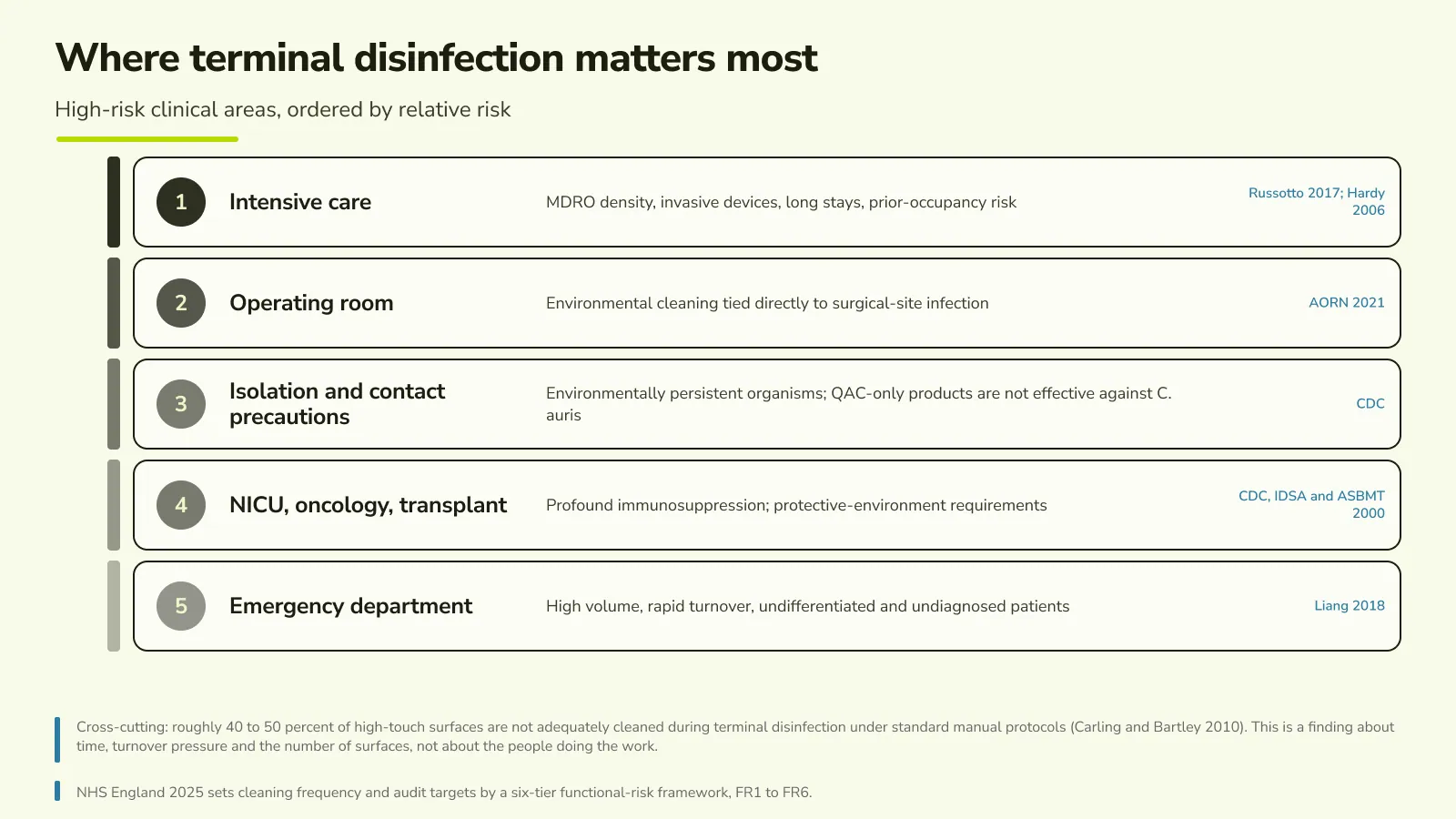
The high-risk areas, one at a time
Across all of these areas the mechanism is the same. Touching a contaminated surface is about as likely to transfer an organism to a healthcare worker's hands or gloves as touching the patient, and admission to a room whose prior occupant carried an organism raises the next occupant's acquisition risk.5 The pooled version of that prior-occupant effect, across a systematic review and meta-analysis, is an acquisition odds ratio of 2.14 (95% CI 1.65 to 2.77).6 An earlier single-centre study put the adjusted odds ratio at 1.4 for both MRSA (P = .04) and VRE (P = .02), and the same authors were careful to note that this route was a minor contributor to overall transmission, around 5.1% of incident MRSA.7 The effect is real and worth acting on, and it is not the whole story. What follows is where it matters most.
Intensive care
The ICU concentrates the risk. Its inanimate surfaces and equipment are frequently contaminated with multidrug-resistant organisms, and prior occupancy by an MDRO-positive patient is a recognised risk factor for the next patient in the bay.8 A 14-month prospective ICU study linked bedside environmental MRSA contamination to patients acquiring MRSA, and showed that conventional cleaning did not eliminate the reservoir.9 The bedside zone is where to look first: the earliest quantitative ranking of hospital surfaces by how often staff touch them identified bed rails and the bedside as the highest-touch surfaces in the room.10 For more on why MRSA in particular persists on those surfaces, see our article on MRSA on surfaces.
Operating rooms
The operating room is judged by a different endpoint: surgical-site infection. AORN's perioperative guideline ties operating-room environmental cleaning, from the agents used through the procedures, competency and monitoring, directly to preventing surgical-site infection.11 Terminal cleaning between cases and at the end of the day is part of that chain, and the OR is one place where the audit and the clinical outcome are tightly coupled.
Isolation and contact-precaution rooms
Rooms holding patients on contact precautions are high-risk by definition, because the organism that put them there is one that spreads through the environment. Candida auris is the sharpest example. It persists on surfaces for weeks to months, resists products that rely solely on quaternary ammonium compounds, and has been cultured from both high-touch surfaces such as bed rails and low-touch ones such as windowsills. The CDC is explicit that no-touch devices, including germicidal UV, should be used only as a supplement to standard cleaning and disinfection, never on their own.12 C. difficile isolation rooms carry the same reservoir logic: patients admitted to a room whose immediately prior occupant had CDI acquired it more often, and after adjustment the prior occupant's CDI status remained an independent predictor, with an adjusted hazard ratio of 2.35.13 Our companion articles on C. difficile environmental disinfection and Candida auris disinfection go deeper on each.
The NICU, oncology, and transplant units
Here the stakes are set by the patient, not the pathogen. Neonatal, oncology and transplant recipients live with profound immunosuppression, and long-standing protective-environment guidance for hematopoietic stem cell transplant recipients built surface and equipment hygiene into their care for exactly that reason.14 Treat that guidance as the rationale for rigour in these units, not as a current ventilation-engineering specification. An organism a healthier patient would clear can become an invasive infection here, so the margin for a missed surface is smaller than anywhere else in the hospital.
The emergency department
The emergency department is high-risk for reasons of flow rather than acuity. It runs on high patient volume, rapid room turnover and a stream of undifferentiated, undiagnosed patients, and that combination makes its environmental cleaning uniquely challenged.15 You often will not know what a patient was carrying until after the room has turned over twice, which is precisely the condition under which terminal disinfection is hardest to do well.
The gap that runs through every one of these areas
There is one finding that spans all of the above, and it is uncomfortable but well-established. Across 23 acute-care hospitals, the mean thoroughness of terminal cleaning of standardised high-touch surfaces was 49%, with a range from 35% to 81%.16 A separate study across 36 hospitals found that at baseline only 48% of high-touch surfaces, 9,910 of 20,646, were adequately cleaned at terminal cleaning; structured feedback raised that to 77%, but that improved figure required intensive, sustained feedback and is not what routine practice looks like.17 A synthesis of this body of work puts the routine figure at roughly 40% to 50% of high-touch surfaces not adequately cleaned during terminal disinfection under standard manual protocols.18
Read that correctly. It is not a verdict on the people doing the work. It is a finding about time, turnover pressure and the sheer number of surfaces a terminal clean has to cover, under conditions that leave almost no room for a missed spot. A person cleaning a discharge room against the clock, with the next admission already waiting, is being asked to hit every high-touch surface for the full contact time every time, and the data simply show how hard that is to sustain by hand. The gap is structural. That is exactly the kind of consistency problem a second, automated pass is suited to close.
Where a no-touch adjunct earns its place first
Start from the clinical risk, then decide where to add a layer. The strongest clinical evidence for no-touch UV-C is the BETR-D trial, which found that in the room-exposed population, adding UV-C to standard quaternary-ammonium terminal cleaning was associated with a relative risk of 0.70 (95% CI 0.50 to 0.98, p = 0.036) for acquiring any of four target organisms combined, driven mainly by MRSA and VRE. In the same trial, adding UV to bleach for C. difficile changed nothing: the C. difficile stratum was null, a relative risk of 1.00 (95% CI 0.57 to 1.75, p = 0.997).19 That is the honest shape of the evidence, and it should shape where you deploy. A no-touch device is one component of a disinfection bundle, alongside policy, product selection, education and monitoring, not a replacement for any of them.20 The literature reviewing these methods says as much about itself: most, though not all, clinical trials report reduced colonisation or infection in later room occupants, but most of those trials use weak before-after designs, which the authors themselves flag.21 Any single intervention, no-touch disinfection included, is one part of a multimodal IPC programme and never a substitute for it.22
This is where the deployment decision gets practical: you almost never roll a no-touch adjunct out everywhere at once, so the question is where it goes first. Sequence it by the risk map above. The rooms where a missed pathogen costs the most, and where the manual cleaning gap is hardest to close under turnover pressure, are the ICU, isolation and contact-precaution rooms, the protective-environment units, and the OR and ED terminal cleans. Those are where a documented, repeatable second pass buys the most risk reduction per cycle, and where an auditable per-room record is worth the most when the standard asks you to prove it. The operational efficiency is real, but it follows the clinical case rather than leading it.
The ROZOR Disinfection Robot is built for exactly that role: a no-touch 254 nm UV-C pass run in a vacated room after the manual clean, delivering a consistent, documented dose to the surfaces in its line of sight. Its limits are the honest ones for any UV-C source, because the light travels in straight lines and shadowed surfaces are under-dosed, which is why room geometry decides what actually gets treated, as our article on UV-C shadowing explains. It closes the consistency gap on the surfaces it can reach; it does not remove the manual clean that has to come first.
Accreditation and documentation
There is an accreditation dimension to all of this. The Prevention and Control of Infections (PCI) and Facility Management and Safety (FMS) chapters of Joint Commission International's 8th-edition hospital standards address environmental infection control and facility safety.23 A risk-stratified terminal-disinfection programme, with a record of what was done in each high-risk area and when, is easier to defend against that kind of standard than a flat "we clean every room the same." The documentation is not paperwork for its own sake. It is the evidence that your effort actually landed where your risk assessment said it should.
See how the ROZOR Disinfection Robot fits your terminal-disinfection programme. It delivers no-touch UV-C disinfection as an adjunct to your cleaning programme, physical AI for critical environments. Learn more about the ROZOR Disinfection Robot.
Frequently asked questions
What is terminal disinfection, and how is it different from daily cleaning?
Terminal disinfection is the thorough clean and disinfection performed when a patient is discharged or transferred, holding the room to a higher standard than the daily cleaning done around an occupied bed. National guidance has separated the two for decades and classifies surfaces by contamination risk so each is held to its own standard.
Which hospital areas are considered high-risk for terminal disinfection?
The consistently high-risk areas are the ICU, operating rooms, isolation and contact-precaution rooms, the NICU, oncology and transplant units, and the emergency department. Each is high-risk for a different reason: environmental MDRO reservoirs in the ICU, surgical-site infection in the OR, environmentally spread organisms in isolation rooms, profound immunosuppression in protective-environment units, and volume and turnover in the ED.
Why not just terminally disinfect every room the same way?
Because the standards themselves stratify by risk. NHS England's 2025 cleanliness standards use a six-tier functional-risk framework that sets cleaning frequency and audit targets by area risk, so intensive-care spaces are cleaned and audited far more often than low-risk rooms. Weighting effort toward the highest-risk areas is standard practice, not a shortcut.
Does UV-C count as high-level disinfection?
No. "High-level disinfection" is a term of art in Spaulding's classification reserved for semi-critical instruments that touch mucous membranes. A room is made up of non-critical surfaces, and UV-C is a no-touch adjunct applied after manual cleaning, not a high-level disinfection process.
Where should a no-touch adjunct be deployed first?
Sequence it by clinical risk. The ICU, isolation and contact-precaution rooms, protective-environment units, and OR and ED terminal cleans are where a missed pathogen costs the most and where the manual cleaning gap is hardest to close under turnover pressure, so a documented second pass buys the most risk reduction there. It is one component of a disinfection bundle, added on top of manual cleaning, never a replacement for it.
Does UV-C reduce C. difficile infection?
The evidence does not support that claim. In the BETR-D trial, adding UV to bleach for C. difficile rooms produced a null result, a relative risk of 1.00 (95% CI 0.57 to 1.75, p = 0.997). The trial's roughly 30% reduction was for four organisms combined in the room-exposed population, driven mainly by MRSA and VRE, not for C. difficile.
Sources
- Sehulster L., Chinn R.Y.W.; CDC/HICPAC. "Guidelines for environmental infection control in health-care facilities." MMWR Recommendations and Reports, 2003; 52(RR-10):1-42. PMID 12836624. https://pubmed.ncbi.nlm.nih.gov/12836624/
- Rutala W.A., Weber D.J. "A rational approach to disinfection and sterilization" (Spaulding classification). U.S. Centers for Disease Control and Prevention. https://www.cdc.gov/infection-control/hcp/disinfection-sterilization/rational-approach.html
- Rutala W.A., Weber D.J., and the Healthcare Infection Control Practices Advisory Committee (HICPAC). "Guideline for disinfection and sterilization in healthcare facilities, 2008" (updated). U.S. Centers for Disease Control and Prevention. https://www.cdc.gov/infection-control/hcp/disinfection-and-sterilization/index.html
- NHS England. "National standards of healthcare cleanliness 2025." Published 5 February 2025. https://www.england.nhs.uk/long-read/national-standards-of-healthcare-cleanliness-2025/
- Weber D.J., Rutala W.A., Miller M.B., Huslage K., Sickbert-Bennett E. "Understanding and preventing transmission of healthcare-associated pathogens due to the contaminated hospital environment." Infection Control & Hospital Epidemiology, 2013; 34(5):449-452. PMID 23571359. https://pubmed.ncbi.nlm.nih.gov/23571359/
- Mitchell B.G., Dancer S.J., Anderson M., Dehn E. "Risk of organism acquisition from prior room occupants: a systematic review and meta-analysis." Journal of Hospital Infection, 2015; 91(3):211-217. PMID 26365827. https://pubmed.ncbi.nlm.nih.gov/26365827/
- Huang S.S., Datta R., Platt R. "Risk of acquiring antibiotic-resistant bacteria from prior room occupants." Archives of Internal Medicine, 2006; 166(18):1945-1951. PMID 17030826. https://pubmed.ncbi.nlm.nih.gov/17030826/
- Russotto V., Cortegiani A., Fasciana T., et al. "What healthcare workers should know about environmental bacterial contamination in the intensive care unit." BioMed Research International, 2017; 2017:6905450. https://pmc.ncbi.nlm.nih.gov/articles/PMC5682046/
- Hardy K.J., Oppenheim B.A., Gossain S., Gao F., Hawkey P.M. "A study of the relationship between environmental contamination with MRSA and patients' acquisition of MRSA." Infection Control & Hospital Epidemiology, 2006; 27(2):127-132. PMID 16465628. https://pubmed.ncbi.nlm.nih.gov/16465628/
- Huslage K., Rutala W.A., Sickbert-Bennett E., Weber D.J. "A quantitative approach to defining high-touch surfaces in hospitals." Infection Control & Hospital Epidemiology, 2010; 31(8):850-853. PMID 20569115. https://www.cambridge.org/core/journals/infection-control-and-hospital-epidemiology/article/quantitative-approach-to-defining-hightouch-surfaces-in-hospitals/47211D8DC5A1353B4C7910D6C415A234
- Link T. "Guidelines in practice: environmental cleaning." AORN Journal, 2021; 113(5):487-499. PMID 33929738. https://pubmed.ncbi.nlm.nih.gov/33929738/
- U.S. Centers for Disease Control and Prevention. "Infection control guidance: Candida auris." https://www.cdc.gov/candida-auris/hcp/infection-control/index.html
- Shaughnessy M.K., Micielli R.L., DePestel D.D., et al. "Evaluation of hospital room assignment and acquisition of Clostridium difficile infection." Infection Control & Hospital Epidemiology, 2011; 32(3):201-206. PMID 21460503. https://pubmed.ncbi.nlm.nih.gov/21460503/
- Dykewicz C.A., et al.; CDC, IDSA, ASBMT. "Guidelines for preventing opportunistic infections among hematopoietic stem cell transplant recipients." MMWR Recommendations and Reports, 2000; 49(RR-10):1-125. PMID 11718124. https://pubmed.ncbi.nlm.nih.gov/11718124/
- Liang S.Y., Riethman M., Fox S. "Infection prevention for the emergency department: out of reach or standard of care?" Emergency Medicine Clinics of North America, 2018; 36(4):873-887. PMID 30297010. https://pmc.ncbi.nlm.nih.gov/articles/PMC6203442/
- Carling P.C., Parry M.M., Von Beheren S.M.; Healthcare Environmental Hygiene Study Group. "Identifying opportunities to enhance environmental cleaning in 23 acute care hospitals." Infection Control & Hospital Epidemiology, 2008; 29(1):1-7. PMID 18171180. https://pubmed.ncbi.nlm.nih.gov/18171180/
- Carling P.C., Parry M.F., Rupp M.E., Po J.L., Dick B., Von Beheren S. "Improving cleaning of the environment surrounding patients in 36 acute care hospitals." Infection Control & Hospital Epidemiology, 2008; 29(11):1035-1041. PMID 18851687. https://pubmed.ncbi.nlm.nih.gov/18851687/
- Carling P.C., Bartley J.M. "Evaluating hygienic cleaning in health care settings: what you do not know can harm your patients." American Journal of Infection Control, 2010; 38(5 Suppl 1):S41-S50. PMID 20569855. https://pubmed.ncbi.nlm.nih.gov/20569855/
- Anderson D.J., Chen L.F., Weber D.J., et al. "Enhanced terminal room disinfection and acquisition and infection caused by multidrug-resistant organisms and Clostridium difficile (the Benefits of Enhanced Terminal Room Disinfection study): a cluster-randomised, multicentre, crossover study." The Lancet, 2017; 389(10071):805-814. PMID 28104287. https://pubmed.ncbi.nlm.nih.gov/28104287/
- Rutala W.A., Weber D.J. "Best practices for disinfection of noncritical environmental surfaces and equipment in health care facilities: a bundle approach." American Journal of Infection Control, 2019; 47(Suppl):A96-A105. PMID 31146858. https://doi.org/10.1016/j.ajic.2019.01.014
- Weber D.J., Rutala W.A., Anderson D.J., Sickbert-Bennett E.E. "No touch methods for health care room disinfection: focus on clinical trials." American Journal of Infection Control, 2023; 51(11S):A134-A144. PMID 37890944. https://pubmed.ncbi.nlm.nih.gov/37890944/
- World Health Organization. "Guidelines on core components of infection prevention and control programmes at the national and acute health care facility level." Geneva: WHO; 2016. https://www.who.int/publications/i/item/9789241549929
- Joint Commission International. "Accreditation standards for hospitals, 8th edition." Published July 2024. https://www.jointcommission.org/en-us/knowledge-library/news/2024-07-jci-publishes-8th-edition-of-international-accreditation-standards