Not all UV-C devices are the same. What decides whether one disinfects a surface is the ultraviolet dose actually delivered there, how the device handles shadowed areas, whether its cycles are validated, and its wavelength and technology. In Canada, any device that names a specific pathogen or a kill percentage must hold data and be registered with the PMRA.
If you are weighing up a UV-C disinfection device, the brochures make them all sound alike: the same ultraviolet band, the same promise of fast, hands-free disinfection. Put a harder question to them and the differences appear quickly. Two machines both sold as "UV-C" can deliver very different results, because whether a cycle actually disinfects a surface comes down to physics you can measure, and because Canadian law treats a specific disinfection claim very differently from a vague one. What follows is what separates a validated hospital device from a UV gadget, and each difference is written as a question you are entitled to put to a vendor before you sign.
Do all UV-C devices work the same way?
No. "UV-C" names a slice of the ultraviolet spectrum, not a single technology or a guaranteed dose. The first thing two devices can differ on is the light source itself. Low-pressure mercury lamps emitting at 254 nm are the established hospital workhorse; far-UVC at 222 nm and newer UV-C LED arrays are different technologies, and a 2025 systematic review treats 222 nm and 254 nm as distinct in both efficacy and safety.1 That matters for your evaluation, because a result demonstrated for one wavelength does not automatically carry to another. A device built around a different source is a different instrument, not a cheaper version of the same one.
Even among 254 nm room devices, there is a second problem: no shared yardstick. A metrology review from the US National Institute of Standards and Technology found that whole-room healthcare UV-C has no standardized efficacy metric, so two units cannot be compared on their marketing claims alone.2 The International Ultraviolet Association is blunter still, advising buyers plainly that there are few accepted standards in this market.3 The burden of comparison falls on you, and the only way to carry it is to ask about the variables that actually decide the outcome.
What actually determines whether a UV-C device works?
Strip away the branding and a UV-C cycle succeeds or fails on one thing: the ultraviolet dose it delivers to the surface you care about. Dose is not a fixed property of the machine. It is irradiance multiplied by time, the intensity reaching a surface times how long that surface is exposed.4 Move the emitter farther away or off-axis and the intensity reaching a surface drops, so the same machine delivers a different dose to a bed rail across the room than to one beside it. This is why a serious device measures the dose it delivers rather than assuming it, the quantity NIST frames as the one that has to be verified.2
The dose you need is not one number either. Different organisms require different doses for the same log reduction, a relationship mapped in standard dose-response tables.5 Bacterial spores are the demanding case: Clostridioides difficile spores need roughly ten times the exposure of vegetative cells such as MRSA or VRE to reach a comparable reduction.6 So a cycle tuned to clear an easy target can leave a harder one under-dosed. As a rough benchmark, one international industry body suggests a target surface dose of at least 40 mJ/cm² on ideal flat surfaces, and more on textured ones.3 Our guide to dose, distance, time and angle covers how the delivered dose is built, and our explainer on what a log reduction means covers why the target figure moves with the organism.
Then there is coverage. UV-C only disinfects the surfaces its light physically reaches. In pooled carrier tests, C. difficile spore reductions were markedly higher on directly exposed surfaces than on shadowed ones, about 3.4 log versus about 2.0 log, and the same direct-versus-shadowed gap appears for vegetative organisms.7 Those are carrier measurements at a set geometry rather than a room-wide guarantee, but the direction is unambiguous, and the IUVA states the principle plainly: a pathogen the light does not reach is not disinfected.8 How a device handles shadowed and out-of-line-of-sight surfaces, through emitter position, movement or cycle design, is therefore a real axis of difference, and our article on UV-C shadowing covers it in depth. These are the physical variables; for what the clinical and laboratory evidence shows once a dose is delivered, see our companion review of the evidence for UV-C disinfection.
The fourth variable ties the first three together: validation. A validated device has been tested to show that its cycles deliver the dose it claims, to the surfaces that matter, under conditions like the ones you will use it in. Without that, a quoted dose is a specification, not a result.
How are UV-C disinfection devices regulated?
In any market, the same principle applies: a UV-C device that makes a disinfection claim has to be registered or authorized for the market it is sold in, for the exact claims it makes, and what changes from one country to the next is only which agency runs that gate. Canada is a clear worked example, because its rules spell the principle out. Here the regulation follows the claim. A device used to reduce or kill the viruses, bacteria and other micro-organisms that cause disease in people has to be registered or authorized before it can be sold or used, through the Pest Management Regulatory Agency under the Pest Control Products Act; a non-exempt device without that registration is prohibited.9 Alongside that, the Radiation Emitting Devices Act governs the radiation-safety side of every UV device sold here, whatever its disinfection status.9
The line between a regulated disinfection device and an exempt one is drawn by what the manufacturer says. A device can avoid full registration only as "supplemental sanitization", and only if it makes no express or implied reference to preventing, treating or mitigating disease and does not name a specific micro-organism or any quantifiable level of efficacy.10 The moment a vendor claims a named pathogen or a percentage kill, Canadian law requires them to hold supporting data and to register the device.10 Read that the useful way round: the more specific and quantified a disinfection claim, the more evidence and registration the law already obliges the seller to have behind it. A confident, specific claim with nothing to support it is not permitted here, which hands you a clean test.
There is a separate frame that is easy to conflate with this one. Health Canada also groups devices that have a medical purpose into four risk classes, from Class I at the lowest risk to Class IV at the highest, with higher classes needing a Medical Device Licence and Class I devices, importers and distributors needing an establishment licence.11 That machinery is risk-based and set out in the Medical Devices Regulations, but it applies to devices with a medical purpose and does not itself assign a class to a room-disinfection robot.12 So treat a bare "medical device, Class II" badge on a UV robot with care: which frame governs depends on the claim and the intended purpose, and for a surface-disinfection claim the PMRA route is the one that applies. For contrast, the United States splits the same territory between the Environmental Protection Agency, for surface-disinfection claims, and the Food and Drug Administration, for medical-purpose devices; the Canadian frame is the one that governs a sale here.
One caution runs under all of this. Registration or authorization means a device met a regulatory requirement, not that a regulator has endorsed how well it works. It is a floor to stand on, not a substitute for the efficacy questions above.
How do you spot a UV gadget?
You rarely have to guess. Health Canada drew the line in public after a wave of UV wands and lamps arrived claiming to disinfect against COVID-19: to claim that a UV light protects against a pathogen, it advised, a manufacturer must hold evidence that the product works as claimed, and it warned that UV-C is an extremely dangerous form of radiation that can injure skin and eyes.13 Those two sentences are most of the test.
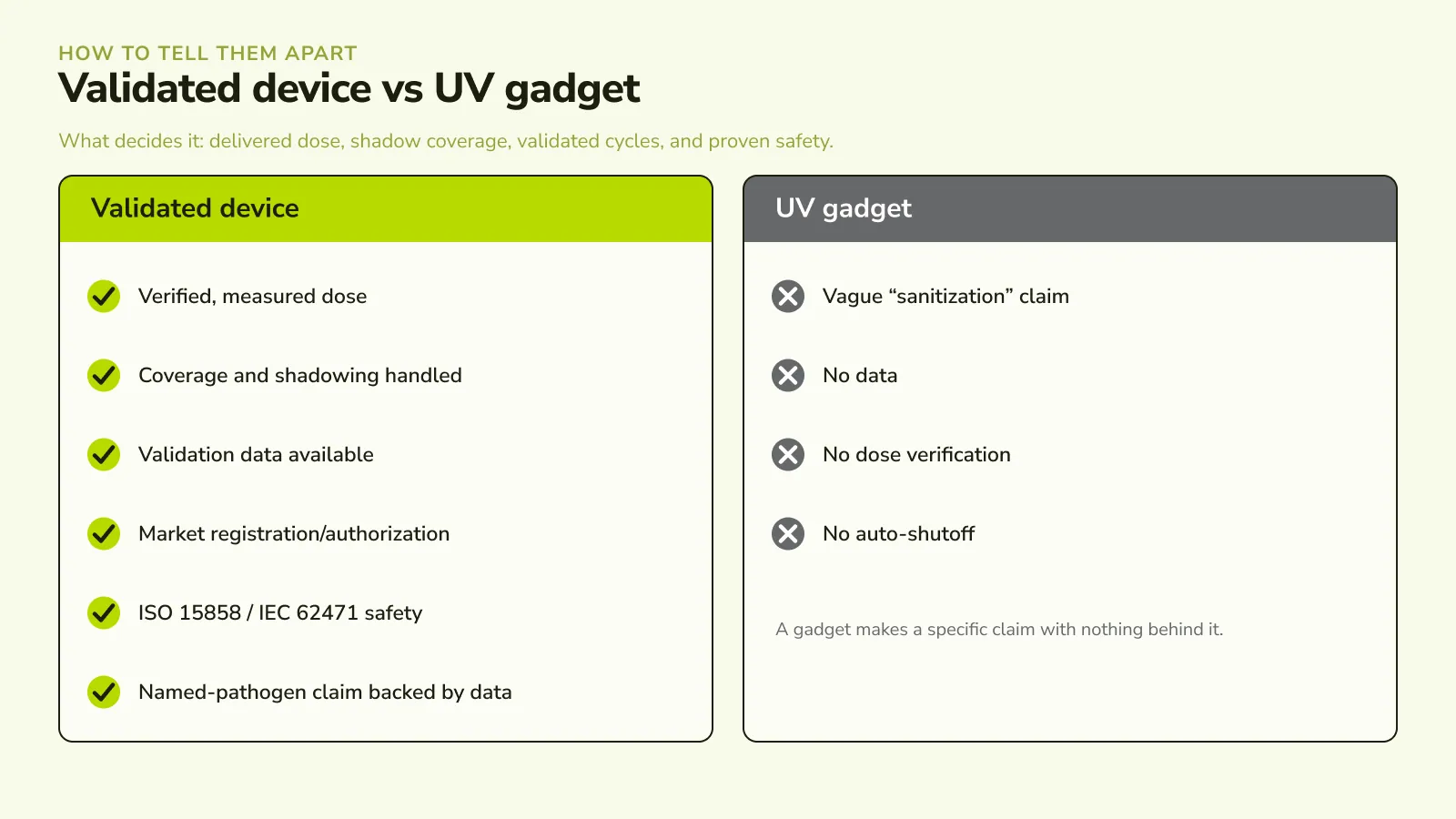
The red flags follow from everything above. A named-pathogen or percentage-kill claim with no data behind it is, in Canada, a claim the seller is legally required to be able to support and register, so its absence tells you a great deal.10 A device that cannot state the dose it delivers, or how that dose was measured, is asking you to take the result on faith. No third-party testing, no independent or peer-reviewed data, and no safety interlock to shut the lamp off if someone walks in are each a reason to slow down.
The other half of the test is knowing what to ask for instead. The IUVA advises buyers to request the scientific papers documenting real microorganism-reduction data for the device, and to look for a built-in UV safety sensor that shuts the lamp off on occupancy.3 It and other guidance also point you to third-party testing or certification from a recognized body such as CSA, UL or NSF.8 A serious vendor has these ready; a gadget changes the subject.
What safety standards should a serious device meet?
Safety and efficacy are different questions, and a device has to pass both. On the human-exposure side, ISO 15858 sets minimum safety requirements for UV-C devices, including portable in-room units; a device built to it is engineered to keep people from UV-C skin and eye harm.14 For the lamp itself, Health Canada expects an unshielded UV lamp that lacks a lock-out or automatic shut-off to be certified "Exempt Group" under IEC 62471, the photobiological-safety risk grouping.15 On the electrical side, certification to CSA or UL standards is the ordinary bar for any powered hospital equipment.8
Hold on to one distinction here. None of these is an efficacy standard. A device can conform to every safety requirement and still deliver too little dose to the surfaces that matter, just as a powerful emitter with no interlock can be effective and unsafe. Conformance to ISO 15858 or IEC 62471 tells you the device is built not to harm the people around it; it says nothing about whether it disinfects. That is why the safety questions and the efficacy questions are asked, and answered, separately.
The questions to ask a vendor
All of this reduces to a short list you can take into any evaluation or tender. For each one, a validated device has a specific answer and a gadget has a slogan.
- What UV-C dose does the cycle deliver to the surfaces that matter, and how is that dose measured rather than assumed?2
- How does the device handle shadowed and out-of-line-of-sight surfaces, given that spores and awkward geometry need the most dose?6
- Can you show peer-reviewed or independent laboratory data for the reductions you claim, on the organisms I care about?3
- Is the device registered or cleared appropriately for the market you buy in, and for exactly which claims? In Canada that means PMRA registration or authorization under the Pest Control Products Act; other markets have their own equivalent.9
- Does it meet ISO 15858 for human exposure and carry CSA or UL electrical certification, with an occupancy sensor that shuts the lamp off?14
- Does it record each cycle, so you can show later what dose ran where?
A device like the ROZOR Disinfection Robot, a continuous 254 nm UV-C system, should be able to answer every one of these, and you should hold it to that bar exactly as you would any competitor. Concretely, its own disinfection efficacy is validated to BS 8628:2022, the British Standard quantitative test method for automated UV-C disinfection and the one that speaks to measured efficacy rather than safety or build quality; it is built under ISO 13485 medical-device quality management, with ISO 9001, which certify how it is made rather than what it disinfects; and it is CE marked with market and electrical clearances across the United States (FCC), South Korea (KC), Australia and New Zealand (RCM), Saudi Arabia (SABER) and Japan (PSE), which permit sale in those markets and are not efficacy claims. The list exists to make the differences between machines visible before money changes hands, whichever machine you end up choosing.
What this means for your evaluation
Even the most rigorously validated UV-C device does not stand alone. It is an adjunct: a no-touch pass that runs after your team has finished the manual clean, one named component of a disinfection bundle rather than a replacement for any part of it.16 The agencies are explicit on the point, advising that no-touch devices be used only as a supplement to standard cleaning and disinfection.17 A device sold to you as a way to do without cleaning staff or standard protocol has already failed the first test.
So "are all UV-C devices the same" has a practical answer as well as a technical one. They differ in the light they use, the dose they deliver, the surfaces they can reach, the evidence behind their claims, and the regulatory bar they have cleared, and every one of those differences is something you can ask about and a serious vendor can document. That is your real leverage as a buyer. You do not have to referee competing marketing claims; you have to ask the questions the physics and the law already license, then choose the device whose answers hold up.
Ask these questions of any UV-C device you evaluate, including ours. See how the ROZOR Disinfection Robot answers them at rozor.ai/disinfection. It delivers no-touch 254 nm UV-C disinfection as an adjunct to your cleaning programme, physical AI for critical environments.
Frequently asked questions
Are all UV-C devices the same?
No. They differ in the light source itself, since 254 nm mercury lamps, 222 nm far-UVC and UV-C LEDs are distinct technologies, and, even within one wavelength, there is no standardized efficacy metric to compare whole-room devices by. What decides the outcome is the dose actually delivered to each surface, how the device handles shadowed areas, and the evidence and registration behind its claims.
What determines whether a UV-C device works?
The ultraviolet dose delivered to the surface, which is irradiance multiplied by exposure time and falls with distance and angle. Different organisms need different doses for the same log reduction, and spores need roughly ten times the exposure of vegetative bacteria, so coverage and cycle design, not lamp wattage alone, decide the result.
Does the wavelength, 254 nm versus 222 nm, matter?
Yes. A 2025 systematic review treats 222 nm far-UVC and 254 nm low-pressure-mercury UV-C as distinct technologies with different efficacy and safety profiles, so a result shown for one wavelength should not be assumed for another. Match the evidence to the exact technology in front of you.
How are UV-C disinfection devices regulated in Canada?
A device that claims to reduce disease-causing micro-organisms must be registered or authorized through the Pest Management Regulatory Agency under the Pest Control Products Act, and its radiation safety falls under the Radiation Emitting Devices Act. A device is exempt as "supplemental sanitization" only if it names no specific pathogen and no quantifiable efficacy; a named-pathogen or percentage claim requires supporting data.
How do I tell a validated device from a UV gadget?
Ask for the delivered dose and how it is measured, peer-reviewed or independent reduction data, registration or authorization for its market for the exact claims made, for example PMRA in Canada, and recognized safety certification with an occupancy shut-off. Health Canada is explicit that any protective claim for a UV light must be backed by evidence the manufacturer holds. A gadget makes a specific claim with nothing behind it.
Is a UV-C device a replacement for manual cleaning?
No. UV-C is a no-touch adjunct that runs after the manual clean, one component of a disinfection bundle, and public-health guidance says no-touch devices should be used only as a supplement to standard cleaning and disinfection. It completes the clean; it does not replace it or the people who do it.
Sources
- "Disinfection efficacy and safety of 222-nm versus 254-nm ultraviolet-C: a systematic review and meta-analysis." Journal of Hospital Infection 2025;161. https://pubmed.ncbi.nlm.nih.gov/40254071/
- Poster DL, Miller CC, Obeng YS, et al. "Ultraviolet Radiation Technologies and Healthcare-Associated Infections: Standards and Metrology Needs." Journal of Research of the National Institute of Standards and Technology 2021;126:126014. https://pmc.ncbi.nlm.nih.gov/articles/PMC10046890/
- International Ultraviolet Association. "Advice on selection and operation of equipment for the UV disinfection of air and surfaces." https://iuva.org/Advice-selection/operation-of-equipment-for-the-UV-disinfection-of-air-and
- Boyce JM, Donskey CJ. "Understanding ultraviolet light surface decontamination in hospital rooms: A primer." Infection Control & Hospital Epidemiology 2019;40(9):1030-1035. https://pubmed.ncbi.nlm.nih.gov/31210119/
- Masjoudi M, Mohseni M, Bolton JR. "Sensitivity of Bacteria, Protozoa, Viruses, and Other Microorganisms to Ultraviolet Radiation." Journal of Research of the National Institute of Standards and Technology 2021;126:126021. https://pmc.ncbi.nlm.nih.gov/articles/PMC11259122/
- Rutala WA, Gergen MF, Weber DJ. "Room Decontamination with UV Radiation." Infection Control & Hospital Epidemiology 2010;31(10):1025-1029. https://pubmed.ncbi.nlm.nih.gov/20804377/
- Weber DJ, Rutala WA, Anderson DJ, Chen LF, Sickbert-Bennett EE, Boyce JM. "Effectiveness of ultraviolet devices and hydrogen peroxide systems for terminal room decontamination: Focus on clinical trials." American Journal of Infection Control 2016;44(5 Suppl):e77-e84. https://pubmed.ncbi.nlm.nih.gov/27131140/
- International Ultraviolet Association. "Fact Sheet on UV Disinfection for COVID-19." https://www.iuva.org/IUVA-Fact-Sheet-on-UV-Disinfection-for-COVID-19
- Health Canada. "Regulating ultraviolet-radiation-emitting and ozone-generating devices under the Pest Control Products Act: Overview." Government of Canada. https://www.canada.ca/en/health-canada/services/drugs-health-products/covid19-industry/disinfectants-sanitizers-cleaners-soaps/ultra-violet-radiation-emitting-ozone-generating-devices.html
- Health Canada. "Regulating ultraviolet-radiation-emitting and ozone-generating devices under the Pest Control Products Act: Devices subject to the Act." Government of Canada. https://www.canada.ca/en/health-canada/services/drugs-health-products/covid19-industry/disinfectants-sanitizers-cleaners-soaps/ultra-violet-radiation-emitting-ozone-generating-devices/devices-subject.html
- Health Canada. "Safe medical devices in Canada (fact sheet)." Government of Canada. https://www.canada.ca/en/health-canada/services/drugs-health-products/medical-devices/activities/fact-sheets/safe-medical-devices-fact-sheet.html
- Health Canada. "Guidance Document: Guidance on the Risk-based Classification System for Non-In Vitro Diagnostic Devices (non-IVDDs)." Government of Canada. https://www.canada.ca/en/health-canada/services/drugs-health-products/medical-devices/application-information/guidance-documents/guidance-document-guidance-risk-based-classification-system-non-vitro-diagnostic.html
- Health Canada. "Ultraviolet (UV) lights and wands falsely claiming to disinfect against COVID-19 may pose risks to health." Recalls and safety alerts; 18 November 2020. https://recalls-rappels.canada.ca/en/alert-recall/ultraviolet-uv-lights-and-wands-falsely-claiming-disinfect-against-covid-19
- International Organization for Standardization. "ISO 15858:2016, UV-C Devices, Safety information, Permissible human exposure." Geneva: ISO; 2016. https://www.iso.org/standard/55553.html
- International Electrotechnical Commission. "IEC 62471, Photobiological safety of lamps and lamp systems" (required by Health Canada for unshielded UV lamps). https://webstore.iec.ch/publication/7076
- Rutala WA, Weber DJ. "Best practices for disinfection of noncritical environmental surfaces and equipment in health care facilities: A bundle approach." American Journal of Infection Control 2019;47(Suppl):A96-A105. https://doi.org/10.1016/j.ajic.2019.01.014
- U.S. Centers for Disease Control and Prevention. "Infection Prevention and Control for Candida auris." https://www.cdc.gov/candida-auris/hcp/infection-control/index.html