Hospital-acquired infections (HAIs) are infections a patient develops during care that were not present, or incubating, on admission. In high-income countries roughly 7 of every 100 hospital patients acquire at least one. Contaminated surfaces are one transmission route among several, which is why no-touch disinfection is added after manual cleaning as one part of a multimodal prevention bundle.
If you lead infection prevention, you already live with this reality: a share of the patients on your wards will leave with an infection they did not arrive with. This article is the starting point for our pillar on the pathogens you fight. It sets out what an HAI is, what the burden looks like in the published surveillance, what the evidence says about the part contaminated surfaces play, and where a no-touch disinfection step sits inside the prevention bundle you already run. From here, follow the links to the deeper pieces on individual organisms.
What counts as a hospital-acquired infection?
A hospital-acquired infection, also called a healthcare-associated infection, is one that develops as a result of care in a healthcare setting and was not present or incubating when the patient was admitted. It covers a broad set of clinical events, not a single disease.
How are HAIs defined and categorised?
In the United States, HAI surveillance runs on standardised case definitions maintained by the CDC's National Healthcare Safety Network (NHSN), which sort infections into 14 major types by body site and clinical criteria.1 The familiar four (central-line bloodstream, catheter urinary, ventilator-associated and surgical-site infections) are only part of it. A shared definition lets you benchmark your rates against a network and tell a real change from a change in how you count.
How does standard practice handle contaminated surfaces?
Environmental control has long been part of the answer. The foundational CDC and HICPAC guidance sets out the hierarchy every programme is built on: surfaces are physically cleaned to remove soil, then treated with an EPA-registered disinfectant matched to the organisms of concern, and spore-formers such as Clostridioides difficile need a sporicidal agent that ordinary low- and intermediate-level disinfectants do not reliably inactivate.2 The question is how well that manual step performs in practice, and what can reliably be added on top of it.
How big is the burden of hospital-acquired infections?
The numbers below frame the size of the problem you are working against.
What do the prevalence surveys show?
The World Health Organization estimates that roughly 7 of every 100 patients in high-income countries, and about 15 of every 100 in low- and middle-income countries, acquire at least one HAI during a hospital stay.3 In the United States, CDC point-prevalence surveys found about 4 percent of acute-care inpatients had an HAI in 2011,4 falling to 3.2 percent by 2015, which the authors reported as a 16 percent lower adjusted risk (risk ratio 0.84, 95 percent CI 0.74 to 0.95).5 European surveillance across more than 1,200 hospitals found the same infections concentrated in intensive care, with respiratory, surgical-site, urinary and bloodstream infections the most common.6 These are prevalence snapshots, not incidence counts, so read them as the shape of the problem, not a precise annual tally. In Canada, the Public Health Agency's Canadian Nosocomial Infection Surveillance Program provides the national benchmark for HAI and antimicrobial-resistance surveillance.7
What is the human and system cost?
The burden is not only a count of cases. A modelled European study estimated that six common HAIs cost the EU and EEA about 501 disability-adjusted life years per 100,000 population each year, higher than the combined burden of the 32 other communicable diseases in the same study.8 That turns HAI prevention from a clinical concern into a board-level one: patient harm comes first, and the cost of that harm follows on its own. But the mechanism of prevention is where an IPC programme earns its result, so it helps to understand how these infections move.
How do contaminated surfaces contribute to transmission?
The contaminated environment is a real and modifiable contributor to transmission, and the evidence for it has held up across two decades. It is not the whole story, hands, devices, the air in some cases and the patient's own flora all play a part, but it is the part you can engineer against.
How long do pathogens survive on surfaces?
The reason surfaces matter at all is persistence. A systematic review of survival studies found that many nosocomial pathogens last far longer on dry inanimate surfaces than intuition suggests: S. aureus including MRSA persists from 7 days to several months, Enterococcus including VRE from days to months, Acinetobacter species for weeks, C. difficile spores for up to about five months, and Candida for days to months.9 These are wide, method-dependent laboratory ranges rather than a field half-life, but the direction is unambiguous: a pathogen shed onto a bed rail today can still be viable when the next patient arrives. Our companion pieces on MRSA on hospital surfaces, C. difficile and environmental disinfection and Candida auris disinfection go deeper on the organisms that survive longest and resist standard cleaning.
How do surfaces move a pathogen to the next patient?
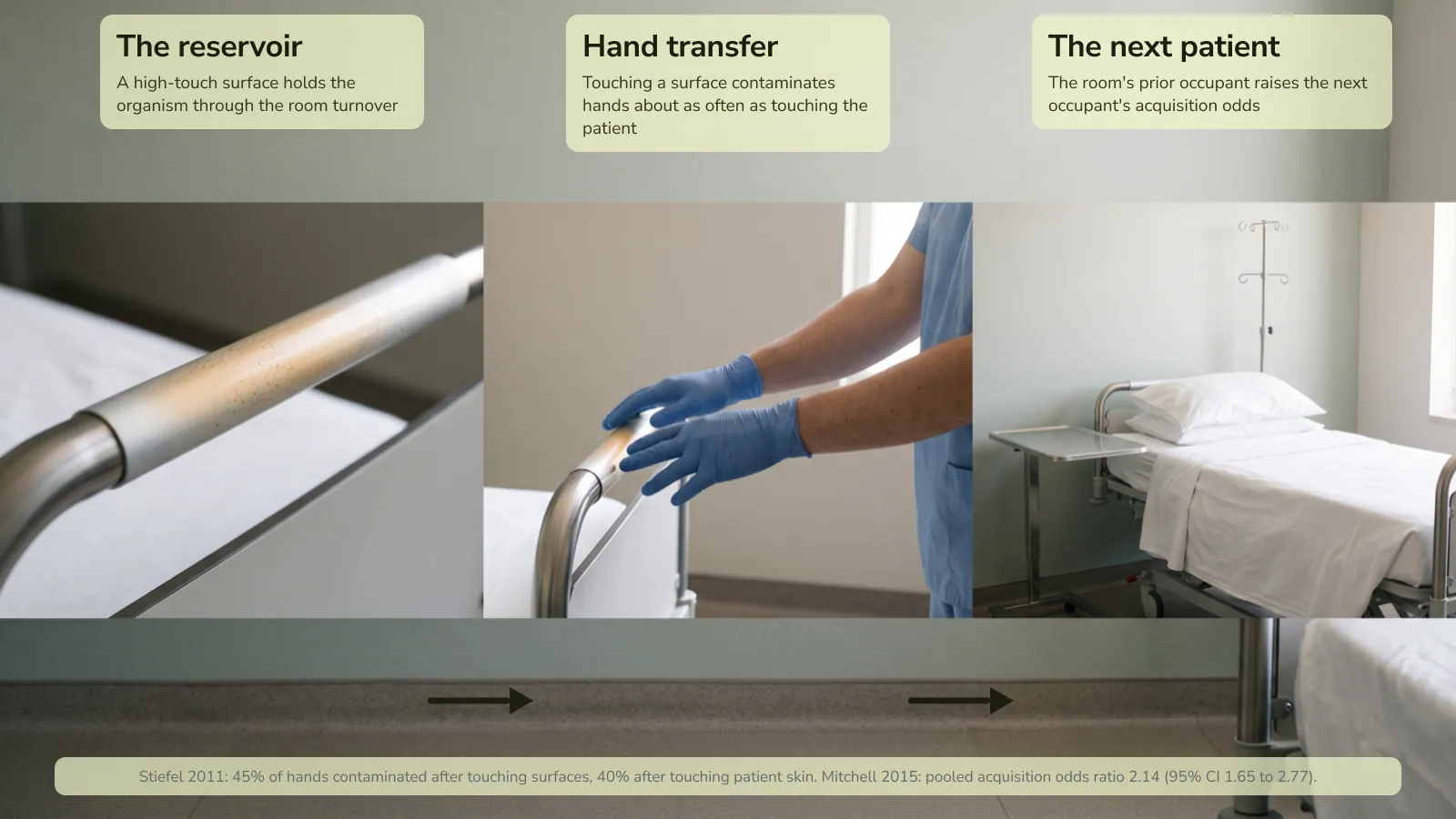
Persistence only matters if the pathogen gets from the surface to a patient, and that chain is well described. A review concluded that contaminated surfaces contribute materially to the transmission of C. difficile, VRE, MRSA, Acinetobacter, Pseudomonas and norovirus.10 The bridge is usually hands and gloves: one synthesis found that touching a contaminated surface is about as likely to contaminate a healthcare worker's hands or gloves as touching the patient, and that admission to a room previously occupied by a patient with one of these organisms raises the next occupant's acquisition risk.11 A bedside study put a number on the hand step, finding that hands became contaminated with MRSA about as often after touching environmental surfaces (45 percent) as after touching the patient's skin (40 percent).12 The surface is a genuine reservoir that feeds the same hands your hand-hygiene programme works so hard on.
Does the prior room occupant really raise the risk?
This is the cleanest natural experiment in the field, and also the most over-claimed. When a patient is admitted to a room whose previous occupant carried MRSA or VRE, their own odds of acquiring that organism rise: in a large single-centre study the adjusted odds ratio was about 1.4 for both organisms (MRSA P=.04, VRE P=.02).13 The authors were careful to add that this route was a minor contributor to overall transmission, accounting for roughly 5 percent of new MRSA cases, and that is the honest reading to carry forward. A later systematic review and meta-analysis pooled the effect somewhat higher, at an odds ratio of 2.14 (95 percent CI 1.65 to 2.77) across organisms and settings.14 Both are associations, not proof, but together they establish that the room itself carries a residual risk. The encouraging corollary: cleaning that room, and not only isolating the patient, reduces the excess risk the prior occupant leaves behind.15
Why does manual cleaning alone leave a gap?
The evidence that manual cleaning misses surfaces is not a comment on the people doing the work. Terminal cleaning is done under real time pressure, against a long list of surfaces and a fast room-turnover clock, in a layout full of shadowed and awkward-to-reach spots. The gap that results is structural.
When researchers used fluorescent markers to audit how thoroughly high-touch surfaces were cleaned across 36 hospitals, only about 48 percent of those surfaces were adequately cleaned at baseline; with structured feedback and repeated auditing the figure rose to 77 percent.16 A wider synthesis of marker studies found the same pattern, with roughly 40 to 50 percent of high-touch surfaces missed during standard manual terminal cleaning.17 Notice what improved the number: not working the cleaners harder, but changing the system around them with measurement and feedback. A no-touch step applies the same lesson differently. It does not replace the manual clean or the person doing it; it adds a consistent, reproducible pass free of the same time-and-layout pressures, so surfaces missed on a rushed turnover still receive a dose.
Where does no-touch disinfection fit in the prevention bundle?
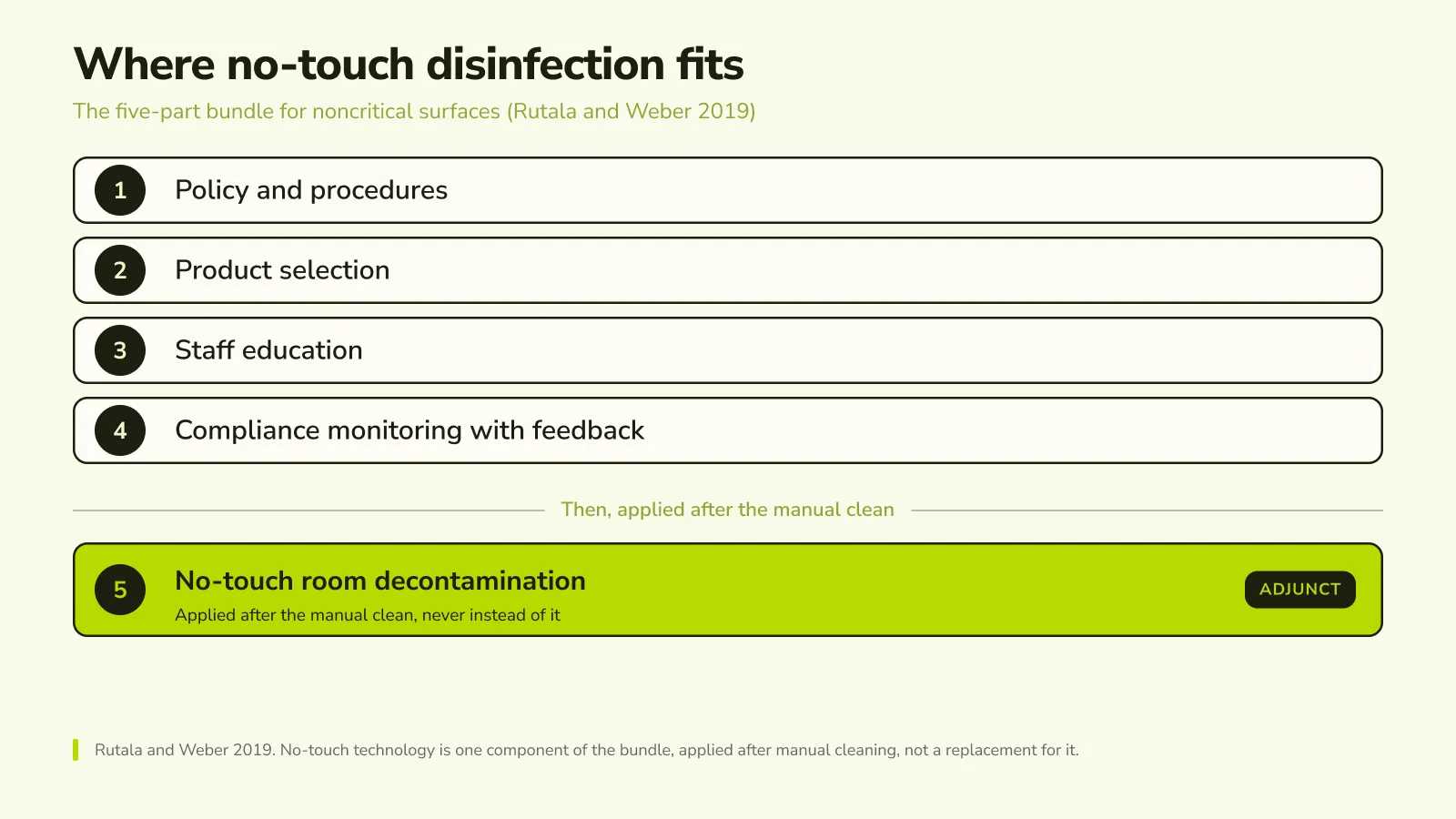
No-touch disinfection is best understood as one named component of a bundle, never a standalone solution. A widely used framework describes a five-part approach for noncritical surfaces: a clear policy, the right product selection, staff education, compliance monitoring with feedback, and no-touch room decontamination technology as an adjunct to manual cleaning.18 The word "adjunct" is doing real work there: it runs after your team has cleaned and disinfected, not instead of them.
The clinical evidence is encouraging but should be read with its limits attached. A recent review of no-touch terminal disinfection trials found that most, though not all, report reduced colonisation or infection in the next room occupant, while noting that many use weaker before-and-after designs open to confounding.19 The strongest single study is the multicentre cluster-randomised BETR-D trial. Among patients later admitted to a room whose prior occupant had carried one of four target organisms (MRSA, VRE, multidrug-resistant Acinetobacter or C. difficile), the arm that added UV-C to quaternary ammonium cleaning saw about a 30 percent lower rate of acquiring or being infected by those organisms combined (risk ratio 0.70, 95 percent CI 0.50 to 0.98; published 2017).20 In the same trial, adding UV-C on top of a bleach protocol, which was the sporicidal clean the trial itself used for C. difficile rooms, did not further lower C. difficile infection among exposed patients (risk ratio 1.00, 95 percent CI 0.57 to 1.75). That null measures what UV-C added beyond a sporicidal clean in an infection outcome. It is not a measurement of surface contamination. The honest reading: no-touch UV-C can strengthen a terminal-cleaning programme against several multidrug-resistant organisms, while its effect on C. difficile alone is not established, a point we treat in full in our piece on C. difficile and environmental disinfection. Stating that null as plainly as the 30 percent is what earns the 30 percent your trust.
This is where a device like the ROZOR Disinfection Robot fits: it delivers that no-touch adjunct, a documented 254 nm UV-C cycle run in the vacated room after your team has completed the manual clean, sized to the toughest target expected in the space. For the science of how the light inactivates a microbe, our hub article on how UV-C disinfection works covers the mechanism, and our guide to which pathogens UV-C inactivates covers where it is stronger and weaker. The WHO's guidance is the anchor to keep in view: any single intervention, no-touch disinfection included, is one part of a multimodal IPC programme and never a replacement for it.21
What this means for your IPC programme
The picture for your programme is coherent. HAIs remain common, the contaminated environment is one real and modifiable route among several, manual cleaning reliably leaves a structural gap, and a no-touch step is a validated way to narrow it for the organisms that matter most.
The practical implications follow the risk. National guidance already grades surfaces and areas by contamination risk, and that grading is the right map for where to invest.22 Keep the manual clean strong, because no-touch technology cannot remove soil and only reaches what its light can see. Add the no-touch pass where the stakes and the reservoir are highest, typically your terminal cleans in high-acuity and outbreak-relevant spaces, which we cover in our guide to terminal disinfection in high-risk areas. And where an emerging pathogen forces a step change in readiness, as with the questions raised by Ebola and UV-C surface disinfection, the same logic holds: clean first, add a consistent no-touch pass, and document every cycle so your surveillance and accreditation prep both benefit. That is where surfaces fit, and it is a position you can defend to a skeptical peer and board alike.
See how the ROZOR Disinfection Robot fits your prevention bundle. It delivers no-touch UV-C disinfection as an adjunct to your cleaning programme, physical AI for critical environments. Learn more about the ROZOR Disinfection Robot.
Frequently asked questions
What is a hospital-acquired infection?
A hospital-acquired infection, or healthcare-associated infection, is an infection a patient develops as a result of care in a healthcare setting that was not present or incubating on admission. US surveillance sorts them into 14 major types by body site using standardised CDC and NHSN case definitions.
How common are hospital-acquired infections?
The WHO estimates that roughly 7 of every 100 patients in high-income countries acquire at least one HAI during a hospital stay, and about 15 of every 100 in low- and middle-income countries. US prevalence has been falling, from 4.0 percent of inpatients in 2011 to 3.2 percent in 2015 (a 16 percent lower adjusted risk).
Do contaminated surfaces really cause hospital infections?
Surfaces are one transmission route among several, not the whole story, but the evidence for their contribution is solid. Pooled analysis shows admission to a room whose prior occupant carried a target pathogen roughly doubles the odds of the next occupant acquiring it (odds ratio 2.14, 95 percent CI 1.65 to 2.77).
Can better manual cleaning alone close the gap?
Better manual cleaning helps, and structured feedback raised measured cleaning thoroughness from about 48 percent to 77 percent of high-touch surfaces in one multi-hospital study. But roughly 40 to 50 percent of high-touch surfaces are missed under standard practice because of time and layout pressure, which is a structural gap a consistent no-touch step is designed to narrow.
Does no-touch UV-C disinfection reduce infections?
The strongest evidence, the BETR-D trial, found that adding UV-C to standard terminal cleaning was associated with about a 30 percent lower rate of acquiring four multidrug-resistant organisms combined in exposed patients (risk ratio 0.70, 95 percent CI 0.50 to 0.98). The same trial found no effect on C. difficile specifically, so the honest reading is a strengthened programme, not a guaranteed single result.
Is no-touch disinfection a replacement for manual cleaning?
No. No-touch disinfection is an adjunct that runs after manual cleaning, never instead of it, because it cannot remove soil and only treats surfaces its light or vapour can reach. The WHO frames any single intervention as one part of a multimodal IPC programme.
Sources
- CDC / National Healthcare Safety Network. "Surveillance Definitions for Specific Types of Infections" (Patient Safety Component Manual, Ch. 17). https://www.cdc.gov/nhsn/pdfs/pscmanual/17pscnosinfdef_current.pdf
- Rutala WA, Weber DJ, and the Healthcare Infection Control Practices Advisory Committee (HICPAC). "Guideline for Disinfection and Sterilization in Healthcare Facilities, 2008" (updated). U.S. Centers for Disease Control and Prevention. https://www.cdc.gov/infection-control/hcp/disinfection-and-sterilization/index.html
- World Health Organization. "Global report on infection prevention and control." Geneva: WHO; 2022. https://www.who.int/publications/i/item/9789240051164
- Magill SS, Edwards JR, Bamberg W, et al. "Multistate Point-Prevalence Survey of Health Care-Associated Infections." New England Journal of Medicine 2014;370(13):1198-1208. https://pubmed.ncbi.nlm.nih.gov/24670166/
- Magill SS, O'Leary E, Janelle SJ, et al. "Changes in Prevalence of Health Care-Associated Infections in U.S. Hospitals." New England Journal of Medicine 2018;379(18):1732-1744. https://pubmed.ncbi.nlm.nih.gov/30380384/
- European Centre for Disease Prevention and Control. "Point prevalence survey of healthcare-associated infections and antimicrobial use in European acute care hospitals 2016-2017." Stockholm: ECDC; 2018. https://www.ecdc.europa.eu/en/publications-data/point-prevalence-survey-healthcare-associated-infections-and-antimicrobial-use-5
- Public Health Agency of Canada. "Canadian Nosocomial Infection Surveillance Program (CNISP)." https://health-infobase.canada.ca/cnisp/index.html
- Cassini A, Plachouras D, Eckmanns T, et al. "Burden of Six Healthcare-Associated Infections on European Population Health." PLoS Medicine 2016;13(10):e1002150. https://pubmed.ncbi.nlm.nih.gov/27755545/
- Kramer A, Schwebke I, Kampf G. "How long do nosocomial pathogens persist on inanimate surfaces? A systematic review." BMC Infectious Diseases 2006;6:130. https://pmc.ncbi.nlm.nih.gov/articles/PMC1564025/
- Otter JA, Yezli S, French GL. "The role played by contaminated surfaces in the transmission of nosocomial pathogens." Infection Control & Hospital Epidemiology 2011;32(7):687-699. https://pubmed.ncbi.nlm.nih.gov/21666400/
- Weber DJ, Rutala WA, Miller MB, Huslage K, Sickbert-Bennett E. "Understanding and preventing transmission of healthcare-associated pathogens due to the contaminated hospital environment." Infection Control & Hospital Epidemiology 2013;34(5):449-452. https://pubmed.ncbi.nlm.nih.gov/23571359/
- Stiefel U, Cadnum JL, Eckstein BC, Guerrero DM, Tima MA, Donskey CJ. "Contamination of hands with methicillin-resistant Staphylococcus aureus after contact with environmental surfaces and after contact with the skin of colonized patients." Infection Control & Hospital Epidemiology 2011;32(2):185-187. https://pubmed.ncbi.nlm.nih.gov/21460476/
- Huang SS, Datta R, Platt R. "Risk of acquiring antibiotic-resistant bacteria from prior room occupants." Archives of Internal Medicine 2006;166(18):1945-1951. https://pubmed.ncbi.nlm.nih.gov/17030826/
- Mitchell BG, Dancer SJ, Anderson M, Dehn E. "Risk of organism acquisition from prior room occupants: a systematic review and meta-analysis." Journal of Hospital Infection 2015;91(3):211-217. https://pubmed.ncbi.nlm.nih.gov/26365827/
- Datta R, Platt R, Yokoe DS, Huang SS. "Environmental cleaning intervention and risk of acquiring multidrug-resistant organisms from prior room occupants." Archives of Internal Medicine 2011;171(6):491-494. https://pubmed.ncbi.nlm.nih.gov/21444840/
- Carling PC, Parry MF, Rupp ME, Po JL, Dick B, Von Beheren S. "Improving cleaning of the environment surrounding patients in 36 acute care hospitals." Infection Control & Hospital Epidemiology 2008;29(11):1035-1041. https://pubmed.ncbi.nlm.nih.gov/18851687/
- Carling PC, Bartley JM. "Evaluating hygienic cleaning in health care settings: what you do not know can harm your patients." American Journal of Infection Control 2010;38(5 Suppl 1):S41-S50. https://pubmed.ncbi.nlm.nih.gov/20569855/
- Rutala WA, Weber DJ. "Best practices for disinfection of noncritical environmental surfaces and equipment in health care facilities: A bundle approach." American Journal of Infection Control 2019;47(Suppl):A96-A105. https://doi.org/10.1016/j.ajic.2019.01.014
- Weber DJ, Rutala WA, Anderson DJ, Sickbert-Bennett EE. "'No touch' methods for health care room disinfection: Focus on clinical trials." American Journal of Infection Control 2023;51(11S):A134-A144. https://pubmed.ncbi.nlm.nih.gov/37890944/
- Anderson DJ, Chen LF, Weber DJ, et al. "Enhanced terminal room disinfection and acquisition and infection caused by multidrug-resistant organisms and Clostridium difficile (the Benefits of Enhanced Terminal Room Disinfection study): a cluster-randomised, multicentre, crossover study." The Lancet 2017;389(10071):805-814. https://pubmed.ncbi.nlm.nih.gov/28104287/
- World Health Organization. "Guidelines on core components of infection prevention and control programmes at the national and acute health care facility level." Geneva: WHO; 2016. https://www.who.int/publications/i/item/9789241549929
- Sehulster L, Chinn RYW; CDC / HICPAC. "Guidelines for environmental infection control in health-care facilities." MMWR Recommendations and Reports 2003;52(RR-10):1-42. https://pubmed.ncbi.nlm.nih.gov/12836624/