Candida auris disinfection is difficult because the yeast survives on surfaces for weeks, resists the quaternary-ammonium products many hospitals default to, and is measurably less susceptible to UV-C than MRSA, with a response that varies by clade. The defensible approach is an EPA List P manual clean first, then UV-C as a no-touch supplement, never a standalone.
You know the drill when a Candida auris result comes back on your unit. Isolation, screening of contacts, a hard look at the environmental clean. What makes this organism worth its own protocol is that almost every habit that works against a routine pathogen works less well here. It lingers longer, shrugs off products that handle other microbes, spreads on shared equipment, and gives your no-touch technology its single hardest job. This article walks through why, and what a defensible response looks like, with the evidence attached.
What is Candida auris, and why did it earn a critical priority listing?
Candida auris is a multidrug-resistant yeast first described in 2009 and now tracked as an urgent global concern. The World Health Organization placed it in the critical priority group, the top tier of its fungal priority pathogens list.1 In the United States, CDC counted 6,304 new clinical cases in 2024, and the annual total has risen every year since the first US case was identified in 2016.2 It is one of the multidrug-resistant organisms that make the hospital environment such a control challenge in the first place (see our overview of hospital-acquired infections).
What sets it apart from the Candida species you already know is how it behaves in a ward. The European Centre for Disease Prevention and Control notes that, unlike other Candida, C. auris has a high propensity for patient-to-patient transmission in healthcare settings, possibly tied to environmental contamination and colonisation, and it warns that commercial laboratory tests may fail to identify it.3 So it can be circulating before it has been named. For an infection preventionist that identification gap is operational, not academic: a misidentified isolate can delay isolation and contact screening, giving the organism room to establish before the response begins. That combination, a hardy environmental organism that spreads person to person and can hide from routine identification, is why it earns the attention it does.
How long does Candida auris survive on surfaces, and where does it hide?
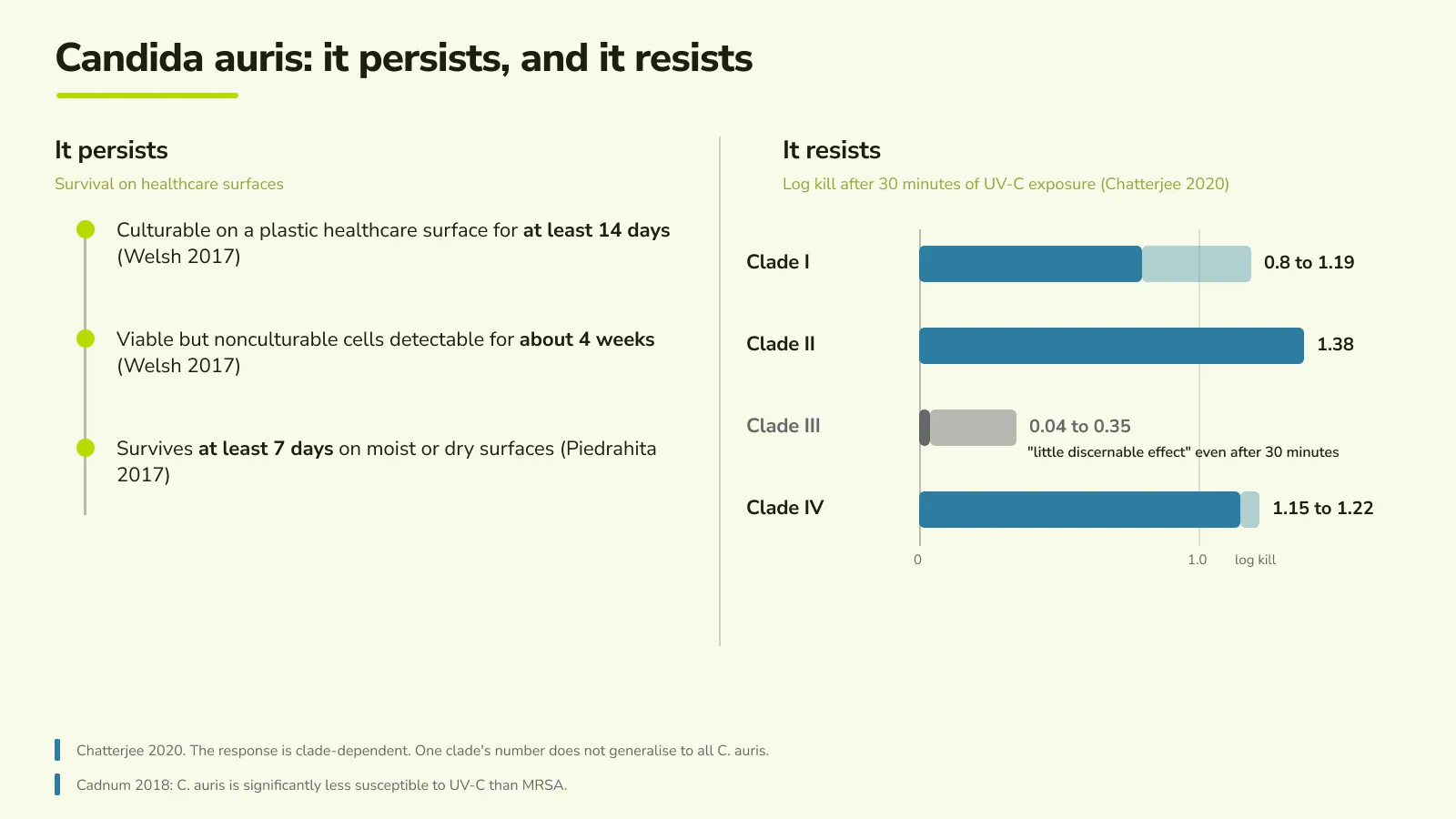
Long enough to outlast a discharge and the next admission. In controlled laboratory work, C. auris stayed culturable on a plastic healthcare surface for at least 14 days, and viable-but-nonculturable cells were still detectable by metabolic assay for roughly four weeks.4 A separate study recovered C. auris and other Candida species from both moist and dry surfaces after seven days.5 For context, the broader Candida picture was already unhelpful: a systematic review of surface survival put Candida albicans anywhere from 1 to 120 days on dry inanimate surfaces.6
That viable-but-nonculturable state matters to you directly: a surface can read negative on culture and still carry metabolically active cells,4 so a clean environmental sample is reassurance rather than proof of clearance.
It is also not particular about where it settles. CDC reports culturing C. auris from high-touch surfaces such as bed rails and from low-touch surfaces such as windowsills.7 That matters for how you plan a clean, because the reservoir is not confined to the obvious hand-contact zones you would prioritise first.
Why does routine cleaning struggle against Candida auris?
Here is the part that catches teams out. The disinfectant on your cart may not be doing what you assume. CDC states plainly that products solely dependent on quaternary ammonium compounds, the QACs common in everyday hospital wipes, are not effective against C. auris.7 That is not a small caveat. If your routine surface product is QAC-based, a thorough clean by the book can still leave viable organism behind.
The fix is a product matched to the organism. CDC directs facilities to use an EPA-registered disinfectant effective against C. auris, and the EPA maintains a dedicated register for exactly this, List P, because ordinary hospital disinfectants and QACs are not reliably effective against the yeast.8 Confirming that your terminal-clean product carries a List P claim is one of the highest-value checks you can make on a C. auris unit. (For how chemical disinfectants and UV-C differ in what each can and cannot do, see our note on UV-C versus chemical disinfection.)
How does Candida auris actually move through a unit?
Two published outbreaks make it concrete. The first reported European outbreak, at a London cardiothoracic centre, ran to 50 cases over 16 months.9 The dynamics that make it so persistent were laid bare more vividly in a UK neurosciences intensive care unit, where 70 patients became colonised or infected over roughly two and a half years.10
That second outbreak is worth sitting with, because it points at equipment, not only surfaces. Reusable axillary temperature probes were associated with a nearly seven-fold increase in risk, and the outbreak was brought under control only after the probes were withdrawn.10 The lesson is not that anyone cleaned carelessly. It is that a shared, reusable device can become a vector that ordinary cleaning does not neutralise, and that the environment you have to account for includes the instruments moving between patients, not just the fixed surfaces around the bed.
Does UV-C kill Candida auris?
We make a UV-C robot, so here is our own technology held to the same standard as everything else on this page. Against C. auris, UV-C does inactivate the organism, but it needs a bigger dose than the pathogens you would more often point it at: a longer dwell at a shorter emitter-to-surface distance. That is a condition to design for, not a technology that fails. It is also exactly what a mapped, mobile emitter that stops at set positions can deliver, and what a fixed corner tower cannot. This yeast sits at the resistant end of the pathogens UV-C addresses.
Start with the direct comparison. In laboratory testing, C. auris and two other Candida species were significantly less susceptible to killing by UV-C than methicillin-resistant Staphylococcus aureus.11 So the dose and dwell time you might associate with a solid MRSA result do not transfer. C. auris needs more.
How much more depends on the strain, and that is the second complication. When researchers exposed the main clades to broad-spectrum UV-C for a full 30 minutes, the log reduction varied sharply: Clade I fell by 0.8 to 1.19 log, Clade II by 1.38 log, Clade IV by 1.15 to 1.22 log, and Clade III by only 0.04 to 0.35 log, which the authors described as little discernible effect even at 30 minutes.12 Read that last figure again. One clade barely responded to half an hour of direct exposure. You cannot generalise a single number to all C. auris, and any vendor who quotes you one has skipped the clade question.
Distance and time compound the problem. A separate study, seeding isolates and exposing them at 2 or 4 metres for 10 or 30 minutes, found that killing depended strongly on both exposure time and distance, and again varied by geographic strain.13 That is the shadow-and-distance behaviour you already know from any UV-C cycle, magnified for an organism that needs a generous dose to begin with. The practical answer is the one the physics always points to: put the emitter closer and hold it longer at each mapped position, so the dose a single distant pass would lose is actually delivered. (Our article on UV-C dose, distance, time and angle covers why those variables decide the delivered dose.)
For completeness, one study used a different technology, a 10-minute pulsed-xenon UV cycle rather than a continuous 254 nm source like ours, and cut C. auris on glass slides by 99.6 percent.14 That is roughly a 2.4 log reduction on a coupon, not elimination, and pulsed xenon is a distinct device class, so the figure does not carry over to continuous mercury-vapour UV-C. It is encouraging that UV energy reaches this organism given enough of it. It is not a result anyone should stretch into a clean kill.
What does a defensible Candida auris protocol look like?
It follows the order the evidence supports, and it puts the manual step first.
Clean and disinfect by hand, with a product that carries an EPA List P claim, before any no-touch step runs.78 That physical clean lifts soil and the bulk of the organism, and it uses chemistry proven against this specific yeast. Nothing that follows can substitute for it.
Then, and only then, add UV-C as the no-touch supplement CDC frames it as. CDC is explicit that data on no-touch devices such as germicidal UV and vaporised hydrogen peroxide are limited, and that these methods should only be used as a supplement to standard cleaning and disinfection methods.7 Note the deliberate ceiling in that sentence, and note that we, a UV-C manufacturer, are quoting it to you rather than around it. The wider evidence base asks for the same humility: a 2023 review of no-touch clinical trials found that while most report reduced colonisation or infection, most also rest on weak before-and-after designs with uncontrolled confounders such as hand-hygiene and cleaning compliance.15 Treat UV-C as a consistency layer on top of a disciplined clean, not as the thing that carries the room.
Wrap the sequence in verification. Because a QAC-only product can leave the organism behind7 and a culture-negative swab does not prove clearance,4 build in cleaning audits and, where your programme allows, environmental sampling around known cases, so you are measuring the protocol rather than assuming it.
Used that way, the ROZOR Disinfection Robot runs a no-touch UV-C cycle in the vacated room after your team has finished the List P clean, adding a repeatable pass across the surfaces a manual protocol reaches unevenly. It does not replace the clean, and against C. auris specifically it needs a longer dwell at a shorter distance than it would for a vegetative organism. That is precisely the cycle a mapped, mobile emitter is built to run: it stops at set positions close to the high-touch surfaces and holds the dose there, which a tower parked in one corner of the room cannot. That is the honest shape of the tool, and the reason its mobility is the mechanism, not a convenience. (For where a no-touch pass earns its place in the terminal cleaning of high-risk areas, see our guide to terminal disinfection.)
See how the ROZOR Disinfection Robot fits into a Candida auris protocol. Learn more at rozor.ai/disinfection. The ROZOR Disinfection Robot delivers no-touch UV-C disinfection as an adjunct to your cleaning programme. Physical AI for critical environments.
Frequently asked questions
Does UV-C kill Candida auris?
It inactivates it, but less readily than most hospital pathogens. Candida auris is significantly less susceptible to UV-C than MRSA, and its response varies by clade: at 30 minutes of exposure one study saw reductions ranging from about 1.4 log down to as little as 0.04 log for the most resistant clade. UV-C reaches this organism, but only at a higher dose, and only as a supplement to a manual clean.
What disinfectant kills Candida auris?
Use an EPA-registered product with a specific Candida auris claim, listed on EPA List P. CDC warns that products relying solely on quaternary ammonium compounds are not effective, so a QAC-only wipe is not enough on its own.
How long does Candida auris live on surfaces?
In laboratory studies it stayed culturable on plastic for at least 14 days, with viable-but-nonculturable cells detectable for around four weeks, and it was recovered from both moist and dry surfaces after seven days.
Why is Candida auris so hard to get rid of?
It combines long environmental survival, resistance to common QAC disinfectants, easy patient-to-patient and equipment-mediated spread, and reduced susceptibility to UV-C compared with other pathogens. Each of those alone is manageable; together they demand a matched, layered protocol.
Can UV-C replace cleaning for Candida auris?
No. CDC frames no-touch UV as a supplement to standard cleaning and disinfection, not a replacement, and the manual List P clean is what removes soil and the bulk of the organism first.
Does Candida auris spread through equipment?
Yes. In one UK ICU outbreak, reusable axillary temperature probes were associated with a nearly seven-fold rise in risk, and the outbreak was controlled only after the probes were withdrawn. Shared reusable devices deserve the same scrutiny as fixed surfaces.
Sources
- World Health Organization. "WHO fungal priority pathogens list to guide research, development and public health action." Geneva: WHO; 2022. https://www.who.int/publications/i/item/9789240060241
- U.S. Centers for Disease Control and Prevention. "Tracking C. auris." https://www.cdc.gov/candida-auris/tracking-c-auris/index.html
- European Centre for Disease Prevention and Control. "Candida auris in healthcare settings, Europe (first update)." Rapid risk assessment, 23 April 2018. https://www.ecdc.europa.eu/en/publications-data/rapid-risk-assessment-candida-auris-healthcare-settings-europe
- Welsh RM, Bentz ML, Shams A, Houston H, Lyons A, Rose LJ, Litvintseva AP. "Survival, Persistence, and Isolation of the Emerging Multidrug-Resistant Pathogenic Yeast Candida auris on a Plastic Health Care Surface." Journal of Clinical Microbiology, 2017; 55(10):2996-3005. PMID 28747370. https://journals.asm.org/doi/full/10.1128/jcm.00921-17
- Piedrahita CT, Cadnum JL, Jencson AL, Shaikh AA, Ghannoum MA, Donskey CJ. "Environmental Surfaces in Healthcare Facilities are a Potential Source for Transmission of Candida auris and Other Candida Species." Infection Control & Hospital Epidemiology, 2017; 38(9):1107-1109. PMID 28693657. https://pubmed.ncbi.nlm.nih.gov/28693657/
- Kramer A, Schwebke I, Kampf G. "How long do nosocomial pathogens persist on inanimate surfaces? A systematic review." BMC Infectious Diseases, 2006; 6:130. PMID 16914034. https://pmc.ncbi.nlm.nih.gov/articles/PMC1564025/
- U.S. Centers for Disease Control and Prevention. "Infection Prevention and Control for Candida auris." https://www.cdc.gov/candida-auris/hcp/infection-control/index.html
- U.S. Environmental Protection Agency. "List P: Antimicrobial Products Registered with EPA for Claims Against Candida auris." https://www.epa.gov/pesticide-registration/list-p-antimicrobial-products-registered-epa-claims-against-candida-auris
- Schelenz S, Hagen F, Rhodes JL, et al. "First hospital outbreak of the globally emerging Candida auris in a European hospital." Antimicrobial Resistance & Infection Control, 2016; 5:35. PMID 27777756. https://pmc.ncbi.nlm.nih.gov/articles/PMC5069812/
- Eyre DW, Sheppard AE, Madder H, et al. "A Candida auris Outbreak and Its Control in an Intensive Care Setting." New England Journal of Medicine, 2018; 379(14):1322-1331. PMID 30281988. https://www.nejm.org/doi/full/10.1056/NEJMoa1714373
- Cadnum JL, Shaikh AA, Piedrahita CT, Jencson AL, Larkin EL, Ghannoum MA, Donskey CJ. "Relative Resistance of the Emerging Fungal Pathogen Candida auris and Other Candida Species to Killing by Ultraviolet Light." Infection Control & Hospital Epidemiology, 2018; 39(1):94-96. PMID 29157326. https://pubmed.ncbi.nlm.nih.gov/29157326/
- Chatterjee P, Choi H, Ochoa B, Garmon G, Coppin JD, Allton Y, Lukey J, Williams MD, Navarathna D, Jinadatha C. "Clade-specific variation in susceptibility of Candida auris to broad-spectrum ultraviolet C light (UV-C)." Infection Control & Hospital Epidemiology, 2020; 41(12):1384-1387. PMID 33046172. https://pmc.ncbi.nlm.nih.gov/articles/PMC7720409/
- de Groot T, Chowdhary A, Meis JF, Voss A. "Killing of Candida auris by UV-C: Importance of exposure time and distance." Mycoses, 2019; 62(5):408-412. PMID 30748018. https://pmc.ncbi.nlm.nih.gov/articles/PMC6850319/
- Maslo C, du Plooy M, Coetzee J. "The efficacy of pulsed-xenon ultraviolet light technology on Candida auris." BMC Infectious Diseases, 2019; 19:540. https://pmc.ncbi.nlm.nih.gov/articles/PMC6585008/
- Weber DJ, Rutala WA, Anderson DJ, Sickbert-Bennett EE. "No touch methods for health care room disinfection: Focus on clinical trials." American Journal of Infection Control, 2023; 51(11S):A134-A144. PMID 37890944. https://pubmed.ncbi.nlm.nih.gov/37890944/