The pathogens UV-C kills most readily are enveloped viruses and vegetative bacteria such as MRSA and VRE; the ones that resist it are bacterial spores like Clostridioides difficile and fungi like Candida auris. But "kills" always depends on dose, distance and line of sight, so every figure is a measured coupon result, not a room-wide guarantee.
You can wheel a UV-C tower into a terminally cleaned room and still face the one question a good IPC programme has to answer: which pathogens did the light actually inactivate, and which ones shrugged it off? The honest answer is not a single headline number. It is a roster, organism by organism, each mapped to how long it survives on a surface and to what the measured UV-C data actually show. Competitors publish uncited pathogen lists. This one carries a source on every line, because on a clinical claim that is the only kind worth reading. The number that should anchor a purchasing conversation comes at the end, and it is a clinical one: in a multicentre randomised trial, adding UV-C to terminal cleaning was associated with roughly 30 percent lower acquisition of four multidrug-resistant organisms combined.26
Why "does UV-C kill X" is the wrong question
The honest answer to "does UV-C kill this organism" is always "at what dose, at what distance, and in whose line of sight." UV-C inactivates microbes by dose, the product of irradiance and time, and that dose falls sharply with distance and drops toward zero anywhere the lamp cannot see. For the physics of that, see our explainer on UV-C dose, distance, time and angle; for what a stated "log" figure means, see what log reduction is; and for why shadowed surfaces get less, see UV-C shadowing.
The compiled fluence tables the field relies on make the relative difficulty concrete, but they carry a caveat you have to keep in view. The canonical UV dose-response compilations123 are built almost entirely from microorganisms suspended in water and exposed under a collimated beam, not from pathogens dried onto a hospital surface.2 They tell you the rough order of difficulty; they do not tell you the log you will get on a soiled bed rail. So read every number below as what it is: a measured coupon or carrier result under stated geometry, against a stated organism, never a promise for every surface in a room.
How long these organisms survive on a surface
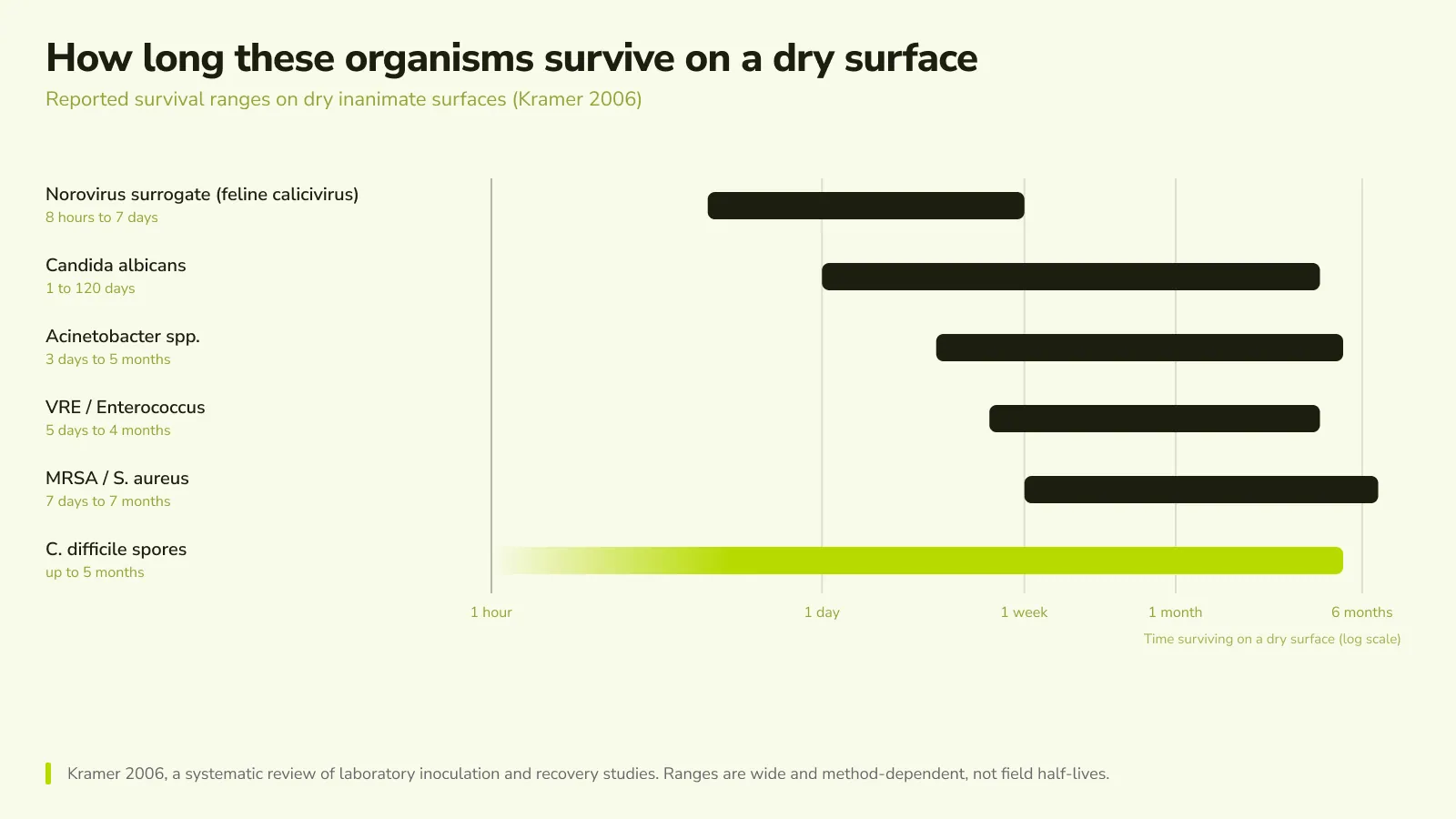
Before the kill question comes the survival question, because it is why the environment matters at all. Contaminated surfaces contribute materially to the transmission of C. difficile, VRE, MRSA, Acinetobacter and norovirus,4 and the organisms that matter most in critical care are exactly the ones that persist for weeks to months. A systematic review of survival on dry inanimate surfaces puts the ranges like this.
| Pathogen | Type | Survives on a dry surface |
|---|---|---|
| MRSA (S. aureus) | Vegetative bacterium | 7 days to 7 months5 |
| VRE (Enterococcus) | Vegetative bacterium | 5 days to 4 months5 |
| Acinetobacter spp. | Vegetative bacterium | 3 days to 5 months5 |
| Norovirus (feline calicivirus surrogate) | Non-enveloped virus | 8 hours to 7 days5 |
| C. difficile spores | Bacterial spore | Up to 5 months5 |
| Candida auris | Fungus (yeast) | 7 days moist or dry;6 culturable up to 14 days on plastic7 |
Those ranges are wide and method-dependent, so read them as "persists for weeks to months," not as a field half-life. The point they make is not subtle: a surface that looks clean can carry a viable reservoir long after the last patient left.
The roster: what the measured data show, organism by organism
Does UV-C kill MRSA?
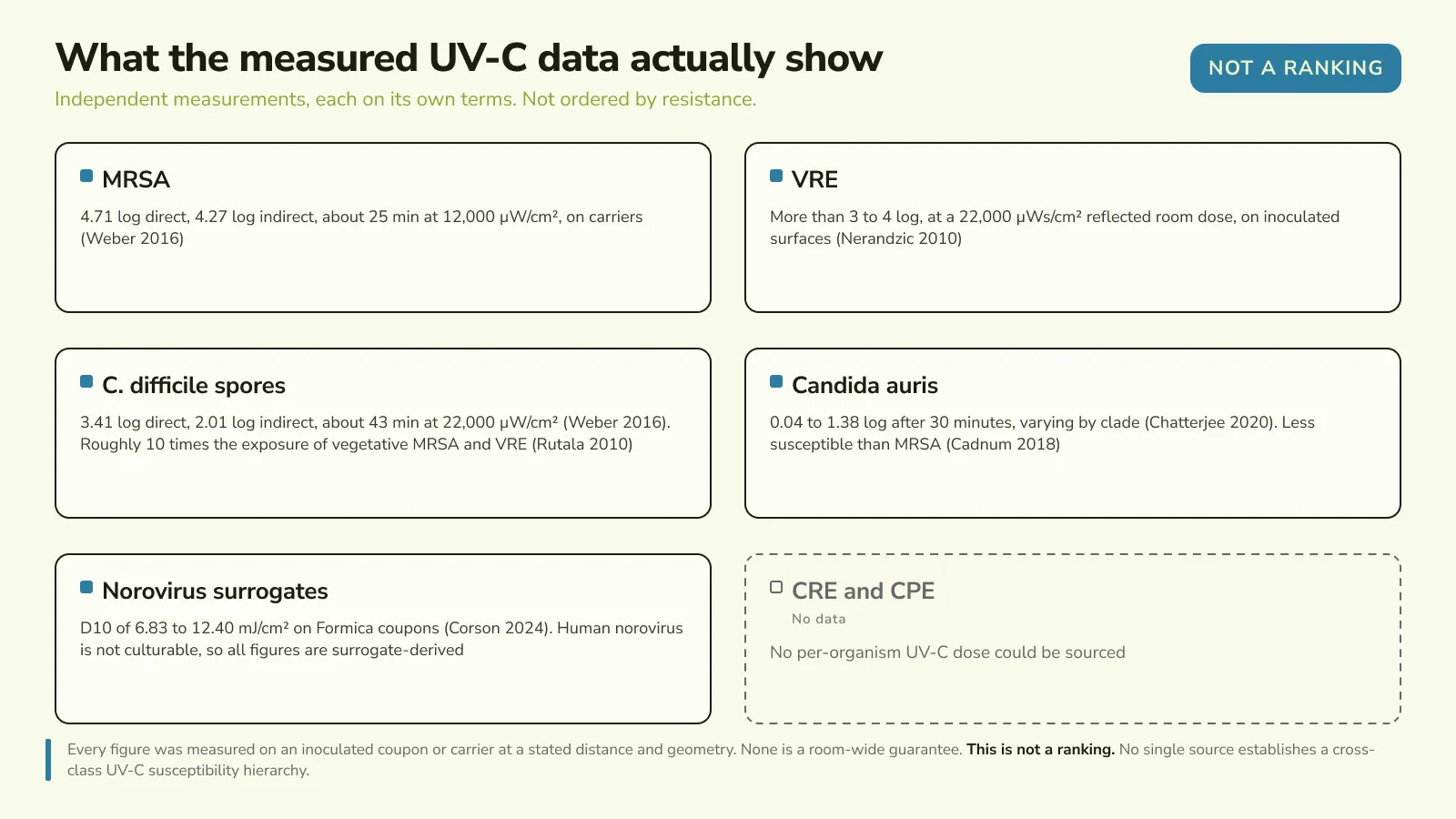
MRSA (methicillin-resistant Staphylococcus aureus) is a vegetative gram-positive bacterium and one of the easier targets for UV-C. Contact precautions and environmental cleaning are its core control measures,8 and CDC attributed roughly 323,700 hospital-onset cases and 10,600 deaths to it in the United States in 2017.9 It persists 7 days to 7 months on dry surfaces.5 On inoculated hospital-room surfaces, a whole-room mobile UV-C device delivering about 22,000 µWs/cm² over roughly 45 minutes produced on the order of 2 to 3 log₁₀ reduction of MRSA;10 a separate carrier study measured 4.71 log₁₀ on directly exposed carriers but 4.27 log₁₀ on indirectly exposed ones after about 25 minutes at 12,000 µW/cm².11 Both are coupon and carrier figures under stated geometry, and the indirect number is already lower than the direct one. For how that surface reservoir builds, see MRSA on surfaces.
VRE
VRE (vancomycin-resistant enterococci) causes bloodstream, surgical-site and urinary infections and can colonise patients without symptoms, which complicates environmental control.12 It survives 5 days to 4 months on dry surfaces.5 It is also a vegetative bacterium, and in the same room-scale testing UV-C reduced VRE by more than 3 to 4 log₁₀ on inoculated surfaces at the 22,000 µWs/cm² spore-cycle dose,10 a stronger response than the spore-formers see at the same exposure.
Acinetobacter
Acinetobacter infections occur almost exclusively in healthcare settings, concentrated in intensive care among ventilated, catheterised or long-stay patients, and many strains are multidrug-resistant.13 Carbapenem-resistant Acinetobacter is a CDC "urgent" threat.9 It persists 3 days to 5 months on dry surfaces.5 As a vegetative gram-negative it groups with the lower-dose responders rather than with the spores, and it was one of the four organisms in the clinical outcome we come to below. We did not, however, source a clean per-organism coupon figure for it under UV-C, so we will not quote one.
Carbapenem-resistant Enterobacterales (CRE/CPE)
CRE, sometimes labelled CPE for the carbapenemase-producing subset, spreads by direct and indirect contact with contaminated surfaces and equipment such as door handles, bed rails and linen, and environmental cleaning is a core control measure.14 Here candour matters more than completeness: the CDC guidance does not quantify CRE surface survival or its UV-C susceptibility, and we could not source a reliable per-organism UV-C dose for CRE. We would rather tell you that than imply a number we do not have.
Norovirus
Norovirus is environmentally persistent with a low infectious dose, and outbreak guidance calls for EPA-approved norovirus-effective products on high-touch surfaces.15 Its surrogate, feline calicivirus, survives 8 hours to 7 days on dry surfaces.5 Every UV-C number for norovirus comes with a hard caveat: human norovirus cannot be cultured, so all of them are surrogate-derived. On inoculated Formica coupons under a 254 nm source, measured D₁₀ values (the dose for one log) were 12.40 mJ/cm² for hepatitis A virus, 9.97 for feline calicivirus and 6.83 for Tulane virus,16 and surrogates disagree by roughly two- to four-fold. Read any "norovirus" UV figure as a surrogate estimate on a coupon, not a measured human-norovirus dose.
Clostridioides difficile
C. difficile is a spore-forming anaerobe whose spores resist alcohol-based hand sanitiser and many common disinfectants, which is why terminal cleaning uses a sporicidal agent.17 Spores persist up to 5 months on dry surfaces.5 They are the dose-limited organism for UV-C. The same whole-room device that reached 2 to 4 log₁₀ on vegetative bacteria managed roughly 2 to 3 log₁₀ on C. difficile spores at 22,000 µWs/cm² over about 45 minutes,10 and a bench and simulated-room comparison found a mercury-vapour UV-C device needed roughly ten times longer exposure to reach a comparable 3 log₁₀ reduction of C. difficile spores than of vegetative MRSA and VRE.18 Pooled carrier data put it at 3.41 log₁₀ directly exposed and 2.01 log₁₀ indirectly after about 43 minutes at 22,000 µW/cm².11 Every one of those is a coupon or carrier figure at stated geometry, not a room-wide result. For the full picture, see C. difficile environmental disinfection.
Candida auris
C. auris sits in WHO's critical priority group of fungal pathogens.19 It survives at least 7 days on moist or dry surfaces6 and stays culturable on plastic for up to 14 days.7 It is a genuinely hard case for UV-C. In laboratory testing it was significantly less susceptible to UV-C than MRSA, though that study reported the result qualitatively rather than as a dose.20 A clade-specific study put numbers on it: after 30 minutes of broad-spectrum UV-C exposure, log-kill ranged from 0.8 to 1.19 for Clade I, 1.38 for Clade II and 1.15 to 1.22 for Clade IV, but only 0.04 to 0.35 for Clade III, which showed little discernible effect even at half an hour.21 CDC is explicit that data on no-touch devices including germicidal UV are limited and that these methods should be used only as a supplement to standard cleaning.22 The operational reading is not to skip UV-C for C. auris but to give it more of what it needs: a longer cycle with the emitter held in direct line of sight of the surface, since even 30 minutes of exposure left the most resistant clade barely touched. That dwell and that positioning are what a mapped, mobile emitter stopping at planned points can deliver and a fixed corner tower cannot. And never read one clade's number as "C. auris." See Candida auris disinfection.
What the measured data actually let you conclude
Put the roster together and a pattern appears, but it is not the tidy six-rung ladder you may have seen reproduced on vendor slides. There is no single, sourceable hierarchy that ranks every microbial class by UV-C resistance; the familiar "descending order of resistance" chart comes from the disinfection literature on chemical germicides, not UV, and applying it to UV-C is a misattribution.23 What the UV-C evidence supports is a set of individually measured statements, each standing on its own study:
- Bacterial spores are markedly more resistant to UV-C than the vegetative cells of the same species, by a factor of about five to ten.24
- Among viruses, non-enveloped forms are generally more UV-resistant than enveloped ones.2
- In bench and simulated-room testing, C. difficile spores needed roughly ten times the exposure of vegetative MRSA and VRE for a comparable reduction.18
- C. auris is significantly less susceptible to UV-C than MRSA,20 with measured log-kill varying sharply by clade.21
Taken together, the general shape is that spores and some fungi are the hard cases while vegetative bacteria and enveloped viruses are the easier ones. That two-tier grouping is the synthesis of the individually cited measurements above it, and it is consistent with the general observation that spore-formers need materially higher doses to reach the same reduction.25 That is as far as the evidence licenses you to go, and it is why the ROZOR Disinfection Robot reports efficacy the way this article does, organism by organism with the dose and the test condition attached, rather than behind a single room-wide log claim.
What this means for your disinfection programme
The number that should anchor a purchasing conversation is not a coupon log at all; it is a clinical outcome. In the BETR-D cluster-randomised trial, adding UV-C to standard terminal cleaning was associated with a 30 percent lower rate of the combined outcome of acquiring or being infected by four target organisms (MRSA, VRE, multidrug-resistant Acinetobacter and C. difficile) among patients admitted to a previously exposed room: risk ratio 0.70, 95 percent CI 0.50 to 0.98, p=0.036.26 In the same trial the C. difficile stratum was null: adding UV-C to bleach changed nothing, 38 versus 36 cases, risk ratio 1.00, 95 percent CI 0.57 to 1.75, p=0.997.26 Both results are true at once, and an honest reading holds them together.
So the practical conclusion is neither "UV-C kills everything" nor "UV-C is theatre." It is that UV-C is a no-touch adjunct that runs after manual cleaning, strongest against the vegetative bacteria that drive much of the MDRO burden, weaker against spores and resistant clades, and never a substitute for the physical clean that lifts the soil light cannot reach. That is the layer it adds to your bundle, and it is the frame every pathogen claim in this pillar should be read through. For where these organisms fit in the wider infection picture, see hospital-acquired infections.
See how ROZOR approaches no-touch UV-C. ROZOR delivers no-touch UV-C disinfection as an adjunct to your cleaning programme, physical AI for critical environments. Learn more at rozor.ai/disinfection.
Frequently asked questions
Does UV-C kill MRSA?
Yes, MRSA is among the more UV-susceptible pathogens. On inoculated hospital-room surfaces a mobile UV-C device reached roughly 2 to 3 log₁₀ reduction, and on directly exposed carriers about 4.7 log₁₀. Those are coupon and carrier figures at stated distance and geometry; shaded surfaces receive less dose and show less reduction.
Does UV-C kill C. difficile spores?
C. difficile spores are the dose-limited target and are reduced, not eliminated, by a routine cycle. In bench and simulated-room testing they needed roughly ten times the exposure of vegetative MRSA and VRE for a comparable reduction. Treat any spore figure as a reduction under a stated dose, never a guarantee.
Is UV-C effective against Candida auris?
Less so than against MRSA. C. auris is significantly less susceptible to UV-C, and one clade showed only 0.04 to 0.35 log-kill even after 30 minutes of exposure. CDC treats no-touch UV as a supplement to standard cleaning for C. auris, not a standalone.
Does UV-C kill norovirus?
Human norovirus cannot be cultured, so every UV-C figure is surrogate-derived. On Formica coupons under a 254 nm source, surrogate D₁₀ doses ranged from about 6.8 to 12.4 mJ/cm² depending on the surrogate, and surrogates disagree by two- to four-fold. There is no measured human-norovirus surface dose to quote.
Which pathogens resist UV-C the most?
Bacterial spores such as C. difficile, and some fungi such as C. auris, are the hard cases; spores are about five to ten times more resistant than the vegetative cells of the same species. There is no single sourceable six-class ranking for UV-C, so treat resistance organism by organism.
Can UV-C replace manual cleaning?
No. UV-C is a no-touch adjunct that runs after manual cleaning. It cannot lift organic soil and only reaches surfaces in its line of sight, so national guidance positions it as a supplement to physical cleaning, never a replacement.
Sources
- Malayeri AH, Mohseni M, Cairns B, Bolton JR, et al. "Fluence (UV dose) required to achieve incremental log inactivation of bacteria, protozoa, viruses and algae." IUVA News 2016;18(3):4-6. https://www.iuva.org/resources/Resource%20Documents/Malayeri-Fluence%20Required%20to%20Achieve%20Incremental%20Log%20Inactivation%20of%20Bacteria,%20Protozoa,%20Viruses%20and%20Algae.pdf
- Masjoudi M, Mohseni M, Bolton JR. "Sensitivity of bacteria, protozoa, viruses, and other microorganisms to ultraviolet radiation." Journal of Research of the National Institute of Standards and Technology 2021;126:126021. https://doi.org/10.6028/jres.126.021
- Chevrefils G, Caron E. "UV dose required to achieve incremental log inactivation of bacteria, protozoa and viruses." IUVA News 2006;8(1):38-45. https://iuvaarchives.com/iuva-issues/Vol%208%20-%202006/Issue%201/080104Cairns_Article_2006.pdf
- Otter JA, Yezli S, French GL. "The role played by contaminated surfaces in the transmission of nosocomial pathogens." Infection Control & Hospital Epidemiology 2011;32(7):687-699. https://doi.org/10.1086/660363
- Kramer A, Schwebke I, Kampf G. "How long do nosocomial pathogens persist on inanimate surfaces? A systematic review." BMC Infectious Diseases 2006;6:130. https://doi.org/10.1186/1471-2334-6-130
- Piedrahita CT, Cadnum JL, Jencson AL, Shaikh AA, Ghannoum MA, Donskey CJ. "Environmental surfaces in healthcare facilities are a potential source for transmission of Candida auris and other Candida species." Infection Control & Hospital Epidemiology 2017;38(9):1107-1109. https://doi.org/10.1017/ice.2017.127
- Welsh RM, Bentz ML, Shams A, Houston H, Lyons A, Rose LJ, Litvintseva AP. "Survival, persistence, and isolation of the emerging multidrug-resistant pathogenic yeast Candida auris on a plastic health care surface." Journal of Clinical Microbiology 2017;55(10):2996-3005. https://doi.org/10.1128/jcm.00921-17
- U.S. Centers for Disease Control and Prevention. "MRSA in healthcare settings: infection control." https://www.cdc.gov/mrsa/hcp/infection-control/index.html
- U.S. Centers for Disease Control and Prevention. "Antibiotic resistance threats in the United States, 2019." https://www.cdc.gov/antimicrobial-resistance/media/pdfs/2019-ar-threats-report-508.pdf
- Nerandzic MM, Cadnum JL, Pultz MJ, Donskey CJ. "Evaluation of an automated ultraviolet radiation device for decontamination of Clostridium difficile and other healthcare-associated pathogens in hospital rooms." BMC Infectious Diseases 2010;10:197. https://doi.org/10.1186/1471-2334-10-197
- Weber DJ, Rutala WA, Anderson DJ, Chen LF, Sickbert-Bennett EE, Boyce JM. "Effectiveness of ultraviolet devices and hydrogen peroxide systems for terminal room decontamination: focus on clinical trials." American Journal of Infection Control 2016;44(5 Suppl):e77-e84. https://doi.org/10.1016/j.ajic.2015.11.015
- U.S. Centers for Disease Control and Prevention. "Vancomycin-resistant enterococci (VRE) basics." https://www.cdc.gov/vre/about/index.html
- U.S. Centers for Disease Control and Prevention. "About Acinetobacter." https://www.cdc.gov/acinetobacter/about/index.html
- U.S. Centers for Disease Control and Prevention. "Carbapenem-resistant Enterobacterales (CRE) infection control for healthcare providers." https://www.cdc.gov/cre/hcp/infection-control/index.html
- U.S. Centers for Disease Control and Prevention. "Norovirus prevention and control guidelines for healthcare settings." https://www.cdc.gov/infection-control/hcp/norovirus-guidelines/index.html
- Corson E, Pendyala B, Patras A, D'Souza DH. "Inactivation of hepatitis A virus, feline calicivirus, and Tulane virus on Formica coupons using ultraviolet light technologies." Heliyon 2024;10(3):e25201. https://doi.org/10.1016/j.heliyon.2024.e25201
- U.S. Centers for Disease Control and Prevention. "Clinical guidance for C. diff infection prevention in acute care facilities." 2024. https://www.cdc.gov/c-diff/hcp/clinical-guidance/index.html
- Rutala WA, Gergen MF, Weber DJ. "Room decontamination with UV radiation." Infection Control & Hospital Epidemiology 2010;31(10):1025-1029. https://doi.org/10.1086/656244
- World Health Organization. "WHO fungal priority pathogens list to guide research, development and public health action." Geneva: WHO; 2022. https://www.who.int/publications/i/item/9789240060241
- Cadnum JL, Shaikh AA, Piedrahita CT, Jencson AL, Larkin EL, Ghannoum MA, Donskey CJ. "Relative resistance of the emerging fungal pathogen Candida auris and other Candida species to killing by ultraviolet light." Infection Control & Hospital Epidemiology 2018;39(1):94-96. https://doi.org/10.1017/ice.2017.239
- Chatterjee P, Choi H, Ochoa B, Garmon G, Coppin JD, Allton Y, Lukey J, Williams MD, Navarathna D, Jinadatha C. "Clade-specific variation in susceptibility of Candida auris to broad-spectrum ultraviolet C light." Infection Control & Hospital Epidemiology 2020;41(12):1384-1387. https://doi.org/10.1017/ice.2020.410
- U.S. Centers for Disease Control and Prevention. "Infection control guidance: Candida auris." https://www.cdc.gov/candida-auris/hcp/infection-control/index.html
- Rutala WA, Weber DJ, Healthcare Infection Control Practices Advisory Committee (HICPAC). "Guideline for disinfection and sterilization in healthcare facilities, 2008 (updated)." U.S. Centers for Disease Control and Prevention. https://www.cdc.gov/infection-control/hcp/disinfection-and-sterilization/index.html
- Coohill TP, Sagripanti JL. "Overview of the inactivation by 254 nm ultraviolet radiation of bacteria with particular relevance to biodefense." Photochemistry and Photobiology 2008;84(5):1084-1090. https://pubmed.ncbi.nlm.nih.gov/18627518/
- Boyce JM, Donskey CJ. "Understanding ultraviolet light surface decontamination in hospital rooms: a primer." Infection Control & Hospital Epidemiology 2019;40(9):1030-1035. https://doi.org/10.1017/ice.2019.161
- Anderson DJ, Chen LF, Weber DJ, et al. "Enhanced terminal room disinfection and acquisition and infection caused by multidrug-resistant organisms and Clostridium difficile (the Benefits of Enhanced Terminal Room Disinfection study): a cluster-randomised, multicentre, crossover study." The Lancet 2017;389(10071):805-814. https://doi.org/10.1016/S0140-6736(16)31588-4