MRSA on surfaces survives for days to months, and the bedside zone, above all the bed rail, is the main environmental reservoir. Your hands pick these organisms up from surfaces about as readily as from the patient. This is also the one place where UV-C's clinical evidence is strongest, used as a no-touch adjunct after your team has cleaned.
You can isolate the patient, gown and glove your staff, and still watch a multidrug-resistant organism move through a unit. Part of the reason sits on the surfaces around the bed. Methicillin-resistant Staphylococcus aureus, vancomycin-resistant enterococci and the resistant gram-negatives persist on dry hospital surfaces long enough to bridge one patient to the next, and the bed rail is at the centre of it. This article sets out what the evidence actually shows about where these organisms live, how they reach the next patient, why terminal cleaning leaves a gap, and what UV-C measurably does about it, where its clinical evidence, a roughly 30 percent lower rate of acquiring these organisms in the one randomised trial, is at its strongest.23 It builds on our overview of hospital-acquired infections.
What is a multidrug-resistant organism, and which ones matter?
A multidrug-resistant organism, or MDRO, is a bacterium that has become non-susceptible to one or more classes of the antibiotics normally used to treat it. The CDC and HICPAC guidance groups the ones that drive hospital environmental control together: MRSA, VRE and the resistant gram-negative bacilli, and it recommends contact precautions plus cleaning and disinfection of the surfaces in their rooms as core measures.1
The burden is not evenly split across them, and the honest figures are specific. In its 2019 antibiotic-resistance threats report, the CDC estimated MRSA caused 323,700 hospital-onset cases and 10,600 deaths in the United States in 2017.2 That same report ranks the organisms by threat level: carbapenem-resistant Enterobacterales and carbapenem-resistant Acinetobacter sit in the "urgent" tier, while MRSA and VRE are "serious."2 MRSA spreads by contact and is controlled through contact precautions and environmental cleaning.3 VRE colonises patients asymptomatically and causes bloodstream, surgical-site and urinary infections, which is part of what makes it hard to clear from a unit.4 The resistant gram-negatives are the harder-to-treat end of the problem: CRE spreads by direct and indirect contact with contaminated surfaces and equipment,5 and Acinetobacter concentrates in intensive care among ventilated and long-stay patients, with many strains multidrug-resistant.6
How long do these organisms survive on surfaces?
Long enough to matter between one occupant and the next. The most-cited systematic review of surface persistence, by Kramer and colleagues, compiled laboratory survival ranges on dry inanimate surfaces: S. aureus including MRSA persists from 7 days to 7 months, Enterococcus including VRE from 5 days to 4 months, and Acinetobacter species from 3 days to 5 months.7 Read those for what they are: laboratory inoculation-and-recovery figures, with wide ranges that depend heavily on method, inoculum and humidity. They are not a field half-life. What they establish is that the environmental window stays open far longer than a single room turnover.
How contaminated does a real room get? In an early single-centre study, Boyce and colleagues sampled 350 surfaces in the rooms of MRSA patients and found 27 percent contaminated with MRSA; surfaces were contaminated in 73 percent of the rooms of infected patients and 69 percent of the rooms of colonised patients.8 That work predates 2000 and the rate varies with the patient's colonised site, so treat it as an order of magnitude rather than a fixed figure. A later 14-month prospective ICU study by Hardy and colleagues linked bedside environmental MRSA contamination to patients' own acquisition of MRSA, and showed that conventional cleaning did not eliminate the reservoir.9 That is an association, not a controlled trial, but it points the same way as Boyce.
Why is the bed rail the reservoir?
Because it is touched more than almost anything else in the room. Huslage and colleagues produced the first quantitative ranking of hospital surfaces by how often healthcare workers touch them, and the bed rail and the rest of the bedside zone came out on top.10 Note precisely what it measured: touch frequency, not contamination burden. Pair it with the contamination data above,89 and the point lands: a surface that is both frequently contaminated and frequently touched is the one that moves an organism.
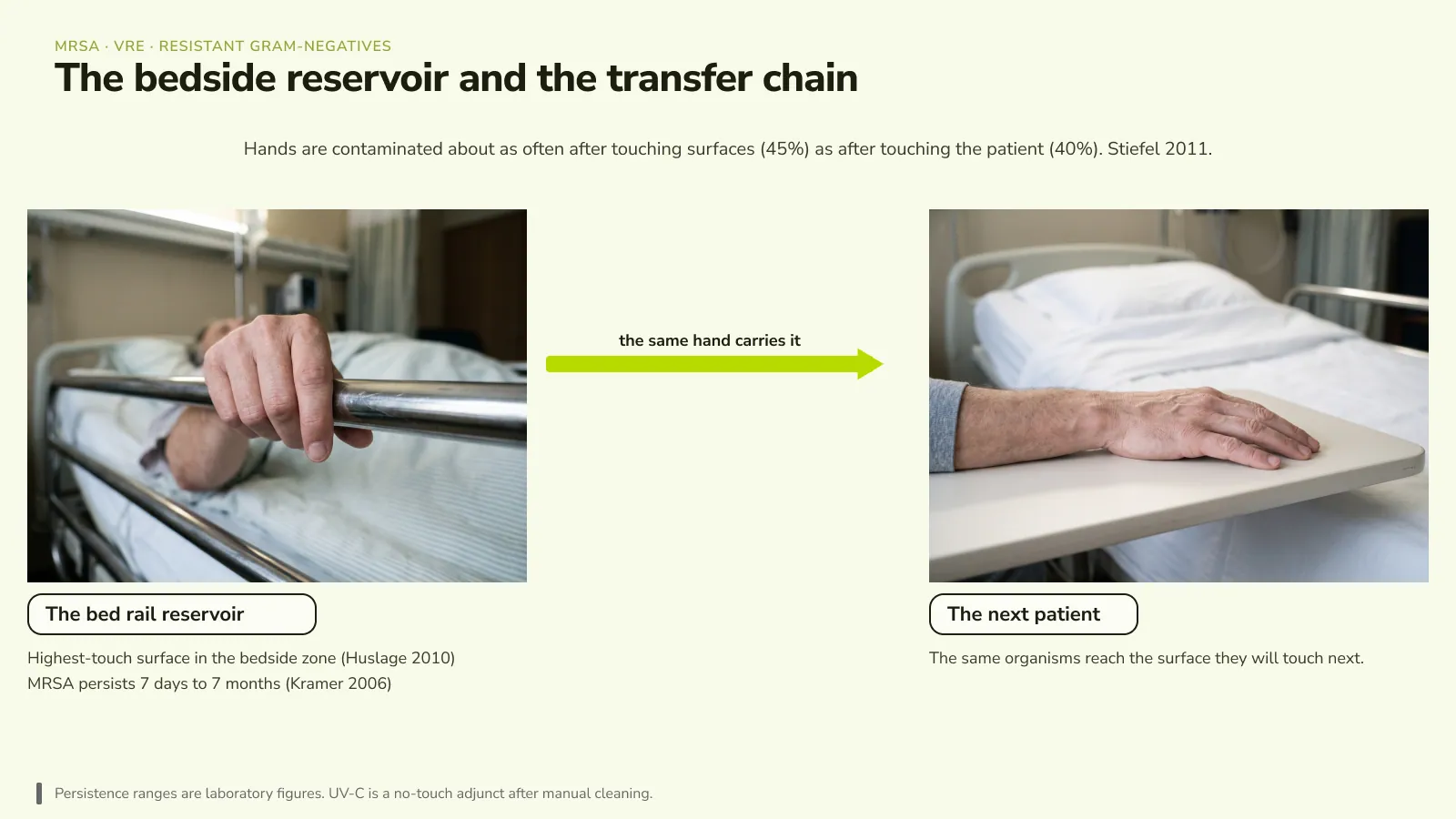
And hands do pick it up. Stiefel and colleagues sampled the hands of staff caring for 40 MRSA carriers and found hand contamination was about as likely after touching environmental surfaces (45 percent) as after touching commonly examined patient skin sites (40 percent).11 It is a single-centre study with a small sample, so hold the exact percentages loosely, but the finding is the one that reframes the bed rail: for your hands, the contaminated surface is roughly as risky a contact as the patient.
Does the environment actually transmit these organisms?
The environment is a genuine route, and the honest reading is that it is one contributor among several rather than the dominant one. Huang and colleagues showed that a patient whose prior room occupant carried MRSA or VRE had higher odds of acquiring that organism: among patients whose predecessor was MRSA-positive, 3.9 percent acquired MRSA versus 2.9 percent when the predecessor was negative, an adjusted odds ratio of 1.4 (P=.04); the VRE figures were 4.5 percent versus 2.8 percent, adjusted odds ratio 1.4 (P=.02).12 The same authors were candid that this route was a minor contributor to overall transmission, accounting for 5.1 percent of incident MRSA and 6.8 percent of VRE.12 Citing the effect without that caveat would overstate our own case, so we state both.
The signal strengthens as the evidence accumulates. Drees and colleagues found VRE acquisition ran at a hazard ratio of 3.1 (95 percent CI 1.6 to 5.8) when the prior occupant was VRE-colonised, rising to 3.8 (95 percent CI 2.0 to 7.4) after adjustment.13 A systematic review and meta-analysis by Mitchell and colleagues pooled the prior-occupant studies to an acquisition odds ratio of 2.14 (95 percent CI 1.65 to 2.77), with the gram-negatives higher at 2.65 (2.02 to 3.47) and the gram-positives at 1.89 (1.62 to 2.21).14 Reviews of the wider mechanism reach the same conclusion: contaminated surfaces contribute materially to the transmission of MRSA, VRE, Acinetobacter and others,15 and touching a contaminated surface is about as likely to contaminate a worker's hands or gloves as touching the patient.16
The point that matters for your programme is that cleaning the room, not only isolating the patient, changes the risk. Datta and colleagues showed that a bleach-based cleaning intervention reduced MRSA and VRE room contamination and reduced the excess acquisition risk that a prior positive occupant confers.17 The reservoir is not fixed. It responds to what you do to the surfaces.
Why does terminal cleaning leave a gap?
Not because of the people doing it, but because of how much has to be cleaned, how fast, and under what pressure. When cleaning thoroughness is measured objectively with fluorescent markers, the numbers are consistent and sobering. Across 23 acute-care hospitals, Carling and colleagues found mean terminal-cleaning thoroughness of standardised high-touch surfaces was 49 percent.18 In a separate study across 36 hospitals, only 48 percent of high-touch surfaces (9,910 of 20,646) were adequately cleaned at baseline; reaching 77 percent required an intensive feedback programme and is not typical of routine practice.19 A synthesis of this work puts the figure at roughly 40 to 50 percent of high-touch surfaces not adequately cleaned during standard terminal disinfection.20
Read that as a systems finding: turnover pressure, the sheer number of surfaces and the minutes available per room leave predictable gaps, and the surfaces most often missed are the high-touch ones this article is about. It is not that a manual clean can be skipped; it is the reason a second, no-touch pass has a job to do.
What does UV-C measurably do, and what did the trial actually show?
Start with what UV-C does to these organisms on a surface, and keep every figure inside its measured conditions. In Nerandzic and colleagues' evaluation, a whole-room mobile UV-C device on a spore cycle delivered a reflected room dose of 22,000 µWs/cm² over roughly 45 minutes and achieved more than 3 to 4 log reduction of VRE and about 2 to 3 log of MRSA and C. difficile spores on inoculated room surfaces, with pathogen-positive cultures in clinical rooms falling by 80 to 93 percent.21 Weber and colleagues' pooled carrier data show the vegetative-versus-spore split clearly: about 25 minutes at 12,000 µW/cm² gave a 4.71 log reduction of MRSA on directly exposed carriers and 4.27 log on indirect ones.22 Every one of those is a coupon or carrier measurement at a stated distance and geometry. None is a room-wide guarantee, and the gap between direct and indirect exposure is exactly why line of sight and shadowing decide the real-room dose, and why a log figure has to be read against the conditions that produced it.
This is where the clinical evidence for UV-C is at its strongest, and it is worth stating precisely. The BETR-D trial, a cluster-randomised, multicentre, crossover study across nine hospitals, compared four terminal-disinfection strategies. Among patients exposed to a room whose prior occupant carried a target organism, adding UV-C to standard quaternary-ammonium cleaning (the UV arm) was associated with a rate ratio of 0.70 (95 percent CI 0.50 to 0.98, p=0.036) for acquisition or infection with any of the four target organisms combined, a result driven mainly by MRSA and VRE.23 That roughly 30 percent reduction is the strongest MDRO outcome the category has. Report its limits in the same breath: bleach alone was not significant (RR 0.85, 95 percent CI 0.69 to 1.04, p=0.116), bleach plus UV was not significant (RR 0.91, 95 percent CI 0.76 to 1.09, p=0.303), and the C. difficile stratum was null (RR 1.00, 95 percent CI 0.57 to 1.75, p=0.997).23 The roughly 30 percent belongs to the UV arm, the room-exposed population, and the four organisms combined; it is not an organism-specific number, and the primary trial does not report a per-organism rate ratio you can quote for MRSA or VRE alone.
A later hospital-wide secondary analysis of the same programme looked at a different population, all patients rather than only the room-exposed, and found a partly different pattern: an overall rate ratio of 0.89 (95 percent CI 0.79 to 1.00, p=0.052, borderline), driven by C. difficile (RR 0.89, 0.80 to 0.99) and VRE (RR 0.56, 0.31 to 0.996), with no hospital-wide MRSA benefit (RR 1.08, 0.89 to 1.30, p=0.42).24 Keep the two analyses separate in your reading. The primary trial is the room-exposed MDRO result you cite for adjunct UV-C; the secondary analysis is a hospital-wide view with a different emphasis, and it shows no hospital-wide MRSA effect. The ROZOR Disinfection Robot is built to deliver that adjunct pass as an autonomous, mapped 254 nm cycle after your team has cleaned, so the dose lands on the high-touch surfaces this evidence is about.
What this means for your programme
The chain is short and each link is evidenced: MDROs persist on surfaces for weeks to months, the bed rail and bedside zone are the reservoir, hands lift the organism from surfaces about as readily as from the patient, manual cleaning reliably reaches only about half of the high-touch surfaces, and adding UV-C to that clean was associated with about 30 percent fewer MDRO acquisitions in the one randomised trial designed to test it.23 The guidance is consistent with treating the environment as a control target: contact precautions plus cleaning and disinfection of MDRO patients' surfaces are core measures.1 Deploy the adjunct where the reservoir and the acuity are highest first, which our guide to terminal disinfection in high-risk areas covers, and match the method to the organism, which our roster of what UV-C acts on sets out. UV-C is a no-touch adjunct after manual cleaning, never a replacement for the manual step. Used that way, on the surfaces that carry these organisms, it earns its place in the bundle.
See how the ROZOR Disinfection Robot puts this to work. It delivers no-touch UV-C disinfection as an adjunct to your cleaning programme, physical AI for critical environments. Learn more about the ROZOR Disinfection Robot.
Frequently asked questions
How long does MRSA survive on a surface?
In laboratory testing, S. aureus including MRSA has persisted on dry inanimate surfaces from 7 days to 7 months. That is a wide, method-dependent range from inoculation-and-recovery studies, not a field half-life, but it confirms the organism can bridge the gap between one room occupant and the next.
Does UV-C reduce MRSA infections?
The strongest evidence, the BETR-D trial, found that adding UV-C to standard cleaning was associated with about 30 percent fewer acquisitions of the four target MDROs combined among room-exposed patients (RR 0.70, 95 percent CI 0.50 to 0.98), driven mainly by MRSA and VRE. A per-organism MRSA-only rate ratio was not reported, and a hospital-wide secondary analysis found no MRSA benefit, so state it as an MDRO-combined result, not an MRSA-specific claim.
Which surfaces carry the most risk?
The bedside zone, and the bed rail above all. It ranks highest for healthcare-worker touch frequency, and the surfaces around an MDRO patient are frequently contaminated, so the bed rail combines high contamination and high contact, which is what moves an organism.
Can these organisms transfer to hands from surfaces?
Yes. Among staff caring for MRSA carriers, hand contamination was about as likely after touching environmental surfaces (45 percent) as after touching the patient's skin (40 percent). For your hands, a contaminated surface is roughly as risky a contact as the patient.
Does a prior room occupant raise the next patient's risk?
It does, modestly. A prior MRSA- or VRE-positive occupant raised the next patient's adjusted odds of acquiring that organism (OR 1.4 for each), and pooled across studies the acquisition odds ratio is 2.14. The original authors called the prior-occupant route a minor contributor to overall transmission, and a bleach-based cleaning intervention reduced the excess risk, so it is a real but addressable route.
Is UV-C a replacement for terminal cleaning?
No. UV-C cannot lift soil off a surface and reaches only what its light can, so it is a no-touch adjunct that runs after a manual clean, never a replacement for it. Manual cleaning reaches only about half of high-touch surfaces on average, which is the gap the adjunct is there to narrow.
Sources
- Siegel JD, Rhinehart E, Jackson M, Chiarello L; HICPAC. "Management of Multidrug-Resistant Organisms in Healthcare Settings, 2006." Centers for Disease Control and Prevention. https://www.cdc.gov/infection-control/hcp/mdro-management/index.html
- Centers for Disease Control and Prevention. "Antibiotic Resistance Threats in the United States, 2019." 2019. https://www.cdc.gov/antimicrobial-resistance/media/pdfs/2019-ar-threats-report-508.pdf
- Centers for Disease Control and Prevention. "MRSA in Healthcare Settings: Infection Control." https://www.cdc.gov/mrsa/hcp/infection-control/index.html
- Centers for Disease Control and Prevention. "Vancomycin-resistant Enterococci (VRE) Basics." https://www.cdc.gov/vre/about/index.html
- Centers for Disease Control and Prevention. "Carbapenem-resistant Enterobacterales (CRE): Infection Control for Healthcare Providers." https://www.cdc.gov/cre/hcp/infection-control/index.html
- Centers for Disease Control and Prevention. "About Acinetobacter." https://www.cdc.gov/acinetobacter/about/index.html
- Kramer A, Schwebke I, Kampf G. "How long do nosocomial pathogens persist on inanimate surfaces? A systematic review." BMC Infectious Diseases 2006;6:130. https://doi.org/10.1186/1471-2334-6-130
- Boyce JM, Potter-Bynoe G, Chenevert C, King T. "Environmental contamination due to methicillin-resistant Staphylococcus aureus: possible infection control implications." Infection Control & Hospital Epidemiology 1997;18(9):622-627. https://www.cambridge.org/core/journals/infection-control-and-hospital-epidemiology/article/abs/environmental-contamination-due-to-methicillinresistant-staphylococcus-aureus-possible-infection-control-implications/EFC89CFF289751035E381AADF0CBECBD
- Hardy KJ, Oppenheim BA, Gossain S, Gao F, Hawkey PM. "A study of the relationship between environmental contamination with methicillin-resistant Staphylococcus aureus (MRSA) and patients' acquisition of MRSA." Infection Control & Hospital Epidemiology 2006;27(2):127-132. https://pubmed.ncbi.nlm.nih.gov/16465628/
- Huslage K, Rutala WA, Sickbert-Bennett E, Weber DJ. "A quantitative approach to defining high-touch surfaces in hospitals." Infection Control & Hospital Epidemiology 2010;31(8):850-853. https://www.cambridge.org/core/journals/infection-control-and-hospital-epidemiology/article/quantitative-approach-to-defining-hightouch-surfaces-in-hospitals/47211D8DC5A1353B4C7910D6C415A234
- Stiefel U, Cadnum JL, Eckstein BC, Guerrero DM, Tima MA, Donskey CJ. "Contamination of hands with methicillin-resistant Staphylococcus aureus after contact with environmental surfaces and after contact with the skin of colonized patients." Infection Control & Hospital Epidemiology 2011;32(2):185-187. https://pubmed.ncbi.nlm.nih.gov/21460476/
- Huang SS, Datta R, Platt R. "Risk of acquiring antibiotic-resistant bacteria from prior room occupants." Archives of Internal Medicine 2006;166(18):1945-1951. https://pubmed.ncbi.nlm.nih.gov/17030826/
- Drees M, Snydman DR, Schmid CH, et al. "Prior environmental contamination increases the risk of acquisition of vancomycin-resistant enterococci." Clinical Infectious Diseases 2008;46(5):678-685. https://pubmed.ncbi.nlm.nih.gov/18230044/
- Mitchell BG, Dancer SJ, Anderson M, Dehn E. "Risk of organism acquisition from prior room occupants: a systematic review and meta-analysis." Journal of Hospital Infection 2015;91(3):211-217. https://doi.org/10.1016/j.jhin.2015.08.005
- Otter JA, Yezli S, French GL. "The role played by contaminated surfaces in the transmission of nosocomial pathogens." Infection Control & Hospital Epidemiology 2011;32(7):687-699. https://doi.org/10.1086/660363
- Weber DJ, Rutala WA, Miller MB, Huslage K, Sickbert-Bennett E. "Understanding and preventing transmission of healthcare-associated pathogens due to the contaminated hospital environment." Infection Control & Hospital Epidemiology 2013;34(5):449-452. https://doi.org/10.1086/670223
- Datta R, Platt R, Yokoe DS, Huang SS. "Environmental cleaning intervention and risk of acquiring multidrug-resistant organisms from prior room occupants." Archives of Internal Medicine 2011;171(6):491-494. https://doi.org/10.1001/archinternmed.2011.64
- Carling PC, Parry MM, Von Beheren SM; Healthcare Environmental Hygiene Study Group. "Identifying opportunities to enhance environmental cleaning in 23 acute care hospitals." Infection Control & Hospital Epidemiology 2008;29(1):1-7. https://doi.org/10.1086/524329
- Carling PC, Parry MF, Rupp ME, Po JL, Dick B, Von Beheren S. "Improving cleaning of the environment surrounding patients in 36 acute care hospitals." Infection Control & Hospital Epidemiology 2008;29(11):1035-1041. https://pubmed.ncbi.nlm.nih.gov/18851687/
- Carling PC, Bartley JM. "Evaluating hygienic cleaning in health care settings: what you do not know can harm your patients." American Journal of Infection Control 2010;38(5 Suppl 1):S41-S50. https://doi.org/10.1016/j.ajic.2010.03.004
- Nerandzic MM, Cadnum JL, Pultz MJ, Donskey CJ. "Evaluation of an automated ultraviolet radiation device for decontamination of Clostridium difficile and other healthcare-associated pathogens in hospital rooms." BMC Infectious Diseases 2010;10:197. https://doi.org/10.1186/1471-2334-10-197
- Weber DJ, Rutala WA, Anderson DJ, Chen LF, Sickbert-Bennett EE, Boyce JM. "Effectiveness of ultraviolet devices and hydrogen peroxide systems for terminal room decontamination: focus on clinical trials." American Journal of Infection Control 2016;44(5 Suppl):e77-e84. https://doi.org/10.1016/j.ajic.2015.11.015
- Anderson DJ, Chen LF, Weber DJ, et al. "Enhanced terminal room disinfection and acquisition and infection caused by multidrug-resistant organisms and Clostridium difficile (the Benefits of Enhanced Terminal Room Disinfection study): a cluster-randomised, multicentre, crossover study." The Lancet 2017;389(10071):805-814. https://doi.org/10.1016/S0140-6736(16)31588-4
- Anderson DJ, Moehring RW, Weber DJ, et al. "Effectiveness of targeted enhanced terminal room disinfection on hospital-wide acquisition and infection with multidrug-resistant organisms and Clostridium difficile: a secondary analysis of a multicentre cluster randomised controlled trial with crossover design (BETR Disinfection)." The Lancet Infectious Diseases 2018;18(8):845-853. https://pmc.ncbi.nlm.nih.gov/articles/PMC6487496/