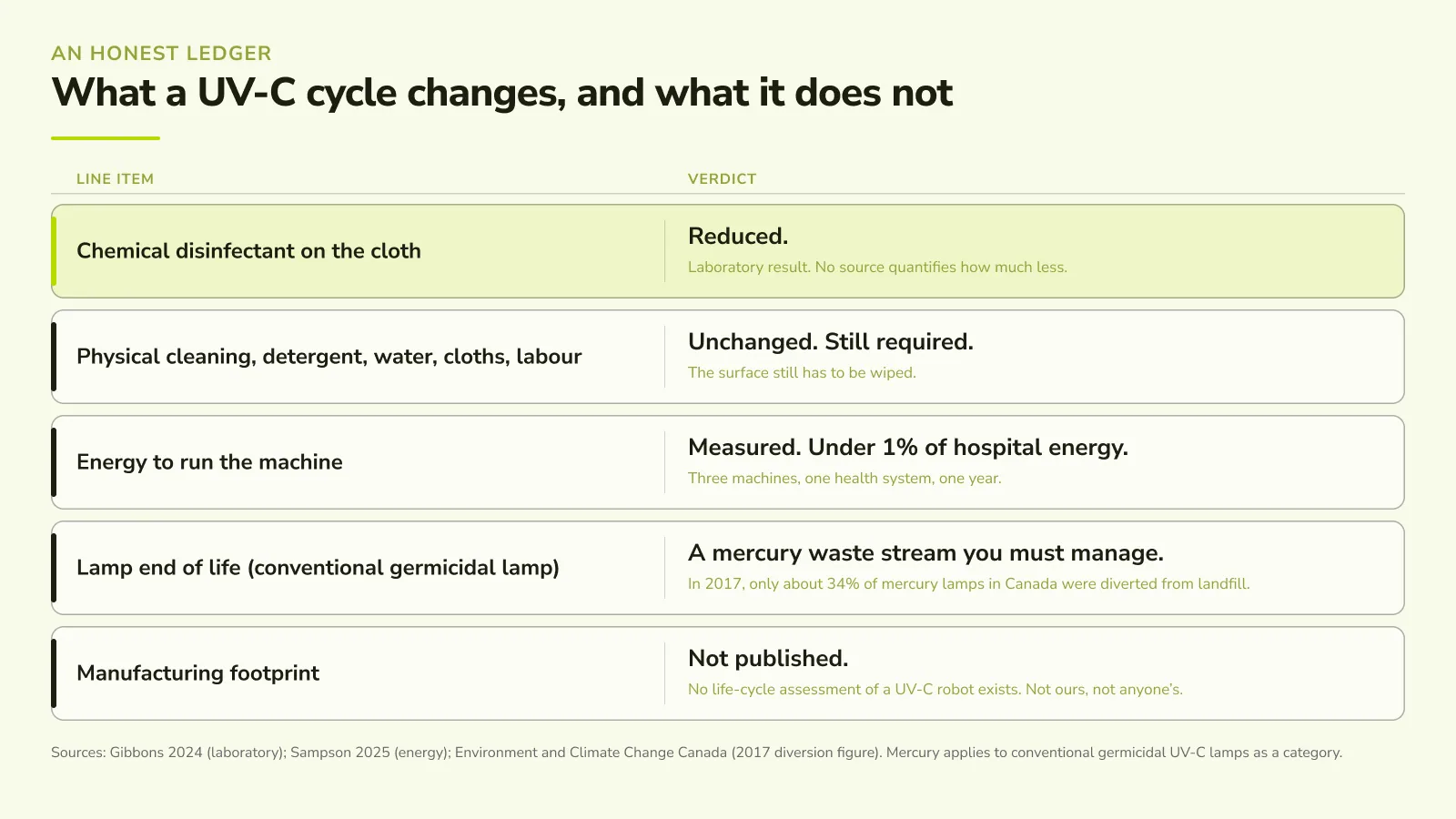
Sustainable disinfection means a lower chemical disinfectant load, never zero. A UV-C cycle cannot take the cloth out of a cleaner's hand, because the surface still has to be wiped. What it can change is what is on the cloth. The ledger cuts both ways: a conventional germicidal lamp contains mercury, so ask what happens to that lamp.
Somewhere in the sustainability plan on your desk is a line about cleaning chemicals, and it is probably the vaguest line in the document. Behind it sits a real conflict: the chemicals that protect your patients are the ones your environmental services team breathes and your drains carry away. Canada's healthcare system accounts for 4.6 percent of national greenhouse gas emissions, roughly 90 percent of it upstream in purchased goods,1 and the Joint Commission International's 8th edition, effective 1 January 2025, added an all-new chapter on environmental sustainability, Global Health Impact.2 This article is the honest ledger: what a no-touch UV-C cycle takes off the chemical side, what it never takes off, and what it adds back.
What can a UV-C cycle actually take off the chemical load?
One part of it, and a specific part: the disinfectant, on the routine surfaces the light reaches. Under the Spaulding framework, non-critical surfaces, the bed rails and cuffs and bedside tables that make up most of a room, need only low-level disinfection.3
The closest thing to a direct test is a 2024 laboratory study. Researchers inoculated 270 polycarbonate slides with a pathogenic Staphylococcus aureus strain under four soiling conditions. One arm used a quaternary-ammonium and alcohol germicidal wipe. The other wiped once with a microfibre cloth dampened with sterile water alone, then gave the slides 21 minutes of UV-C at a mean delivered dose of roughly 361 to 363 millijoules per square centimetre. All 144 slides in the water-and-UV-C arm came back with no recoverable colonies, regardless of soiling, matching the germicidal wipes.4 Its limits matter as much as its finding: a bench study on plastic slides in a low-barrier journal, one vegetative organism at one dose and one geometry, with its own authors calling for a clinical trial against usual care.4 It says nothing about spores, and nothing about a real room.
Then look at what the winning arm still did. It wiped the slide. Soil has to come off a surface before any disinfectant, or any photon, can act on what sits underneath it,5 and in real rooms manual post-discharge cleaning by environmental services staff significantly reduced floor contamination on its own, with UV-C effective as an adjunct to that cleaning.6 The person cleans, then the machine runs.
So here is the sentence the rest of this article rests on. A UV-C cycle cannot take the cloth out of a cleaner's hand, because the surface still has to be wiped or the soil will shield whatever sits under it. What it can change is what is on the cloth.
An autonomous, mobile, no-touch robot, the ROZOR Disinfection Robot among them, occupies that slot: a cycle in the vacated room, after your team finishes the manual clean. One number this article will not give you is how much less disinfectant, because nobody has measured how much chemical a UV-C cycle displaces in a working hospital. A vendor who offers you that percentage has offered you a number that does not exist.
What does the chemical load cost?
Two costs, and the first is measured in people.
What does it cost the people who apply it?
Start with the most exposed people in the building. A systematic review of 39 studies of occupational cleaners, 21 of them pooled for asthma, found elevated risk of both asthma (meta-relative risk 1.50, 95% CI 1.44 to 1.56) and COPD (meta-relative risk 1.43, 95% CI 1.31 to 1.56).7 The people who hold the cloth for a whole shift are the most exposed group in this literature. The authors add that none of the included studies had quantitative exposure assessment, so the causal agent is not pinned, and the action that stays open to you is concrete: look at your own product inventory, and at where the heaviest applications land.
One hospital shows the whole trade-off in a single decision. A large multispecialty hospital brought in a stronger surface disinfectant, hydrogen peroxide with peracetic acid and acetic acid, to fight healthcare-associated infections. Its staff raised concerns, and a survey of 163 employees found product users reporting significantly more work-related wheeze and watery eyes than non-users, with a threefold excess of current asthma in the highest-exposure department (standardised morbidity ratio 3.47, 95% CI 1.48 to 8.13).8 The hospital did the right infection-control thing. Its staff paid for it in their airways. That is the trade-off a no-touch cycle exists to loosen, and the two methods are compared side by side in UV-C vs chemical disinfection.
Clinical staff carry a smaller version of the same exposure, and here the popular version of the story is wrong. In a prospective cohort of 73,262 US female nurses followed from 2009 to 2015, weekly use of disinfectants to clean surfaces was associated with a 38 percent higher rate of newly diagnosed chronic obstructive pulmonary disease (adjusted hazard ratio 1.38, 95% CI 1.13 to 1.68).9 That is COPD incidence, in nurses.
Now the half a vendor will not tell you. In the same cohort, over the same years, weekly disinfectant use showed no association with new-onset asthma at all (adjusted hazard ratio 1.12, 95% CI 0.91 to 1.38).10 Anyone selling a robot on the line that disinfectants give nurses asthma is quoting a study that found the opposite. In nurses the asthma evidence concerns the control of existing disease. Among 4,102 nurses who already had asthma, weekly use of disinfectants to clean instruments was associated with very poorly controlled asthma (odds ratio 1.88, 95% CI 1.38 to 2.56).11 Two populations, three endpoints. They do not collapse into one headline.
These are observational associations, not proof that a disinfectant causes a disease, and a board paper should say so. The direction is still consistent enough to act on, and the action is not the one people assume. Nobody is proposing your environmental services team stop cleaning, and nothing here is a verdict on how well they do it: the measurement above found their manual clean works.6 The chemical is the hazard, never the person holding it. A no-touch cycle applies no chemical and runs in an empty room, so on the surfaces it treats there is nothing to aerosolise and nobody there to breathe it. Your team keeps the room; the machine takes an application off the cloth, a distinction taken up in will robots replace healthcare workers?
What does it cost downstream of the drain?
The wipe ends. The molecule does not. Quaternary ammonium compounds are the workhorse of hospital surface disinfection, and a 28-author consensus review published in 2023 found them acutely toxic to aquatic life at very low concentrations, with algal median effective concentrations reported as low as 11 to 14 micrograms per litre, wastewater effluent in the tens of micrograms per litre, and QAC levels in aquatic ecosystems approaching protective toxicity thresholds. Use rose sharply through the pandemic, when QACs became the active ingredient in about half the products on the US EPA's list of registered SARS-CoV-2 disinfectants, and median total blood levels in human biomonitoring ran 77 percent higher than before it.12 The same authors record their own limits, and those limits keep this an argument about load. The persistence of QACs in soils remains largely unexplored, and evidence of QAC effectiveness at reducing disease transmission in real-world settings is itself limited.12
What is not in doubt is the shape of the problem. Every application of a chemical disinfectant is one a hospital has to buy, store, apply, breathe near and eventually send down a drain, and the only lever a UV-C cycle offers is how many of those applications a vacated room's routine surfaces actually require. That is the chemical side of the ledger. Now turn to the machine, and start with the entry nobody in this industry volunteers.
Does a UV-C lamp contain mercury?
Yes. A conventional germicidal UV-C lamp is a low-pressure mercury-vapour lamp, and the 253.7 nm line that does the germicidal work is a mercury emission line.13 More than 90 percent of such a lamp's radiative output sits at that wavelength, and the peer-reviewed engineering literature lists mercury as a toxic environmental contaminant among the technology's disadvantages.14 The mercury is what makes the light. Here is the whole of it, the parts in our favour and the parts against.
What does the Minamata Convention actually cover?
Not germicidal lamps. This is the most misreported fact in the subject, and a first-pass web search will hand you the wrong answer.
The Convention binds its Parties through Article 4, paragraph 1, which prohibits the manufacture, import or export of mercury-added products listed in Part I of Annex A after the phase-out date specified for them.15 The obligation attaches only to listed products; there is no residual catch-all. In the current Annex, amended by Decision MC-6/3 at the sixth Conference of the Parties in Geneva in November 2025, every mercury-lamp entry is qualified on its face: compact, linear, non-linear and high-pressure mercury-vapour lamps are listed "for general lighting purposes," and cold- and external-electrode fluorescent lamps "for electronic displays." No entry in that table covers germicidal, ultraviolet, disinfection or sterilization lamps, and the treaty text does not use those words at all.1516
So the accurate statement is narrow. Germicidal lamps are not exempt from the Convention, and they are not excluded from it. They were never listed, so the phase-out obligation does not reach them, and even for the lamps it does list that obligation governs manufacture, import and export, not use.15
What does Canada require?
More than the treaty does, and Canada says so itself. The Products Containing Mercury Regulations run the opposite way round from Annex A: manufacture and import are prohibited unless the product is a listed category in Schedule 1, within its mercury limit and before its end date. General-lighting fluorescent lamps hit their end date on 31 December 2025, and high-pressure sodium and metal-halide lamps for general lighting follow at the end of 2028. "Fluorescent or discharge lamps used for air or surface purification, sterilization, sanitization, treatment or disinfection" sit in Schedule 1 with no mercury limit and no end date.17 The regulator's own impact statement is blunt: Canada "goes beyond the requirements of the Convention by broadly prohibiting the manufacture and import of mercury-containing products, while allowing for some exemptions," and its phase-out covers "all mercury-containing lamp manufacturing and imports, except those used for air and water treatment, for growing plants, as well as specialty fluorescent and discharge lamps falling under the catch-all category."18
A country that chose to go further than a global mercury treaty required looked specifically at air- and surface-disinfection lamps and left them without a mercury limit or an end date. That is the strongest fact available to UV-C on this subject, and it is a real one.
Permission is not absolution
It is also not the end of the ledger. Those lamps must still carry a statement that the product contains mercury, safe-handling procedures, the measures to be taken in case of accidental breakage, the options for disposal and recycling, and the Hg symbol.17
And the management is not going well. Environment and Climate Change Canada reports that in 2017 only about 34 percent of lamps containing mercury were diverted, with provincial extended-producer-responsibility programmes ranging from about 15 to 46 percent diversion, and that lamps contributed roughly 300 kilograms of mercury improperly disposed of in landfills. Mercury content per lamp ranges from under 1 milligram to more than 1,000.19 Nobody should claim mercury lamps are routinely recycled. On Canada's own 2017 figure, about two thirds of them were not even diverted from landfill.
A mercury UV-C lamp is not, in itself, the environmental problem. The mercury it holds, a few milligrams, is sealed in glass and stays contained for the lamp's whole working life.
The problem is specific, and it sits at the end of that life. The mercury only reaches the environment if the lamp is broken or sent to landfill,17 and a real collection-and-recycling route captures it and keeps it out of the environment.19 Every germicidal UV-C lamp contains mercury, so that question sorts no vendor from another. What sorts them is what happens to the lamp when it dies.
So here is what you do about it, and you do it in procurement. Put these to every vendor you shortlist, ROZOR included. What lamp technology is in the emitter, and at what wavelength? How much mercury is in a lamp, and how many lamps are in the machine? What is the rated lamp life? Is there a take-back route at end of life, and which provincial programme handles it? What is the breakage procedure, and does it fit our hazardous-materials plan? Canadian regulation already requires a vendor to supply that last one in writing.17 A supplier who cannot answer the rest has not thought about the end of the lamp's life, and one who answers with a confident number they cannot source has told you something worse. This is also where a mercury lamp lands in your accreditation programme: in facility management and safety, with every other hazardous material in the building.2
Will UV-C LEDs or far-UVC make the mercury question go away?
Not for whole-room dosing, and not yet. A low-pressure mercury lamp converts about 25 percent of the power it draws into germicidal light and emits it in watts. UV-C LEDs, per the peer-reviewed 2020 emitter roadmap, produce 1 to 100 milliwatts at a wall-plug efficiency of about 2 to 3 percent: roughly an order of magnitude in efficiency and two to three orders of magnitude in output per emitter. The roadmap concludes that "large scale application of UV-LEDs will require substantial advances in the performance levels" of those emitters,13 and a separate engineering review found UV-LED in-duct air systems existing in the prototype stage only, mainly because LED output power is limited.14 LEDs will get there. They are not there.
Far-UVC is the other alternative you will hear named, and this distinction is one to hold a vendor to. It means krypton-chloride excimer lamps at 222 nm: a different lamp, mercury-free, tolerable around people for reasons specific to that wavelength, and studied mainly for airborne pathogens in occupied rooms, a different job from dosing surfaces in an empty one.20 Its mercury-free status and its safety profile belong to it and transfer to nothing else. A 254 nm device inherits neither, and a vendor who lets the two blur is not being careful with your decision. Device class is an efficacy and safety variable in its own right, the subject of not all UV-C devices are equal.
Which leaves the hazard of 254 nm itself, best read as a scope rather than a fault. Conventional germicidal UV is a hazard to skin and eyes, and it is used to disinfect unoccupied spaces for exactly that reason.20 The cycle runs in an empty room by design, which is also why the chemical exposure it displaces has nobody standing in it. What the light does once it arrives is covered in how UV-C disinfection works.
What is the footprint of the robot itself?
Half of that question has an answer, and half does not. The powered half is good news. A retrospective analysis at Stanford Health Care took the run-time logs of three UV disinfection machines across a year, from September 2023 to August 2024, multiplied them by equipment wattage, and arrived at approximately 7,300 kWh: less than 1 percent of the health system's total energy use for the period.21 It is a conference abstract drawn from vendor run-time logs at one institution, and read as such it still answers the question people ask first. The machine is not power-hungry.
The manufactured-and-disposed-of half is where we have to say what we do not know. No life-cycle assessment of a UV-C disinfection robot has been published that we can find. Not ours, not anyone's. That gap is uncomfortable for us, because a robot is a purchased good and roughly 90 percent of Canadian healthcare's emissions sit upstream in purchased goods.1 A machine arrives on your loading dock with an embodied footprint already on it, and neither we nor our competitors can currently give you the number.
What we can give you is the right question, because your hospital already asks it of other equipment. When researchers ran a life-cycle assessment and costing on a decision as ordinary as laryngoscopes, single-use plastic handles produced 16 to 18 times the carbon-dioxide equivalent of low-level disinfection of reusable steel ones.22 The measure that mattered was impact per use across a service life: a wipe is made, used once and thrown away, while a durable machine amortises its footprint across thousands of cycles. Judge a disinfection robot in that frame, and judge us in it as soon as someone publishes the number. Until then, ask for it, and notice who invents one.
Is UV-C redundant if you already use a sporicidal cleaner?
It can be, and the paper just cited for the energy figure says so in the same breath: "Recent data suggests that there may be no additional benefit to UV light disinfection when other enhanced cleaning methods, such as sporicidal cleaners, are utilized. Therefore, using UV light in addition to sporicidal cleaners may be redundant."21 The objection is fair, and it deserves a straight answer.
Its foundation is BETR-D, a large multi-centre randomised trial of UV-C in hospital rooms. In the arm where UV-C was added to standard quaternary-ammonium terminal cleaning, patients later admitted to those rooms acquired or were infected by four target multidrug-resistant organisms about 30 percent less often (risk ratio 0.70, 95% CI 0.50 to 0.98). But in the Clostridioides difficile stratum the trial compared bleach plus UV-C against bleach alone, and the result was flatly null (risk ratio 1.00, 95% CI 0.57 to 1.75, p=0.997).23 Bleach is already sporicidal, so adding a UV-C cycle on top of an already-sporicidal protocol produced no further drop in C. difficile infection, which is a much narrower statement than "UV-C does not work," and a much more useful one.
Apply that here and it lands with force. Bolt a UV-C cycle on top of an unchanged chemical protocol and you have added a machine and removed nothing. In that scenario the redundancy objection is not merely fair; it is correct, and the sustainability case is zero. Energy in, no chemical out.
The argument only works the other way round. It is a substitution argument, about the routine, non-critical surfaces where a low-level disinfectant was the whole requirement,3 with the cycle running in the vacated room after the manual clean,5 and with the no-touch pass as one component of a five-part environmental-hygiene bundle alongside policy, product selection, staff education, and monitoring with feedback.24 The sporicide stays where the organism demands it, including the C. difficile room, and comes off the surfaces where it was never the requirement. That is a smaller claim than the one most vendors make, and the only one the evidence will carry.
What should you change first?
Not the robot. A 2022 life-cycle assessment compared reusable cotton and microfibre cloths against single-use cloths, each paired with three compatible disinfectants, across 16 environmental-impact categories and 8 human-health categories. The most environmentally sustainable option it found was a microfibre cloth used with a quaternary ammonium compound. The disinfectant with the highest environmental impact was isopropyl alcohol, and the least sustainable combination of all was cotton with isopropyl alcohol. Most of the impact traced to the disinfectant agent itself and to transport, and the infection-prevention policies the authors reviewed do not require single-use wipes.25
That cuts against us twice, and it should be said out loud. The greenest cleaning option in the published literature still uses a chemical, and its levers, a reusable cloth in place of a single-use one and a better-chosen disinfectant, cost nothing and involve no machine at all. Fix the cloth and the chemistry first, because those levers are free and evidenced. Then ask what a no-touch pass can lift off the surfaces where a low-level disinfectant was all that was ever required. The robot comes last in that sequence, and that is where it belongs.
Where does a lower chemical load actually count?
In three places you already answer to. Your disinfection programme lives, as it always has, in prevention and control of infections. A mercury lamp lives in facility management and safety. And since the Joint Commission International's 8th edition took effect on 1 January 2025, environmental sustainability has a chapter of its own, Global Health Impact, developed with the International Hospital Federation's Geneva Sustainability Centre. JCI's own text set the transition: standards in that chapter would be scored but would not factor into an organization's accreditation decision for organizations surveyed before 1 January 2026.2 That date has passed, so for a survey today it counts. The full picture is set out in UV-C disinfection and JCI accreditation.
Procurement is moving the same way. NHS England's Net Zero Supplier Roadmap requires suppliers, from April 2027, to report emissions publicly and publish a carbon reduction plan covering Scopes 1, 2 and 3; from April 2028, to provide product-level carbon footprints; and from 2030, to demonstrate progress in order to qualify for NHS contracts at all.26 That is England, and a Canadian hospital is not bound by it. Read it as the direction of travel, because any supplier of disinfection equipment will be asked these questions. We would rather be asked early.
What the ledger says
A UV-C cycle can take a chemical disinfectant off the routine surfaces in a vacated room, and one laboratory study found light plus a water-damp cloth holding its own against a germicidal wipe on the single organism it tested.4 Nobody can tell you how much less chemical that means in a working hospital, because nobody has measured it. The wipe, the detergent, the water, the cloth and the person all stay where they are. The machine draws power, and the measured amount is small.21 A conventional germicidal lamp contains mercury that Canada permits with no mercury limit and no end date, while still requiring you to label, handle and recycle it,17 and that, on Canada's 2017 figures, most such lamps were not even diverted from landfill.19 The footprint of building the machine has not been published by anyone, us included.
No marketing department would write that ledger. It is, however, the one you can carry into a procurement committee and defend line by line, and that is the only kind worth having. A no-touch cycle moves one line of it, moves it in the right direction, and tells you the truth about the rest. Start with the cloth and the chemistry. Then ask what the light can carry.
See how the ROZOR Disinfection Robot fits your cleaning programme. The ROZOR Disinfection Robot delivers no-touch UV-C disinfection as an adjunct to your cleaning programme, physical AI for critical environments. Learn more about the ROZOR Disinfection Robot.
Frequently asked questions
What is sustainable disinfection in a hospital?
A lower chemical load, not the end of chemicals. The surface still has to be physically wiped, so detergent, water, cloths and the person doing the work all stay. What can change is what is on the cloth for the routine, non-critical surfaces that only ever required low-level disinfection, plus two things needing no technology at all: reusable microfibre instead of single-use cloths, and a better-chosen disinfectant.
Does UV-C reduce how much chemical disinfectant a hospital uses?
On the surfaces it reaches, the disinfectant is the part of the process light can stand in for. In a 2024 laboratory study, a microfibre cloth with plain water followed by 21 minutes of UV-C left no recoverable S. aureus on soiled slides, matching a germicidal wipe. That is a bench result on one organism, not a hospital trial. No study has quantified how much disinfectant a real hospital displaces, so treat any percentage you are offered as unsourced.
Do UV-C lamps contain mercury?
Conventional germicidal UV-C lamps do. They are low-pressure mercury-vapour lamps, and the 253.7 nm germicidal line is a mercury emission line. The Minamata Convention lists mercury lamps only "for general lighting purposes" or "for electronic displays," so germicidal lamps are never listed and its phase-out does not reach them. Canada permits lamps for air and surface disinfection with no mercury limit and no end date, while still requiring the Hg symbol, breakage instructions and recycling options.
Are hospital disinfectants harmful to cleaning and clinical staff?
Name the population and the endpoint. In nurses, weekly surface-disinfectant use was associated with a 38 percent higher rate of newly diagnosed COPD, while new-onset asthma showed no association at all. Among nurses who already had asthma, disinfectant use was associated with poorer control. The asthma-incidence signal appears in occupational cleaners, a more exposed group, at a meta-relative risk of 1.50. These are observational associations, not proof of causation.
Are UV-C LEDs a mercury-free alternative?
Not for whole-room dosing today. In the peer-reviewed 2020 emitter roadmap, UV-C LEDs emit 1 to 100 milliwatts at about 2 to 3 percent wall-plug efficiency, against roughly 25 percent and watts of output for a low-pressure mercury lamp, and the roadmap concludes that large-scale application will require substantial advances. Far-UVC at 222 nm is mercury-free but a different device class, studied mainly for airborne pathogens in occupied rooms.
What is the environmental footprint of a UV-C disinfection robot?
Partly answered. Three UV machines at one US health system drew approximately 7,300 kWh across a year, under 1 percent of its total energy use. Manufacture and disposal are not answered: no life-cycle assessment of a UV-C disinfection robot has been published, and roughly 90 percent of Canadian healthcare's emissions sit upstream in purchased goods. The right measure is impact per use across a service life, the same question a hospital asks of reusable versus single-use equipment.
Sources
- Eckelman MJ, Sherman JD, MacNeill AJ. "Life cycle environmental emissions and health damages from the Canadian healthcare system: An economic-environmental-epidemiological analysis." PLoS Medicine 2018;15(7):e1002623. https://journals.plos.org/plosmedicine/article?id=10.1371/journal.pmed.1002623
- Joint Commission International. "Joint Commission International Accreditation Standards for Hospitals, 8th Edition" (official sample pages: Contents, Effective Date, Summary of Changes). Joint Commission Resources; 2024. https://digitalassets.jointcommission.org/api/public/content/assets/3/7/ebjcih24_sample_pages.pdf
- Rutala WA, Weber DJ. "A Rational Approach to Disinfection and Sterilization" (Spaulding classification). U.S. Centers for Disease Control and Prevention. https://www.cdc.gov/infection-control/hcp/disinfection-sterilization/rational-approach.html
- Gibbons S, Dexter F, Loftus RW, et al. "Surface Cleaning With a Microfiber Cloth and Water Followed by Ultraviolet-C Light Exposure Achieves Non-Inferior Disinfection of a Pathogenic Staphylococcus aureus Strain Versus Use of Germicidal Wipes." Cureus 2024;16(8):e65963. https://pmc.ncbi.nlm.nih.gov/articles/PMC11365582/
- Rutala WA, Weber DJ, and the Healthcare Infection Control Practices Advisory Committee (HICPAC). "Guideline for Disinfection and Sterilization in Healthcare Facilities, 2008" (updated). U.S. Centers for Disease Control and Prevention. https://www.cdc.gov/infection-control/hcp/disinfection-and-sterilization/index.html
- Mustapha A, Alhmidi H, Cadnum JL, Jencson AL, Donskey CJ. "Efficacy of manual cleaning and an ultraviolet C room decontamination device in reducing health care-associated pathogens on hospital floors." American Journal of Infection Control 2018;46(5):584-586. https://pubmed.ncbi.nlm.nih.gov/29306489/
- Archangelidi O, Sathiyajit S, Consonni D, Jarvis D, De Matteis S. "Cleaning products and respiratory health outcomes in occupational cleaners: a systematic review and meta-analysis." Occupational and Environmental Medicine 2021;78(8):604-617. https://pubmed.ncbi.nlm.nih.gov/33234692/
- Casey ML, Hawley B, Edwards N, Cox-Ganser JM, Cummings KJ. "Health problems and disinfectant product exposure among staff at a large multispecialty hospital." American Journal of Infection Control 2017;45(10):1133-1138. https://pubmed.ncbi.nlm.nih.gov/28549881/
- Dumas O, Varraso R, Boggs KM, et al. "Association of Occupational Exposure to Disinfectants With Incidence of Chronic Obstructive Pulmonary Disease Among US Female Nurses." JAMA Network Open 2019;2(10):e1913563. https://pubmed.ncbi.nlm.nih.gov/31626315/
- Dumas O, Boggs KM, Quinot C, et al. "Occupational exposure to disinfectants and asthma incidence in U.S. nurses: A prospective cohort study." American Journal of Industrial Medicine 2020;63(1):44-50. https://pmc.ncbi.nlm.nih.gov/articles/PMC6891131/
- Dumas O, Wiley AS, Quinot C, et al. "Occupational exposure to disinfectants and asthma control in US nurses." European Respiratory Journal 2017;50(4):1700237. https://pmc.ncbi.nlm.nih.gov/articles/PMC5702691/
- Arnold WA, Blum A, Branyan J, et al. "Quaternary Ammonium Compounds: A Chemical Class of Emerging Concern." Environmental Science & Technology 2023;57(20):7645-7665. https://pmc.ncbi.nlm.nih.gov/articles/PMC10210541/
- Amano H, Collazo R, De Santi C, et al. "The 2020 UV emitter roadmap." Journal of Physics D: Applied Physics 2020;53(50):503001. https://doi.org/10.1088/1361-6463/aba64c
- Luo H, Zhong L. "Ultraviolet germicidal irradiation (UVGI) for in-duct airborne bioaerosol disinfection: Review and analysis of design factors." Building and Environment 2021;197:107852. https://pmc.ncbi.nlm.nih.gov/articles/PMC8021448/
- United Nations Environment Programme. "Minamata Convention on Mercury: Text and Annexes." Adopted 10 October 2013; in force 16 August 2017. https://minamataconvention.org/sites/default/files/2021-06/Minamata-Convention-booklet-Sep2019-EN.pdf
- Conference of the Parties to the Minamata Convention on Mercury. "Decision MC-6/3: Amendments to Annex A." In: Decisions adopted at its sixth meeting, UNEP/MC/COP.6/25/Add.1. Geneva, 3-7 November 2025. https://minamataconvention.org/sites/default/files/documents/final_report_and_outcomes/UNEP-MC-COP6-25-Add1-Compilation-Decisions%20-%20ADVANCE.pdf
- Government of Canada. "Products Containing Mercury Regulations," SOR/2014-254 (as amended by SOR/2024-109), Canadian Environmental Protection Act, 1999. Justice Laws Website. https://laws-lois.justice.gc.ca/eng/regulations/SOR-2014-254/FullText.html
- Canada Gazette, Part II, Vol. 158, No. 13. "Regulations Amending the Products Containing Mercury Regulations (SOR/2024-109), Regulatory Impact Analysis Statement." 19 June 2024. https://gazette.gc.ca/rp-pr/p2/2024/2024-06-19/html/sor-dors109-eng.html
- Environment and Climate Change Canada. "National strategy for lamps containing mercury." Government of Canada. https://www.canada.ca/en/environment-climate-change/services/pollutants/mercury-environment/strategy-lamps-mercury/strategy.html
- Buonanno M, Welch D, Shuryak I, Brenner DJ. "Far-UVC light (222 nm) efficiently and safely inactivates airborne human coronaviruses." Scientific Reports 2020;10:10285. https://pmc.ncbi.nlm.nih.gov/articles/PMC7314750/
- Sampson M, Do A, Fox P, et al. "Assessing the impact of ultraviolet light disinfection on energy use at Stanford Health Care." Antimicrobial Stewardship & Healthcare Epidemiology 2025;5(S2):s95. https://pmc.ncbi.nlm.nih.gov/articles/PMC12461531/
- Sherman JD, Raibley LA 4th, Eckelman MJ. "Life Cycle Assessment and Costing Methods for Device Procurement: Comparing Reusable and Single-Use Disposable Laryngoscopes." Anesthesia & Analgesia 2018;127(2):434-443. https://pubmed.ncbi.nlm.nih.gov/29324492/
- Anderson DJ, Chen LF, Weber DJ, et al. "Enhanced terminal room disinfection and acquisition and infection caused by multidrug-resistant organisms and Clostridium difficile (the Benefits of Enhanced Terminal Room Disinfection study): a cluster-randomised, multicentre, crossover study." The Lancet 2017;389(10071):805-814. https://pubmed.ncbi.nlm.nih.gov/28104287/
- Rutala WA, Weber DJ. "Best practices for disinfection of noncritical environmental surfaces and equipment in health care facilities: A bundle approach." American Journal of Infection Control 2019;47(Suppl):A96-A105. https://doi.org/10.1016/j.ajic.2019.01.014
- Maloney B, McKerlie T, Nasir M, et al. "The environmental footprint of single-use versus reusable cloths for clinical surface decontamination: a life cycle approach." Journal of Hospital Infection 2022;130:7-19. https://pubmed.ncbi.nlm.nih.gov/36115619/
- NHS England. "NHS Net Zero Supplier Roadmap." Greener NHS; 2024. https://www.england.nhs.uk/greenernhs/wp-content/uploads/sites/51/2024/04/NHS-Net-Zero-Supplier-Roadmap-2024.pdf