Will robots replace healthcare workers? Not clinicians: the most-cited automation study puts registered nurses at a 0.009 probability of computerisation. It puts housekeeping cleaners at 0.69, so for hospital cleaning work the worry is rational. The honest answer is task-level: a UV-C cycle automates one step of a terminal clean, not the clean itself.
Sooner or later you are the one who walks onto the unit and tells your environmental services team what the machine in the corridor means for them. Not the sales rep, and not the executive who signed for it. You. Whatever you say has to still be true in a year, because the people you say it to are the ones who will run the cycle. So what follows is the evidence, including the part that does not favour the machine.
What does the automation research actually say about healthcare jobs?
Start where the argument is hardest, because that is where your credibility on the unit is won or lost.
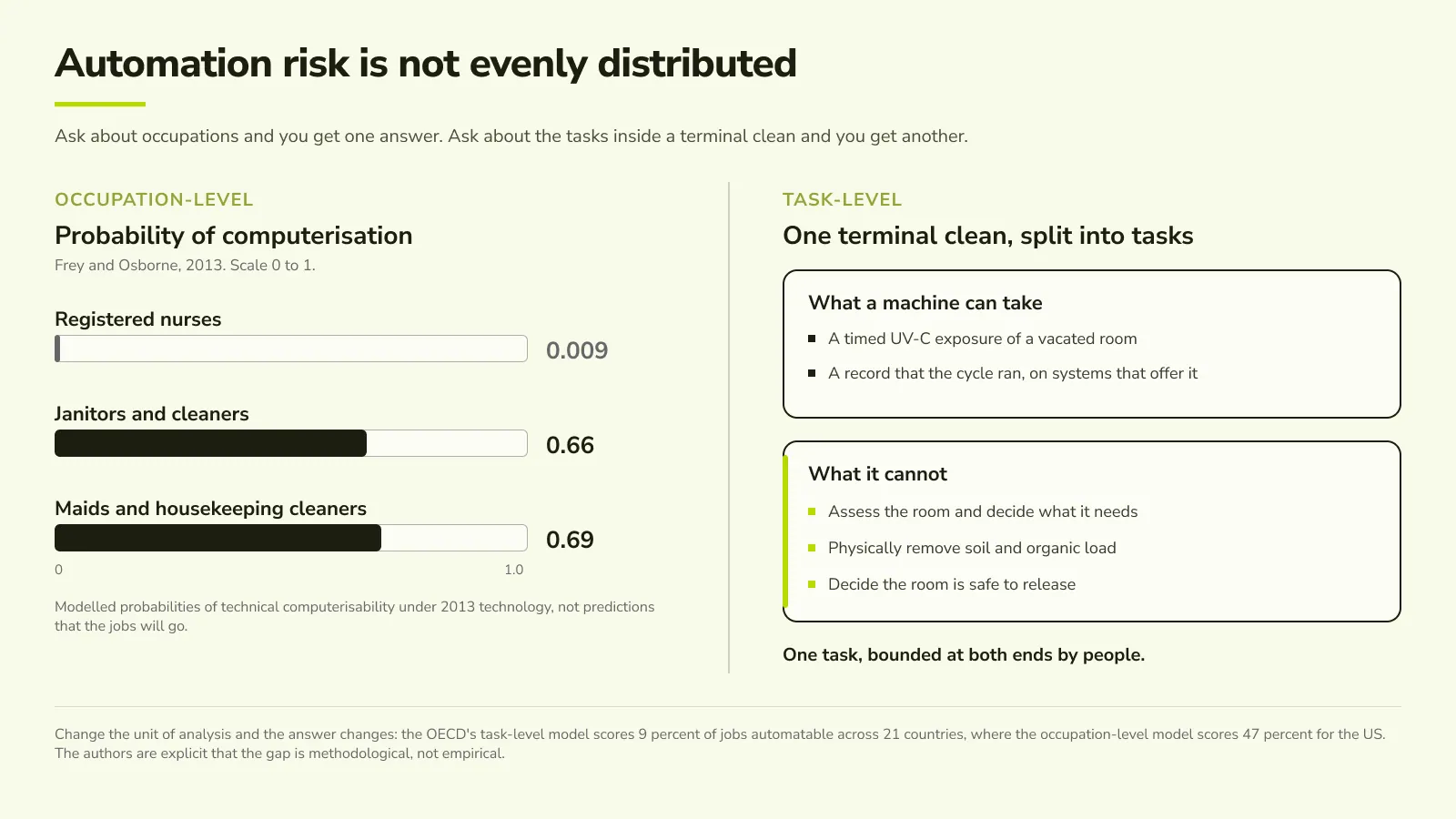
The most-cited study in the field is Frey and Osborne's estimate of how susceptible 702 occupations are to computerisation, source of the headline that about 47 percent of US employment sits in the high-risk category. Its appendix is what matters here. Registered nurses score 0.009, among the least computerisable occupations examined. Janitors and cleaners score 0.66. Maids and housekeeping cleaners score 0.69.1
Read the three together. The occupation the literature calls safest is the one that gets reassured, while the occupations it points at, at roughly two in three, are the ones standing in the room you are about to send a robot into. If you have been treating your EVS team's worry as a misunderstanding to be managed, the literature does not agree with you. These are modelled probabilities of technical computerisability under 2013 technology, not predictions that the jobs will go, and the method is contested for reasons we come to below. They are still the numbers the anxiety tracks.
Nor is that anxiety abstract. Where industrial robots were actually installed, the effect was measured: across US commuting zones between 1990 and 2007, one more robot per thousand workers lowered the employment-to-population ratio by 0.2 percentage points and wages by 0.42 percent.2 That is manufacturing, and an industrial arm is not a service robot, so we will not stretch it into a hospital and neither should anyone selling you one. What it settles is narrower and more important: displacement has been measured.
The worry is not evenly spread, either. Of 5,273 employed US adults surveyed, 52 percent were worried about AI at work, and 32 percent expected fewer job opportunities for themselves against 6 percent expecting more, with lower- and middle-income workers likelier than higher earners to expect fewer.3 That is the wage band environmental services sits in. Healthcare staff are no exception: among 3,800 Finnish healthcare professionals, attitudes to robots ran more negative than the general public's (2.57 against 2.85), and the most reserved group was the one with the lowest occupational status among them.4
So the concession, uncushioned: automation does displace some low-wage work, the effect has been measured, and the fear concentrates on exactly the people who will work alongside a disinfection robot. What follows has to be worth more than a denial of that, and it is. The answer changes when you change the unit of analysis.
Why do tasks give a different answer than jobs?
Frey and Osborne asked whether an occupation could be computerised. The OECD asked whether the tasks inside it could, and got a different number: across 21 OECD countries, 9 percent of jobs came out automatable, against 47 percent for the US. The gap, the authors are explicit, is methodological rather than empirical. An occupation-level model assumes whole occupations are automated; a task-level model accounts for the fact that even a high-risk occupation is a bundle of tasks, many of which resist automation.5 The same paper cautions against its own figure, which reflects what experts judge technology could do rather than what it is used to do.
The mechanism underneath is the one Autor set out in the essay the field still argues from. Automation, he writes, "does indeed substitute for labor" and does so "as it is typically intended to do," but it also "complements labor, raises output in ways that leads to higher demand for labor, and interacts with adjustments in labor supply." What machines take are "routine, codifiable tasks," and taking them raises the value of everything that is not: problem-solving, adaptability, creativity. He names our failure mode directly, that commentators "tend to overstate the extent of machine substitution for human labor and ignore the strong complementarities between automation and labor."6
None of this promises that any individual keeps their job, and Autor does not pretend it does. It is a claim about where to look. So look at the work.
Which parts of a terminal clean can a machine actually take?
Take a terminal clean apart into the tasks it is made of and the question stops being ideological (terminal disinfection in high-risk areas).
Someone has to assess the room and decide what it needs. Someone has to strip it, remove soil and organic load, and reach surfaces a machine has no arms for. Someone has to decide the room is safe to release, and own that decision when it is queried. A no-touch UV-C system does none of this. What it does is one step: a timed germicidal exposure of a vacated room after the manual clean, across the surfaces its light reaches. That is the category the ROZOR Disinfection Robot belongs to, an autonomous, mobile UV-C device. The cycle begins once your team has finished and left the room, and the robot is built to hand back a record of that cycle: which room, when, how long, and a measure of coverage. That is what turns "the cycle ran" from an assurance into something the person releasing the room can check. One task, bounded at both ends by people.
The guideline literature has said so for years, and it is the most useful thing you can quote on the unit. The best-practice bundle for non-critical environmental surfaces has five components: policy, product selection, staff education, compliance monitoring with feedback, and no-touch room decontamination as an adjunct to manual cleaning.7 No-touch technology is the fifth item on a list of five, and a person sits at the centre of the other four. The WHO frames it identically, treating any single intervention as one component of a multimodal infection prevention programme rather than a substitute for one.8
The reason is physical as much as procedural. UV-C cannot lift soil and treats only what its light reaches, which is why a surface that looks clean can still hold a viable reservoir after a routine wipe (visual cleanliness versus disinfection). Remove the manual clean and you do not have an automated terminal clean. You have a light left on in a dirty room.
Even at its best the contribution is an adjunct one. In a large cluster-randomised trial of UV-C in hospital rooms, adding a UV-C cycle to standard quaternary ammonium terminal cleaning lowered acquisition of four target multidrug-resistant organisms combined by about 30 percent among patients later admitted to those rooms (risk ratio 0.70, 95% CI 0.50 to 0.98), while the same trial's C. difficile stratum, where UV-C was added on top of an already-sporicidal bleach protocol, showed no further reduction in C. difficile infection (risk ratio 1.00, p=0.997).9 A benefit in one population and a null in another is the profile of a second pass over what a rushed clean missed, which is how we read the whole of it in what the UV-C evidence actually shows.
Is the cleaning-thoroughness gap a story about cleaners?
No, and getting this wrong is how a vendor loses an EVS team in the first meeting.
The gap is real and well measured. Across 36 acute-care hospitals, only 48 percent of standardised high-touch surfaces (9,910 of 20,646) were adequately cleaned at terminal clean.10 A second Carling-group study of 23 hospitals put mean terminal-cleaning thoroughness at 49 percent, ranging from 35 to 81 percent between sites.11 The figures appear in a great many sales decks, aimed at the wrong target.
Here is what the same body of work says about the cause. Time is not it: a study that looked directly at the question found the time a housekeeper spent cleaning a room did not correlate with how thoroughly the surfaces were cleaned.12 More minutes does not produce a better clean, so the shortfall is not explained by how long the person holding the cloth spent in the room. What did close the gap was structured monitoring with feedback, which raised thoroughness from 48 percent to 77 percent across those same 36 hospitals.10 The variable that moved was measurement.
That points at a system, and the people inside it have been describing it for years. In interviews across three US Veterans Affairs hospitals, environmental services staff and supervisors said their critical role goes unrecognised, that they blend into the background, and that workload spread across too many assignments forces compromises they can see themselves making.13 The 48 percent is what that system produces. Present it to a room as a verdict on the people in it and you will deserve the reaction you get.
So use the number for what it argues: a second, consistent pass over the surfaces a rushed clean missed, and a record that the pass happened (the disinfection audit trail). The gap is an argument for measurement, and a machine is one way to make a step measurable.
What do hospital staff actually think about robots?
Almost nobody asks them, which is why the one study that did is worth more than any argument here.
Researchers surveyed 102 patients, 130 healthcare workers and 47 environmental services staff about ultraviolet room decontamination devices. Framed as an adjunct to routine cleaning, UV-C increased confidence that rooms are clean for 98 percent of the EVS staff surveyed, the highest of the three groups, and 94 percent would accept a delay in admitting a patient so the cycle could run.14 It is a single-centre survey of perceptions rather than outcomes, and still the closest thing to an answer anyone has published: the group most exposed to automation was the group most in favour of this particular machine.
The framing carries the whole result, which is why we will not stretch it. Those numbers describe UV-C presented as an adjunct to routine cleaning. Nobody surveyed a robot pitched as a replacement, and they would not survive the switch.
The same study has a second half that rarely gets quoted. Only 79 percent of EVS staff reported no safety concerns, meaning roughly one in five did have them, and the authors conclude that educational tools are needed to allay them.14 So build the education into the deployment rather than bolting it on: what the light does, why the room has to be empty, how the cycle stops, who is in charge of it. The attitudes research agrees, finding prior hands-on experience with robots systematically associated with higher acceptance in every model tested.4 Familiarity is the intervention. Let your team handle the machine and start the cycles themselves, and do not introduce it by memo.
What the evidence on automation in infection prevention does not show
Three gaps, and they matter as much as the findings.
First, and most directly: no study has measured whether introducing a disinfection robot changes environmental-services headcount, in either direction. We looked. It does not exist. That is an absence of evidence rather than evidence of absence, and it means nobody, this company very much included, can promise your team that no cleaner has ever lost a job to a UV-C robot. What can be shown is what the machine is physically incapable of doing without them. That is the only version of the promise still true in a year.
Second, the staffing pitch is wrong, and an infection preventionist will catch it. The scarcity story, that hospitals are short-staffed and must therefore automate, does not survive the current numbers. The WHO's global nursing shortage fell from 6.2 million in 2020 to 5.8 million in 2023 and is projected to reach 4.1 million by 2030, and the problem it describes is distribution, with around 70 percent of the shortfall in the African and Eastern Mediterranean regions.15 In Canada, health-occupation vacancies were down 31.3 percent from their pandemic peak by the fourth quarter of 2025.16 Whatever case exists for automation in infection prevention, desperation is not it.
Third, the finding that should change how a vendor talks to you. When researchers interviewed 34 staff across 22 US Veterans Affairs hospitals about what helps and hinders UV-C use, a leading barrier they named was distrust of manufacturer claims about exposure times, risks and efficacy. They also named high patient loads requiring fast room turnovers, and reduced staffing.17 Read that twice. In the field, understaffing and time pressure are the reasons the cycle does not get run at all, which is the exact inverse of the pitch that sells a robot as the answer to them. So the operational answer is a protected slot in the turnover that the cycle fits inside, and a decision taken in advance about which rooms still get it when the unit is running hot. Another machine creates neither.
One more caution, even where the machine is welcome. The human-factors literature on automation complacency is unambiguous: over-trust in an automated aid develops under multiple-task workload, appears in expert and novice users alike, and is not trained away by practice.18 That work was done in aviation and decision support, not on UV-C robots, so read it as a caution rather than a finding about this device. It is exactly on point, though. A machine introduced as a replacement invites the reduced vigilance that would make it fail, because a UV-C cycle depends completely on the manual clean before it. Adjunct positioning is not modesty. It is the condition of the device working at all.
What you can honestly tell your team
Four things survive all of it, and you can say each on the unit without walking it back later. The machine takes one step, the timed exposure of an empty room; it cannot assess a room, lift soil, reach what its light does not, or decide the room is safe to release, and the guideline literature makes that human work four of the bundle's five components.7 The 48 percent describes a system that was not measuring itself, and the same study shows what closed it.10 When EVS staff were surveyed, with the device framed honestly as an adjunct, they backed it more strongly than anyone else in the hospital.14 And nobody has studied what these machines do to cleaning headcount, so you will not make that promise on a vendor's behalf.
What you should not do is take our word for any of it. This article is published by a company that sells one of these robots, and the research says to discount that accordingly: a leading barrier those 34 staff named was distrust of manufacturer claims.17 So trust Autor's task framing, the OECD's arithmetic, Rutala's bundle, Dunn's survey, Carling's 48 to 77. All are cited above so you can check us. The harder version of this argument, about what automation and AI can genuinely do inside an IPC programme and what they cannot, is in AI and automation in infection prevention, and the environmental case, including the chemical load a manual clean still carries, is in sustainable hospital disinfection.
For the board that signs for it, the case reads the same in their language. The return is a documented, repeatable step and the surfaces it recovers, and it was never a line removed from a staffing budget. A hospital that buys a disinfection robot to cut its cleaning headcount has bought the wrong machine and misread the evidence for it. The one worth buying makes an existing step measurable, and leaves the people who do the other four in place, better equipped, and finally counted.
See how the ROZOR Disinfection Robot fits your prevention bundle. The ROZOR Disinfection Robot delivers no-touch UV-C disinfection as an adjunct to your cleaning programme, physical AI for critical environments. Learn more about the ROZOR Disinfection Robot.
Frequently asked questions
Will robots replace healthcare workers?
For clinical staff the evidence says no: the most-cited automation study puts registered nurses at a 0.009 probability of computerisation, among the lowest of the 702 occupations it scored. For hospital cleaning work the same study is far less comfortable, scoring janitors and cleaners at 0.66 and housekeeping cleaners at 0.69. The rebuttal is methodological rather than reassuring: the OECD found 9 percent of jobs automatable against that study's 47 percent, because occupations are bundles of tasks and even high-risk occupations hold many tasks that resist automation.
Are hospital cleaners at risk from disinfection robots?
No study has measured whether a disinfection robot changes environmental-services headcount, in either direction, so anyone quoting you a number has invented it. What the evidence does show runs opposite to the usual pitch: in interviews across 22 US Veterans Affairs hospitals, reduced staffing and fast room turnovers were named as barriers to running UV-C cycles at all. A UV-C system cannot assess a room, remove soil, or release the room to the next patient.
Do UV-C robots replace manual cleaning?
No. The best-practice bundle for environmental surfaces places no-touch room decontamination as an adjunct to manual cleaning, one of five components alongside policy, product selection, staff education, and monitoring with feedback, and the WHO treats any single intervention as one part of a multimodal IPC programme. The constraint is physical as well as procedural: UV-C cannot lift soil and treats only the surfaces its light reaches.
What do environmental services staff actually think about UV-C robots?
When surveyed, they are the most positive group in the hospital, provided the device is framed as an adjunct to routine cleaning. In one study UV-C raised confidence that rooms are clean for 98 percent of EVS staff, and 94 percent would accept a delay in admitting a patient so the cycle could run. The same survey found roughly one in five still had safety concerns, which is why staff education belongs inside the deployment plan rather than after it.
Does the staffing shortage mean hospitals have to automate?
The scarcity argument does not hold. The WHO reports the global nursing shortage falling from 6.2 million in 2020 to 5.8 million in 2023, with a projected 4.1 million by 2030, and describes it as a distribution problem concentrated in the African and Eastern Mediterranean regions. Canadian health-occupation vacancies were down 31.3 percent from their pandemic peak by the fourth quarter of 2025. The case for automation in infection prevention has to be made on the work, not on a shortage.
Is the cleaning-thoroughness gap the fault of cleaning staff?
No. Across 36 hospitals only 48 percent of high-touch surfaces were adequately cleaned at terminal clean, and structured monitoring with feedback raised that to 77 percent in the same hospitals. Time spent cleaning does not correlate with thoroughness, so more minutes is not the fix either. The variable that moved was measurement, which makes this a systems finding, and exactly why a documented second pass matters.
Sources
- Frey CB, Osborne MA. "The Future of Employment: How Susceptible Are Jobs to Computerisation?" Oxford Martin School, University of Oxford; 17 September 2013. (Later published in Technological Forecasting and Social Change 2017;114:254-280.) https://oms-www.files.svdcdn.com/production/downloads/academic/The_Future_of_Employment.pdf
- Acemoglu D, Restrepo P. "Robots and Jobs: Evidence from US Labor Markets." Journal of Political Economy 2020;128(6):2188-2244. https://www.journals.uchicago.edu/doi/10.1086/705716
- Pew Research Center. "U.S. Workers Are More Worried Than Hopeful About Future AI Use in the Workplace." Washington, DC: Pew Research Center; 25 February 2025. https://www.pewresearch.org/social-trends/2025/02/25/u-s-workers-are-more-worried-than-hopeful-about-future-ai-use-in-the-workplace/
- Turja T, Van Aerschot L, Särkikoski T, Oksanen A. "Finnish healthcare professionals' attitudes towards robots: Reflections on a population sample." Nursing Open 2018;5(3):300-309. https://pmc.ncbi.nlm.nih.gov/articles/PMC6056472/
- Arntz M, Gregory T, Zierahn U. "The Risk of Automation for Jobs in OECD Countries: A Comparative Analysis." OECD Social, Employment and Migration Working Papers No. 189. Paris: OECD Publishing; 2016. https://www.oecd.org/content/dam/oecd/en/publications/reports/2016/05/the-risk-of-automation-for-jobs-in-oecd-countries_g17a27d8/5jlz9h56dvq7-en.pdf
- Autor DH. "Why Are There Still So Many Jobs? The History and Future of Workplace Automation." Journal of Economic Perspectives 2015;29(3):3-30. https://www.aeaweb.org/articles?id=10.1257%2Fjep.29.3.3
- Rutala WA, Weber DJ. "Best practices for disinfection of noncritical environmental surfaces and equipment in health care facilities: A bundle approach." American Journal of Infection Control 2019;47(Suppl):A96-A105. https://doi.org/10.1016/j.ajic.2019.01.014
- World Health Organization. "Guidelines on core components of infection prevention and control programmes at the national and acute health care facility level." Geneva: WHO; 2016. https://www.who.int/publications/i/item/9789241549929
- Anderson DJ, Chen LF, Weber DJ, et al. "Enhanced terminal room disinfection and acquisition and infection caused by multidrug-resistant organisms and Clostridium difficile (the Benefits of Enhanced Terminal Room Disinfection study): a cluster-randomised, multicentre, crossover study." The Lancet 2017;389(10071):805-814. https://pubmed.ncbi.nlm.nih.gov/28104287/
- Carling PC, Parry MF, Rupp ME, et al. "Improving cleaning of the environment surrounding patients in 36 acute care hospitals." Infection Control & Hospital Epidemiology 2008;29(11):1035-1041. https://pubmed.ncbi.nlm.nih.gov/18851687/
- Carling PC, Parry MM, Von Beheren SM; Healthcare Environmental Hygiene Study Group. "Identifying opportunities to enhance environmental cleaning in 23 acute care hospitals." Infection Control & Hospital Epidemiology 2008;29(1):1-7. https://pubmed.ncbi.nlm.nih.gov/18171180/
- Rupp ME, Adler A, Schellen M, et al. "The time spent cleaning a hospital room does not correlate with the thoroughness of cleaning." Infection Control & Hospital Epidemiology 2013;34(1):100-102. https://pubmed.ncbi.nlm.nih.gov/23221202/
- Goedken CC, McKinley L, Balkenende E, et al. "'Our job is to break that chain of infection': Challenges environmental management services (EMS) staff face in accomplishing their critical role in infection prevention." Antimicrobial Stewardship & Healthcare Epidemiology 2022;2(1):e129. https://doi.org/10.1017/ash.2022.261
- Dunn AN, Vaisberg P, Fraser TG, Donskey CJ, Deshpande A. "Perceptions of Patients, Health Care Workers, and Environmental Services Staff Regarding Ultraviolet Light Room Decontamination Devices." American Journal of Infection Control 2019;47(11):1290-1293. https://pubmed.ncbi.nlm.nih.gov/31253549/
- World Health Organization. "State of the World's Nursing 2025." Geneva: WHO; 12 May 2025. https://www.who.int/publications/i/item/9789240110236
- Statistics Canada. "The nursing crunch is easing, but staffing challenges remain in remote areas." StatCan Plus; 12 May 2026. https://www.statcan.gc.ca/o1/en/plus/9165-nursing-crunch-easing-staffing-challenges-remain-remote-areas
- Dukes KC, Hockett-Sherlock S, Cunningham Goedken C, et al. "Facilitators and Barriers for the Use of Ultraviolet-C Disinfection at VA Hospitals: A Qualitative Analysis." Open Forum Infectious Diseases 2025;12(Suppl 1):ofae631.463. https://pmc.ncbi.nlm.nih.gov/articles/PMC11779112/
- Parasuraman R, Manzey DH. "Complacency and bias in human use of automation: an attentional integration." Human Factors 2010;52(3):381-410. https://pubmed.ncbi.nlm.nih.gov/21077562/