C. difficile environmental disinfection has one hard problem: spores survive for months and resist routine disinfectants; sporicidal manual cleaning comes first; UV-C is a no-touch adjunct that measurably reduces spores on surfaces it can see but has not been shown to lower C. difficile infection rates.
You already treat Clostridioides difficile as a category of its own, and the environment is a large part of why. Most of the pathogens you manage are vegetative cells that a sound clean will handle. C. difficile is not one of them. This article lays out what the environmental reservoir actually is, what sporicidal cleaning and UV-C each measurably do to it, and the part a UV-C company has an obligation to say plainly: the evidence that adding UV-C lowers C. difficile infection is not there. If you are arming yourself to read a vendor's data sheet with a skeptical eye, that distinction is the whole point. (For the wider picture of environmental transmission, see our overview of hospital-acquired infections.)
What UV-C measurably does to spores on surfaces
For UV-C the evidence is real, but every figure comes with the same fine print: it was measured on an inoculated coupon or a room carrier, at a stated distance, and it depends on the surface being in the device's direct line of sight. None of these is a room-wide guarantee.
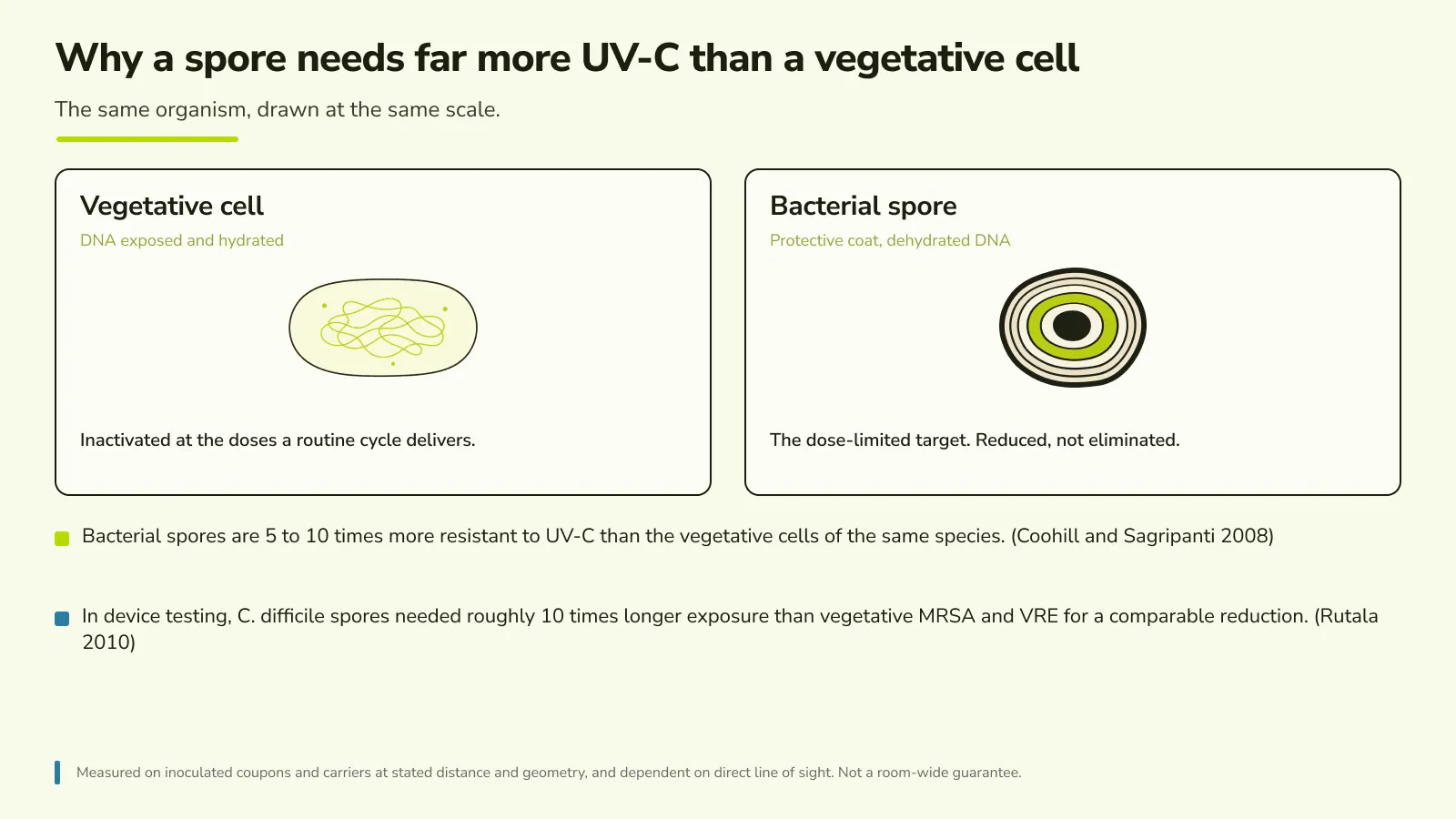
Start with the physics of the target. Bacterial spores are 5 to 10 times more resistant to UV-C than the vegetative cells of the same species, because the spore protects and dehydrates its DNA.10 That resistance shows up directly in room testing: a mercury-vapour UV-C device required roughly ten times longer exposure to reach a comparable reduction of C. difficile spores than of vegetative MRSA and VRE.11 Spores are the dose-limited organism in the room, which is why they, not the easy majority of your bioburden, set the ceiling on any honest claim. (If the "log" language here is unfamiliar, our explainer on what a log reduction means unpacks it.)
The room-level numbers follow. In 25 real patient rooms after discharge, a mobile UV-C unit produced mean C. difficile spore log reductions of 1.8 to 2.9 on high-touch surfaces, with effectiveness dependent on the surface sitting in the device's direct line of sight.12 A whole-room device run on a dedicated spore cycle achieved roughly 2 to 3 log reduction of C. difficile spores on inoculated hospital-room surfaces.13 And pooled carrier data make the geometry explicit: a spore cycle delivered about 3.41 log reduction of C. difficile spores on directly exposed carriers but 2.01 log on indirectly exposed ones, a sharp fall from line-of-sight to shadow.14 That distance-and-shadow dependence is the single most important thing to carry into a vendor conversation. (We cover it in depth in UV-C shadowing and in dose, distance, time, and angle; for the wider susceptibility picture, see which pathogens UV-C acts on.)
So UV-C measurably reduces C. difficile spores on the surfaces it directly illuminates. That is a defensible, sourced statement. It is also a statement about surfaces, not about patients.
Why C. difficile is different
The short version: it is a spore-former, and spores change every assumption you would carry over from a vegetative organism. C. difficile is an anaerobic, spore-forming bacterium whose spores resist alcohol-based hand sanitiser and many common disinfectants, which is why sporicidal agents are required for environmental control rather than the products that work on most other pathogens.1 The CDC's clinical guidance is explicit that spores resist standard disinfectants and that terminal cleaning of a CDI room needs an EPA List K sporicidal agent.2
This sits inside the older cleaning hierarchy you already run to. Surfaces are physically cleaned first, then treated with a disinfectant matched to the organism, and spore-formers demand a sporicidal agent because standard low- and intermediate-level disinfectants do not reliably inactivate them.3 Nothing about UV-C changes that order. It is worth being precise here, because the failure mode is treating a spore like a vegetative cell and expecting the same dose, the same product, or the same result.
The environmental reservoir is real
Spore longevity is the first reason the room matters. On dry inanimate surfaces, C. difficile spores have been recovered for up to five months in the systematic-review literature, far longer than the vegetative organisms you clean around every day.4 That persistence, combined with a low infectious inoculum, frequent room contamination, and relative resistance to standard germicides, is why the contaminated environment plays a genuine role in C. difficile transmission rather than a theoretical one.5
The contamination is not rare or hard to find. When a patient has CDI, C. difficile is recoverable from healthcare-worker hands roughly 60 percent of the time and from environmental surfaces 30 to 50 percent of the time.2 And the reservoir carries forward to the next patient in the bed. In a single-centre study, patients admitted to a room whose immediately prior occupant had CDI acquired CDI more often, 11.0 percent versus 4.6 percent; after adjustment for age, illness severity, and antibiotic and PPI exposure, prior-occupant CDI status remained an independent predictor, adjusted hazard ratio 2.35, p=0.01.6 That is a risk-factor signal about the room, not a disinfection-efficacy number, and it is worth holding those two apart.
The burden, and where it is going
To size the problem: an estimated 453,000 incident C. difficile infections and 29,300 deaths within 30 days of diagnosis occurred in the United States in 2011.7 That figure is now more than a decade old, and the trend has moved. From 2011 to 2017 the estimated national burden of C. difficile infection fell by an adjusted 24 percent, driven by a 36 percent decline in healthcare-associated infection, while the community-associated burden did not change significantly.8
Read that decline carefully, because it is easy to misuse. It reflects changes in antibiotic stewardship and testing practice across the period, not the effect of any single intervention, and certainly not any one device. It is genuinely good news for your ward, and it is not a marketing claim for a disinfection technology. Keeping those two thoughts separate is exactly the discipline this whole topic asks of you.
What sporicidal cleaning does, and where it falls short
Sporicidal manual cleaning is the intervention with the clearest rationale: physically clean the surface to lift organic soil, then apply an EPA-registered sporicidal agent matched to spore-formers, because the standard disinfectants will not reliably do the job.32 It is the floor of C. difficile environmental disinfection, and everything else is built on top of it.
The catch is coverage, and it is a systems problem rather than a people problem. Across fluorescent-marker studies of terminal room disinfection under standard manual protocols, roughly 40 to 50 percent of high-touch surfaces are not adequately cleaned.9 That gap is a product of turnover pressure, room complexity, and the sheer number of high-touch points to reach in the time available, not of anyone cutting corners. It is also the honest reason a no-touch adjunct is on the table at all: not to replace the manual clean, but to add a second, more consistent pass over the surfaces a rushed terminal clean is statistically likely to miss. (For how the chemistry differs from light, see UV-C versus chemical disinfection.)
What UV-C has not been shown to do
This is the part the article exists to say clearly, and we are a UV-C company saying it. A surface log reduction is not an infection-rate reduction, and for C. difficile the infection-rate evidence does not support UV-C.
The pivotal trial is BETR-D, a cluster-randomised, multicentre crossover study across nine hospitals. Its widely quoted result, a roughly 30 percent lower rate of acquiring a target organism, RR 0.70, 95 percent CI 0.50 to 0.98, p=0.036, belongs to the UV arm across all four target organisms combined, in the population exposed to a room whose prior occupant carried a target organism, and it was driven mainly by MRSA and VRE.15 It was not a C. difficile result. In the C. difficile stratum the trial asked a deliberately hard question: it compared bleach plus UV-C against bleach alone, and bleach was the sporicidal agent the trial itself used for C. difficile rooms. Adding a UV-C pass on top of that already-sporicidal clean did not further change infection incidence among exposed patients, 38 versus 36 cases, RR 1.00, 95 percent CI 0.57 to 1.75, p=0.997.15 Read precisely, that is not evidence that UV-C fails against C. difficile. It is the narrower finding that once a room has had a proper sporicidal clean, a UV-C pass did not drive infections lower still.
The most current pooled estimate agrees. A 2023 systematic review and meta-analysis found that UV-C produced no statistically significant reduction in C. difficile infection rates, incidence rate ratio 0.90, 95 percent CI 0.62 to 1.32.16 An earlier and smaller meta-analysis did report a significant pooled decrease in CDI rates, but it mixed UV-C with hydrogen-peroxide vapour across a small number of mostly non-randomised before-after studies, and it predates the 2023 analysis, so it reads as a flagged contrast against the two null results, not as counter-evidence that cancels them.181516 A hospital-wide secondary analysis of BETR-D, a different population from the room-exposed primary outcome, did find an overall C. difficile signal, RR 0.89, 95 percent CI 0.80 to 0.99, p=0.031, though in that analysis MRSA showed no benefit, a partly reversed pattern.19 It is a secondary analysis of a different population, and it does not walk back the primary trial's null.
Guidance lands where the evidence does. The 2017 IDSA and SHEA guideline states that "there are limited data at this time to recommend use of automated, terminal disinfection using a sporicidal method for CDI prevention."17 That is neither an endorsement nor a rejection, and it should not be read as either. It is the honest position, and it is the one to hold, and it points straight at how to use UV-C well: as a surface-consistency layer over a sporicidal clean, not as the intervention you expect to move the infection curve.
So what should you actually do
Put UV-C where the evidence puts it: as one component of a bundle, not the intervention that carries the room. The best-practice bundle for noncritical surfaces has five parts, a written policy, product selection, staff education, compliance monitoring with feedback, and no-touch room decontamination technology as an adjunct.20 The first four are what move outcomes; the fifth is the consistency layer over surfaces a manual clean may miss.
Keep the trial evidence in perspective while you evaluate. Most, though not all, clinical trials of no-touch terminal disinfection report reduced colonisation or infection in later room occupants, but most of those trials use weak before-after designs with uncontrolled confounders such as hand-hygiene and cleaning compliance, so the strength of the claim should track the strength of the study behind it.21 For C. difficile specifically, the strongest designs return a null, and that is the number to weigh.
This is the frame a no-touch UV-C system such as the ROZOR Disinfection Robot belongs in: an adjunct that runs after a sporicidal manual clean, adding a consistent, line-of-sight pass over the high-touch surfaces most likely to be under-cleaned, reported for what it is measured to do on surfaces rather than for an infection outcome it has not been shown to deliver. What earns your trust is not the largest number on a data sheet. It is a vendor who tells you where the number came from, and where it stops.
See how the ROZOR Disinfection Robot fits an existing C. difficile protocol. It delivers no-touch UV-C disinfection as an adjunct to your sporicidal cleaning programme, never a replacement for it. Physical AI for critical environments. Learn more about the ROZOR Disinfection Robot.
Frequently asked questions
Does UV-C kill C. difficile spores?
It reduces them. Spores are 5 to 10 times more UV-resistant than vegetative cells, and room studies measure mean reductions of roughly 1.8 to 2.9 log on directly exposed high-touch surfaces, falling in shadow. Read any spore figure as a reduction under a stated dose, on a surface in direct line of sight, not as elimination.
Does UV-C reduce C. difficile infection rates?
That has not been established. The BETR-D trial found no change in C. difficile infection when UV-C was added to bleach cleaning, RR 1.00, and a 2023 meta-analysis found no significant reduction in CDI rates, IRR 0.90. Current guidance calls the data limited.
Then why use UV-C for C. difficile at all?
As a consistency layer. Roughly 40 to 50 percent of high-touch surfaces are not adequately cleaned under standard manual terminal cleaning, and UV-C adds a second no-touch pass over the surfaces it can see. It is positioned as one part of a five-component bundle, an adjunct after manual cleaning, not a replacement for it.
Why do spores survive routine disinfection?
C. difficile forms spores that resist alcohol-based sanitiser and many common disinfectants, so standard low- and intermediate-level products do not reliably inactivate them. Terminal cleaning of a CDI room therefore needs an EPA List K sporicidal agent applied after physical cleaning.
How long does C. difficile survive on surfaces?
Up to five months on dry inanimate surfaces in the systematic-review literature. Combined with a low infectious inoculum and frequent room contamination, that persistence is why the environment contributes materially to transmission.
Does the previous patient in the room raise the risk?
The evidence points that way. Patients admitted to a room whose prior occupant had CDI acquired CDI more often, and prior-occupant CDI status stayed an independent predictor after adjustment, adjusted hazard ratio 2.35, p=0.01. That is a risk-factor finding about the room, not a UV-C efficacy figure.
Sources
- CDC. "C. diff: Facts for Clinicians (Clinical Overview)." U.S. Centers for Disease Control and Prevention. https://www.cdc.gov/c-diff/hcp/clinical-overview/index.html
- CDC. "Clinical Guidance for C. diff Infection Prevention in Acute Care Facilities." U.S. Centers for Disease Control and Prevention, 2024. https://www.cdc.gov/c-diff/hcp/clinical-guidance/index.html
- Rutala WA, Weber DJ, and the Healthcare Infection Control Practices Advisory Committee (HICPAC). "Guideline for Disinfection and Sterilization in Healthcare Facilities, 2008" (updated). U.S. Centers for Disease Control and Prevention. https://www.cdc.gov/infection-control/hcp/disinfection-and-sterilization/index.html
- Kramer A, Schwebke I, Kampf G. "How long do nosocomial pathogens persist on inanimate surfaces? A systematic review." BMC Infectious Diseases 2006;6:130. https://doi.org/10.1186/1471-2334-6-130
- Weber DJ, Anderson DJ, Sexton DJ, Rutala WA. "Role of the environment in the transmission of Clostridium difficile in health care facilities." American Journal of Infection Control 2013;41(5 Suppl):S105-S110. https://doi.org/10.1016/j.ajic.2012.12.009
- Shaughnessy MK, Micielli RL, DePestel DD, et al. "Evaluation of hospital room assignment and acquisition of Clostridium difficile infection." Infection Control & Hospital Epidemiology 2011;32(3):201-206. https://doi.org/10.1086/658669
- Lessa FC, Mu Y, Bamberg WM, et al. "Burden of Clostridium difficile infection in the United States." New England Journal of Medicine 2015;372(9):825-834. https://doi.org/10.1056/NEJMoa1408913
- Guh AY, Mu Y, Winston LG, et al. "Trends in U.S. burden of Clostridioides difficile infection and outcomes." New England Journal of Medicine 2020;382(14):1320-1330. https://doi.org/10.1056/NEJMoa1910215
- Carling PC, Bartley JM. "Evaluating hygienic cleaning in health care settings: what you do not know can harm your patients." American Journal of Infection Control 2010;38(5 Suppl 1):S41-S50. https://doi.org/10.1016/j.ajic.2010.03.004
- Coohill TP, Sagripanti JL. "Overview of the inactivation by 254 nm ultraviolet radiation of bacteria with particular relevance to biodefense." Photochemistry and Photobiology 2008;84(5):1084-1090. https://pubmed.ncbi.nlm.nih.gov/18627518/
- Rutala WA, Gergen MF, Weber DJ. "Room decontamination with UV radiation." Infection Control & Hospital Epidemiology 2010;31(10):1025-1029. https://doi.org/10.1086/656244
- Boyce JM, Havill NL, Moore BA. "Terminal decontamination of patient rooms using an automated mobile UV light unit." Infection Control & Hospital Epidemiology 2011;32(8):737-742. https://doi.org/10.1086/661222
- Nerandzic MM, Cadnum JL, Pultz MJ, Donskey CJ. "Evaluation of an automated ultraviolet radiation device for decontamination of Clostridium difficile and other healthcare-associated pathogens in hospital rooms." BMC Infectious Diseases 2010;10:197. https://doi.org/10.1186/1471-2334-10-197
- Weber DJ, Rutala WA, Anderson DJ, Chen LF, Sickbert-Bennett EE, Boyce JM. "Effectiveness of ultraviolet devices and hydrogen peroxide systems for terminal room decontamination: focus on clinical trials." American Journal of Infection Control 2016;44(5 Suppl):e77-e84. https://doi.org/10.1016/j.ajic.2015.11.015
- Anderson DJ, Chen LF, Weber DJ, et al. "Enhanced terminal room disinfection and acquisition and infection caused by multidrug-resistant organisms and Clostridium difficile (the Benefits of Enhanced Terminal Room Disinfection study): a cluster-randomised, multicentre, crossover study." The Lancet 2017;389(10071):805-814. https://doi.org/10.1016/S0140-6736(16)31588-4
- Sun Y, Wu Q, Liu J, Wang Q. "Effectiveness of ultraviolet-C disinfection systems for reduction of multi-drug resistant organism infections in healthcare settings: a systematic review and meta-analysis." Epidemiology & Infection 2023;151:e149. https://doi.org/10.1017/S0950268823001371
- McDonald LC, Gerding DN, Johnson S, et al. "Clinical practice guidelines for Clostridium difficile infection in adults and children: 2017 update by the Infectious Diseases Society of America (IDSA) and Society for Healthcare Epidemiology of America (SHEA)." Clinical Infectious Diseases 2018;66(7):e1-e48. https://doi.org/10.1093/cid/cix1085
- Marra AR, Schweizer ML, Edmond MB. "No-touch disinfection methods to decrease multidrug-resistant organism infections: a systematic review and meta-analysis." Infection Control & Hospital Epidemiology 2018;39(1):20-31. https://doi.org/10.1017/ice.2017.226
- Anderson DJ, Moehring RW, Weber DJ, et al. "Effectiveness of targeted enhanced terminal room disinfection on hospital-wide acquisition and infection with multidrug-resistant organisms and Clostridium difficile: a secondary analysis of a multicentre cluster randomised controlled trial with crossover design (BETR Disinfection)." The Lancet Infectious Diseases 2018;18(8):845-853. https://pmc.ncbi.nlm.nih.gov/articles/PMC6487496/
- Rutala WA, Weber DJ. "Best practices for disinfection of noncritical environmental surfaces and equipment in health care facilities: a bundle approach." American Journal of Infection Control 2019;47(Suppl):A96-A105. https://doi.org/10.1016/j.ajic.2019.01.014
- Weber DJ, Rutala WA, Anderson DJ, Sickbert-Bennett EE. "'No touch' methods for health care room disinfection: focus on clinical trials." American Journal of Infection Control 2023;51(11S):A134-A144. https://doi.org/10.1016/j.ajic.2023.08.020